Brain Scans Reveal Shared Regions for Math and Language Processing
A new study published in Science Advances identifies brain regions that process both math and language, reconciling two long-standing views in neuroscience.

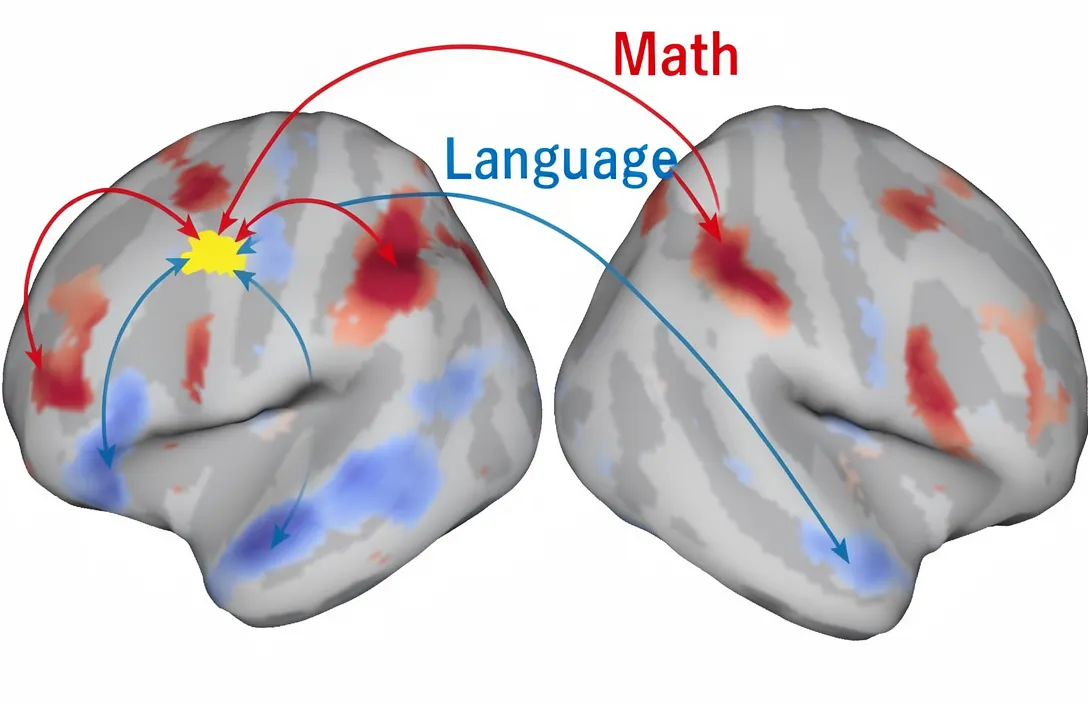

Researchers, including those at the University of Tokyo, have identified brain regions that process both math and language, according to a study published in the journal Science Advances (1). The research addresses an ongoing debate in neuroscience regarding whether math and language are processed in unique areas of the brain or share common regions. The study found that while specialized brain regions exist for each domain, there is also a newly identified region, called 55b, that processes both math and language (1). [1]
The researchers used functional MRI (fMRI) to measure brain activity in 32 participants while they performed either a language task (reading Japanese sentences) or a mathematics task (solving arithmetic problems). They then used computational models to predict brain activity during these tasks (1). The study found that the shared brain areas showed task-dependent associations with language- or math-specific areas when participants performed different tasks (1). [1]
The study also found that during reading, the shared brain regions were more closely connected to other areas involved in language processing, while during calculation, they were more closely connected to areas involved in mathematics. This suggests that certain brain regions may support both activities while working with different networks depending on the task (1). The findings indicate that people may draw on some of the same abilities when working with language and mathematics, particularly the ability to combine individual elements into structured sequences (1). [1]
Researchers, including those at the University of Tokyo, have identified brain regions that process both math and language, according to a study published in the journal Science Advances (1). The researchers used functional MRI (fMRI) to measure brain activity in 32 participants while they performed either a language task (reading Japanese sentences) or a mathematics task (solving arithmetic problems). The study also found that during reading, the shared brain regions were more closely connected to other areas involved in language processing, while during calculation, they were more closely connected to areas involved in mathematics. [1]
Advertisement
The researchers used a large language model to extract information from sentences and mathematical expressions, and then used this information to build computational models that could predict brain activity during tasks (1). To investigate whether language and mathematics involve some of the same brain processes, the team tested whether a model trained on language stimuli could predict brain activity during the mathematics task, and vice versa. They also examined how different parts of the brain communicate with one another during the two tasks. [1]
The team found that, during reading, these shared regions were more closely connected to other areas involved in language processing, while during calculation, they were more closely connected to areas involved in mathematics (1). This suggests that certain brain regions may help support both activities, while working with different networks depending on the task. The study also highlights the potential for future research into mathematics teaching strategies that could leverage the shared neural representations between language and math. [1]
Researchers used functional MRI (fMRI) to measure brain activity in 32 participants while they performed either a language task (reading Japanese sentences) or a mathematics task (solving arithmetic problems) (1). This method allowed them to observe how different regions of the brain responded to each type of cognitive activity, providing insights into the neural mechanisms underlying both language and math processing. [1]
The study found that during reading, the shared brain regions were more closely connected to other areas involved in language processing, while during calculation, they were more closely connected to areas involved in mathematics (1). This indicates that the shared brain areas may support both activities but interact with different networks depending on the task being performed. [1]
Advertisement
The researchers used a large language model to extract information from sentences and mathematical expressions and then built computational models that could predict brain activity during tasks (1). These models were tested to determine whether they could predict brain activity during the opposite task, helping to distinguish shared neural representations from other factors like visual processing or attention. [1]
Researchers at the University of Tokyo have identified brain regions that process both math and language, according to a study published in the journal Science Advances (1). Using functional MRI (fMRI), the team measured brain activity in 32 participants as they performed either a language task (reading Japanese sentences) or a mathematics task (solving arithmetic problems). The study found that shared brain regions showed task-dependent associations with language- or math-specific areas depending on the activity being performed (1). [1]
To investigate the overlap between language and mathematics, the researchers used a large language model to extract information from sentences and mathematical expressions. This information was then used to build computational models that could predict brain activity during tasks (1). The team tested whether a model trained on language stimuli could predict brain activity during a mathematics task and vice versa, confirming the presence of shared neural representations (1). [1]
The study also found that during reading, the shared brain regions were more closely connected to other areas involved in language processing, while during calculation, they were more closely connected to areas involved in mathematics (1). This suggests that certain brain regions may support both activities, working with different networks depending on the task (1). [1]
Advertisement
The Cali Reporter newsletter
The stories worth your time.
California, the country, and what comes next. Join our free newsletter for reporting that keeps you informed.
More in Health & Medicine
- Understanding Fascia and the Evidence Behind Fascia Release
Fascia is a connective tissue that plays a structural role in the human body, but evidence supporting specific exercises or tools for 'fascia release' remains limited.
- Antidepressant Effectiveness and Long-Term Use
A new review suggests that some antidepressants may be more effective than others in helping people manage depression symptoms over the long term, according to a study published in The Lancet Psychiatry.
- Experimental Weight-Loss Drug Shows Promise for Knee Osteoarthritis Pain
A new study suggests that an experimental weight-loss drug, retatrutide, may significantly reduce knee pain in people with osteoarthritis and obesity.