Brain Differentiates Speech and Music Using Acoustic Patterns
A study using the Harry Potter soundtrack reveals how the brain distinguishes between speech and music based on acoustic features.

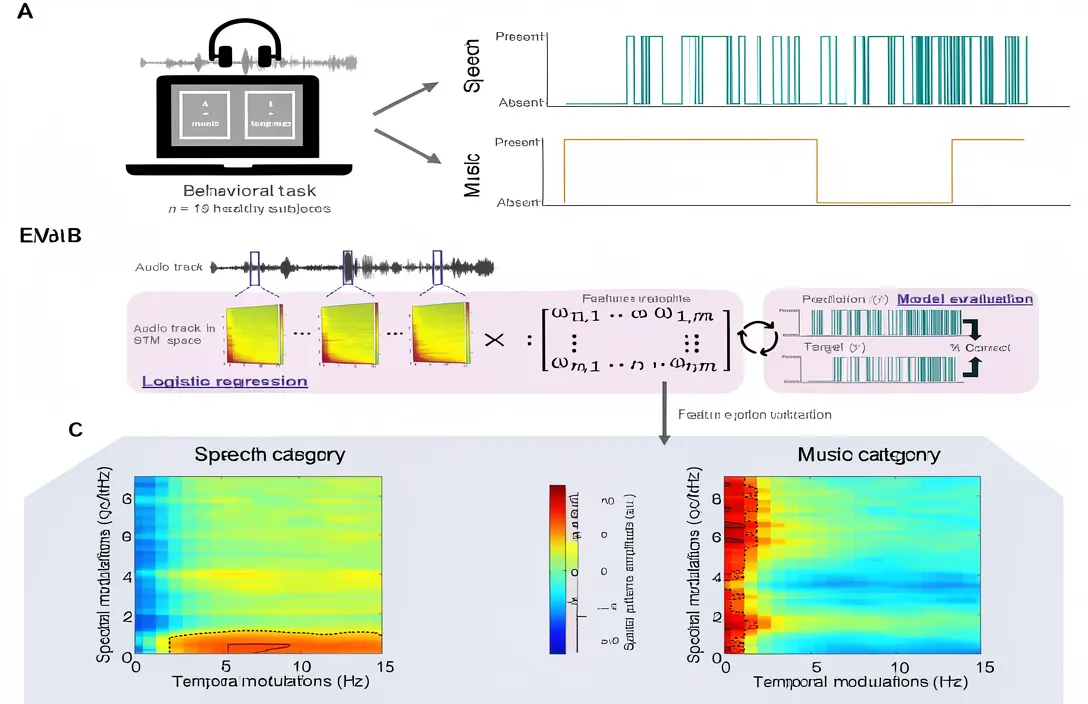

Researchers have found that the brain's auditory cortex differentiates between speech and music using patterns that describe how acoustic energy changes over time and across frequencies. This study, published in Science Advances, corroborates previous findings that suggest the brain uses these spectrotemporal modulations (STMs) to recognize speech and music almost instantaneously, even when they overlap or occur in rapid succession. The auditory cortex tracks how sound changes over time and how energy is distributed across frequencies, according to the study (1). [1]
To test whether acoustic information encoded in the brain contains enough information to predict listeners' speech and music judgments, the team created computational models that linked brain activity, acoustic patterns, and listener judgments. The experiment involved 11 epilepsy patients with clinically implanted electrodes who listened to nearly eight minutes of the French-dubbed soundtrack of 'Harry Potter and the Philosopher's Stone.' Using data from these patients, the researchers identified 39 recording sites in auditory regions on both sides of the brain that reliably tracked these patterns (1). [1]
The study also found that brain-encoded acoustic features predicted whether separate groups of listeners reported hearing speech or music. Models using features reconstructed from individual brain-recording sites achieved 54%–60% accuracy for speech and 54%–71% for music. Models using the soundtrack's acoustic features directly performed much better, with 97%–99% accuracy for speech and 99%–100% for music. These results indicate that acoustic representations contain useful category information, supporting past research results (1). [1]
Researchers have discovered that the brain's auditory cortex differentiates between speech and music using patterns that describe how acoustic energy changes over time and across frequencies. This finding was corroborated by a study published in Science Advances, which used the Harry Potter soundtrack to test how the brain processes overlapping sounds. The study suggests that these processes are sufficient for distinguishing speech and music under normal listening conditions (Source ID: 1). [1]
Advertisement
To test whether acoustic information encoded in the brain contains enough information to predict listeners' speech and music judgments, the team created computational models that linked brain activity, acoustic patterns, and listener judgments. The experiment involved 11 epilepsy patients with implanted electrodes who listened to the French-dubbed soundtrack of "Harry Potter and the Philosopher's Stone." Using data from these patients, the researchers identified 39 recording sites in auditory regions that reliably tracked these patterns (Source ID: 1). [1]
Analysis showed that brain-encoded acoustic features predicted whether separate groups of listeners reported hearing speech or music. This supports acoustic coding as a sufficient information source for this distinction, although it is not necessarily the only mechanism involved. The models using features reconstructed from individual brain-recording sites achieved 54%–60% accuracy for speech and 54%–71% for music, above the study's 50% chance benchmark (Source ID: 1). [1]
The study also found that speech judgments depended mainly on rapid changes in sound over time, while music judgments depended mainly on detailed patterns across sound frequencies. Another experiment with five participants listening to a controlled mixture of speech and organ music provided ground-truth labels, with models reaching similarly high accuracy and showing comparable feature patterns (Source ID: 1). [1]
Researchers have found that the brain's auditory cortex differentiates between speech and music using patterns that describe how acoustic energy changes over time and across frequencies. This discovery is based on a study published in Science Advances, which used the Harry Potter soundtrack to test how the brain processes overlapping sounds. The study found that the auditory cortex tracks spectrotemporal modulations, or STMs, which are patterns in how sound changes over time and how energy is distributed across frequencies (Source ID: 1). [1]
Advertisement
To test whether acoustic information encoded in the brain contains enough information to predict listeners' speech and music judgments, the team created computational models that linked brain activity, acoustic patterns, and listener judgments. The study involved 11 epilepsy patients with clinically implanted electrodes who listened to nearly eight minutes of the French-dubbed soundtrack of 'Harry Potter and the Philosopher's Stone.' Using data from these patients, the researchers identified 39 recording sites in auditory regions on both sides of the brain that reliably tracked these patterns (Source ID: 1). [1]
Analysis showed that brain-encoded acoustic features predicted whether separate groups of listeners reported hearing speech or music. The models using features reconstructed from individual brain-recording sites achieved 54%–60% accuracy for speech and 54%–71% for music, above the study's 50% chance benchmark. Models using the soundtrack's acoustic features directly performed much better: 97%–99% for speech and 99%–100% for music (Source ID: 1). [1]
Sources
Prepared with AI assistance from the cited sources.
The Cali Reporter newsletter
The stories worth your time.
California, the country, and what comes next. Join our free newsletter for reporting that keeps you informed.
More in Health & Medicine
- Understanding Fascia and the Evidence Behind Fascia Release
Fascia is a connective tissue that plays a structural role in the human body, but evidence supporting specific exercises or tools for 'fascia release' remains limited.
- Antidepressant Effectiveness and Long-Term Use
A new review suggests that some antidepressants may be more effective than others in helping people manage depression symptoms over the long term, according to a study published in The Lancet Psychiatry.
- Experimental Weight-Loss Drug Shows Promise for Knee Osteoarthritis Pain
A new study suggests that an experimental weight-loss drug, retatrutide, may significantly reduce knee pain in people with osteoarthritis and obesity.