Astronomers Discover Distant Quasar Pair in Early Universe
Astronomers have identified a rare pair of quasars from just 900 million years after the Big Bang, offering new insights into the formation of massive black holes in the early Universe.

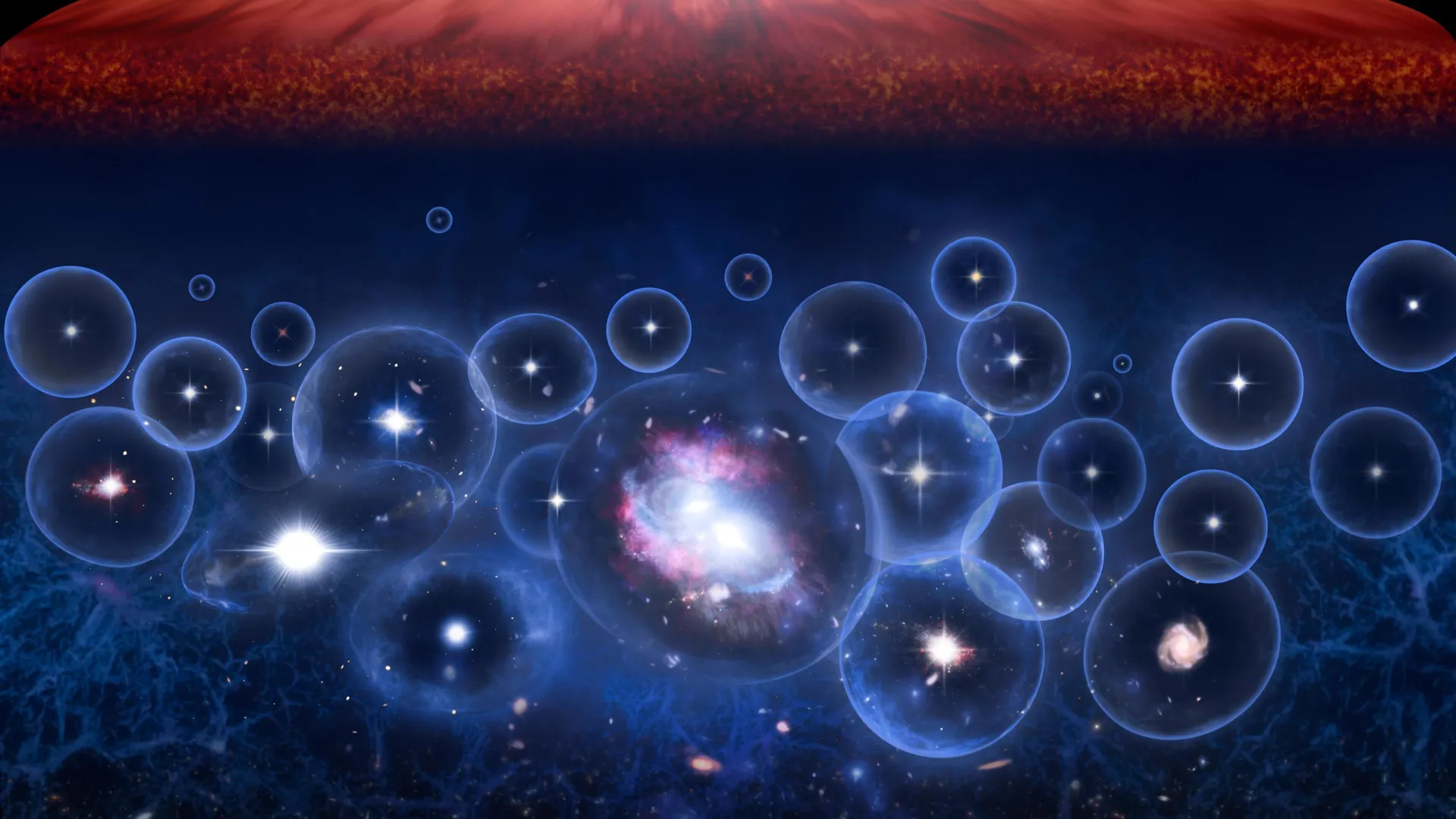
Astronomers have identified an extraordinary pair of quasars dating back to just 900 million years after the Big Bang. Each is powered by an enormous black hole that somehow grew to an astonishing size when the Universe was still in its infancy. Scientists have no definitive explanation for how these two cosmic giants became so massive so quickly. The remarkable pair has been given the Hawaiian name Nāpōwawāʻenakaulua. An international research team has discovered the most distant compact pair of quasars ever observed, offering a rare glimpse into the earliest stages of cosmic history. Officially designated J1602+4228AB and nicknamed Nāpōwawāʻenakaulua, the pair also holds the record for the closest separation between two known quasars from the early period known as cosmic dawn (1). [1]
The discovery was made possible by combining observations from the James Webb Space Telescope (JWST) and the Gemini North telescope on Maunakea, a dormant volcano in Hawai'i. The research was led by Silvia Onorato, a postdoctoral research associate at NSF NOIRLab, and is described in a paper published in The Astrophysical Journal Letters. Gemini North is one of the two telescopes that make up the International Gemini Observatory. Operated by NSF NOIRLab, the observatory is an international partnership led by the U.S. National Science Foundation, with participation from Canada, Chile, Brazil, Argentina, and the Republic of Korea (1). [1]
The discovery began with data collected by the Aether survey, a JWST research program designed to identify and characterize objects from the early Universe. The project is led by Emanuele Paolo Farina, an Associate Scientist at NSF NOIRLab/Gemini. Using JWST's Near-Infrared Spectrograph Integral Field Unit, the survey assembled observations of 200 quasars. That sample represents approximately 43% of all quasars known from this period of cosmic history. While visually examining the survey data, researchers noticed something unexpected. A previously identified quasar, J1602+4228A, appeared to have a companion. To investigate, the team turned to Gemini North's Gemini Near-Infrared Spectrograph (GNIRS). These observations allowed astronomers to distinguish the two quasars individually, providing crucial evidence about the nature of the system (1). [1]
Astronomers have identified an extraordinary pair of quasars dating back to just 900 million years after the Big Bang. Each is powered by an enormous black hole that somehow grew to an astonishing size when the Universe was still in its infancy. Scientists have no definitive explanation for how these two cosmic giants became so massive so quickly (1). [1]
Advertisement
The discovery was made possible by combining observations from the James Webb Space Telescope (JWST) and the Gemini North telescope on Maunakea, a dormant volcano in Hawai'i. The research was led by Silvia Onorato, a postdoctoral research associate at NSF NOIRLab, and is described in a paper published in The Astrophysical Journal Letters (1). [1]
The discovery began with data collected by the Aether survey, a JWST research program designed to identify and characterize objects from the early Universe. Using JWST's Near-Infrared Spectrograph Integral Field Unit, the survey assembled observations of 200 quasars. That sample represents approximately 43% of all quasars known from this period of cosmic history (1). [1]
The discovery of the quasar pair Nāpōwawāʻenakaulua offers a potential clue to understanding how the first massive galaxies formed in the early Universe. Researchers believe the extraordinary properties of the system could point to an unusually dense concentration of matter in the early Universe, which may have facilitated frequent galaxy interactions. Such interactions could have provided vast amounts of gas, simultaneously accelerating the birth of stars and fueling the rapid growth of black holes at the centers of these galaxies. This interpretation could help scientists understand how the earliest massive galaxies developed alongside their central supermassive black holes (source ID: 1). [1]
The quasar pair Nāpōwawāʻenakaulua is considered a unique environment for studying the formation of the first massive galaxies. Silvia Onorato, a postdoctoral research associate at NSF NOIRLab, described the system as a "laboratory" for astronomers to study how the first massive galaxies and their central black holes assembled together through direct galaxy interactions during these early times. This discovery provides valuable insights into the processes that shaped the early Universe and the development of its most massive structures (source ID: 1). [1]
Advertisement
The research team investigated whether gravitational lensing might explain the appearance of the second, fainter quasar. However, differences between the spectra of the two objects suggest they are separate physical quasars. Additional gravitational lens modeling will be required before the lensing possibility can be definitively excluded. The team's findings highlight the challenges of detecting and studying quasar pairs from the early Universe, as well as the importance of combining observations from multiple telescopes to obtain detailed information about these distant systems (source ID: 1). [1]
Sources
Prepared with AI assistance from the cited sources.
The Cali Reporter newsletter
The stories worth your time.
California, the country, and what comes next. Join our free newsletter for reporting that keeps you informed.
More in Science
- Volcanic Eruption Reshapes Iwo Jima’s Coastline
A recent volcanic eruption near Iwo Jima has temporarily extended the island's black sand beaches, though the longevity of the new land remains uncertain.
- Galaxies in the NGC 7771 Group Engage in Cosmic Merger
Astronomers have observed a group of galaxies in the NGC 7771 Group, which is located approximately 200 million light-years away in the constellation Pegasus. These galaxies are in the process of merging, a phenomenon…
- NASA Awards Contract for NOAA’s Near Earth Orbit Network Program
NASA has awarded a contract to Northrop Grumman Systems Corporation for the Sounder for Microwave-Based Applications (SMBA) instruments on NOAA’s Near Earth Orbit Network (NEON) satellites. The contract includes a…