API Paywall Vulnerability Leaves Revenue Untracked
A developer discovered a widespread issue in API paywalls where payment middleware fails to track failed transactions due to incorrect HTTP methods, leading to lost revenue.

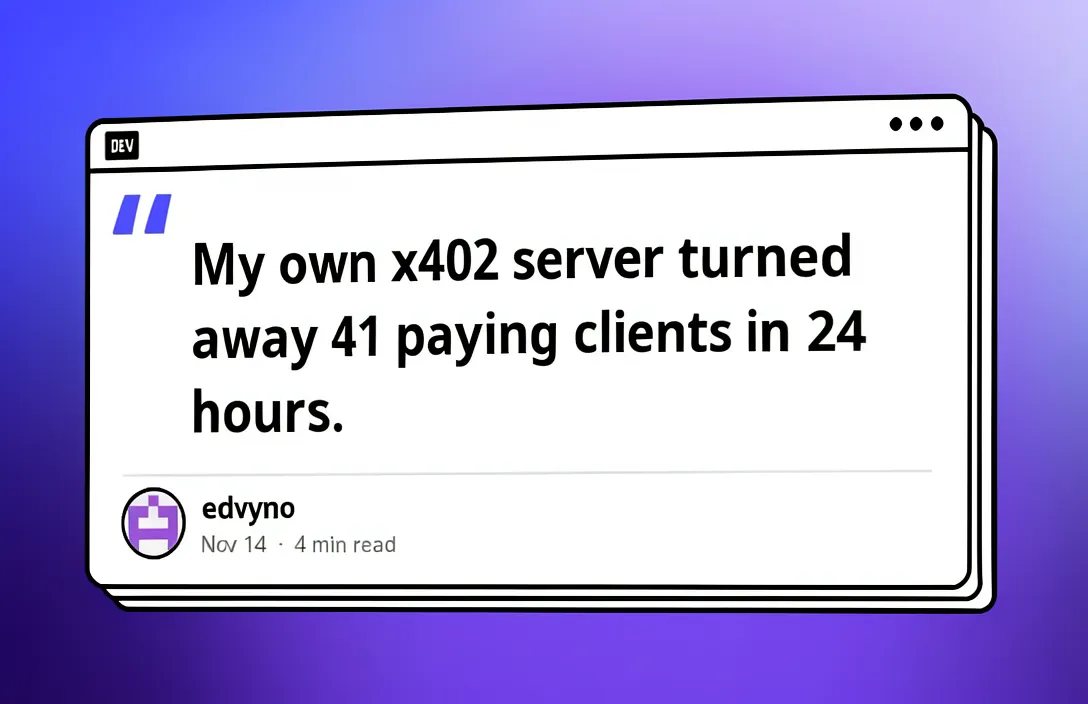

A developer operating an x402 server reported that 41 paying clients were turned away in 24 hours due to a 405 Method Not Allowed error (source ID 1). These clients attempted to use POST requests on routes that were only configured to accept GET requests, which are priced and require payment. The error did not trigger a failed-payment event, making the issue invisible to the server's revenue tracking system. The developer discovered the problem during an audit and noted that the server's dashboard only counted 402s issued and settled, ignoring the 405s as if they were typos (source ID 1). [1]
The developer implemented a fix by adding POST twins to each GET route, ensuring that the payment middleware still sees the price key for both GET and POST requests. This required careful ordering of route configurations to avoid creating free, unauthenticated endpoints that return paid data without requiring payment (source ID 1). The developer emphasized that the failure to account for both HTTP methods is a common issue, as most sellers have not implemented this fix (source ID 1). [1]
The developer recommends that API sellers run a simple curl test to verify that both GET and POST requests on a paid route return a 402 status code. This check is free and reproducible, and the developer has published a detailed measurement of 78 hosts that advertise paid routes, with only 22 serving a real 402 on POST (source ID 1). The developer also offers an audit and monitoring service for a fee, but emphasizes that the basic two-verb check is essential to avoid revenue loss (source ID 1). [1]
A developer operating an x402 server reported that 41 paying clients were turned away in 24 hours due to a 405 Method Not Allowed error (source ID 1). The developer identified that the issue stemmed from the server's configuration, which only allowed GET requests on paid routes, inadvertently blocking POST requests that agents typically use. This error resulted in clients not being charged, and the incident went unnoticed because the system did not record failed-payment events, making the loss of revenue invisible (source ID 1). [1]
Advertisement
To resolve the issue, the developer implemented a fix by adding POST twins to each GET route, ensuring that the payment middleware still sees the price key for both GET and POST requests (source ID 1). This adjustment allowed the server to correctly process and charge for both types of requests, preventing future rejections of paying clients. The developer emphasized that the order of implementation was crucial to avoid creating free, unauthenticated endpoints that could expose paid data (source ID 1). [1]
The developer recommends that API sellers run a simple curl test to verify that both GET and POST requests on a paid route return a 402 status code (source ID 1). This verification is essential to ensure that the payment system is functioning correctly and that both request methods are being charged appropriately. The developer also highlighted that this issue is not isolated and that many sellers have not addressed it, making it a common problem in API payment handling (source ID 1). [1]
A developer operating an x402 server reported that 41 paying clients were turned away in 24 hours due to a 405 Method Not Allowed error (source ID 1). The affected routes included /x402/picks, /x402/reddit-sentiment, and alpha-brief, all of which were registered as paid GET routes. The issue arose when clients attempted to send POST requests, which the server rejected with a 405 error, preventing successful payment processing. This error was not captured in the developer's dashboard, as it did not generate a failed-payment event, leading to unrecorded lost sales. [1]
To resolve the issue, the developer implemented a fix by adding POST twins to each GET route, ensuring that the payment middleware still sees the price key for both GET and POST requests (source ID 1). This adjustment involved modifying the server's configuration to register POST routes with the same handler and paywall logic as their GET counterparts. The developer emphasized that the order of registration is critical to ensure that the payment middleware correctly identifies and prices the routes, avoiding the creation of free, unauthenticated endpoints. [1]
Advertisement
The developer recommends that API sellers run a simple curl test to verify that both GET and POST requests on a paid route return a 402 status code (source ID 1). This test involves sending both GET and POST requests to a paid route and checking that the server responds with a 402 status code for both, indicating that the paywall is correctly enforced. If one of the requests returns a 405 or 200 status code, it indicates a potential issue with the paywall configuration that could lead to lost revenue. [1]
A developer operating an x402 server reported that 41 paying clients were turned away in 24 hours due to a 405 Method Not Allowed error (source ID 1). The error occurred because the server was configured to only accept GET requests on paid routes, and clients attempted to use POST requests instead. This issue went undetected because the server's dashboard did not track 405 errors as failed payments, leading to the loss of revenue without any visible indication of the problem. [1]
To resolve the issue, the developer implemented a fix by adding POST twins to each GET route, ensuring that the payment middleware still sees the price key for both GET and POST requests (source ID 1). This change involved creating a duplicate route for each GET endpoint that handles POST requests in the same way, allowing the payment system to recognize the price and enforce the paywall correctly for both request methods. [1]
The developer recommends that API sellers run a simple curl test to verify that both GET and POST requests on a paid route return a 402 status code (source ID 1). This test involves sending both GET and POST requests to a paid route and checking that both return a 402 status, which indicates that the paywall is correctly enforcing the price. If one of the requests returns a 405 or 200 status, it indicates a potential issue with the paywall configuration that could lead to lost revenue. [1]
Advertisement
The Cali Reporter newsletter
The stories worth your time.
California, the country, and what comes next. Join our free newsletter for reporting that keeps you informed.
More in Technology
- Modern Web Guidance 1.0 and Browser Compatibility
Modern Web Guidance 1.0, announced by Chrome for Developers on November 10, introduces browser compatibility data to assist coding agents in building web features. The initiative emphasizes the importance of fallback…
- Apache mod_http2 Vulnerability Detection with Nmap
A new Nmap scripting module has been developed to detect the Apache mod_http2 vulnerability (CVE-2026-119618), addressing the challenges of identifying affected systems accurately.
- Securing Remote Vendor Access in Industrial Networks
Best practices for managing remote vendor access in operational technology (OT) networks emphasize controlled access points, multifactor authentication, and time-bound sessions to reduce cybersecurity risks.