Antibody Recognizes DNA Shape and Responds to Antibiotic-Induced Structural Changes
A research team has identified a VHH antibody that can recognize the three-dimensional structure of a DNA aptamer and respond to its interaction with an antibiotic.

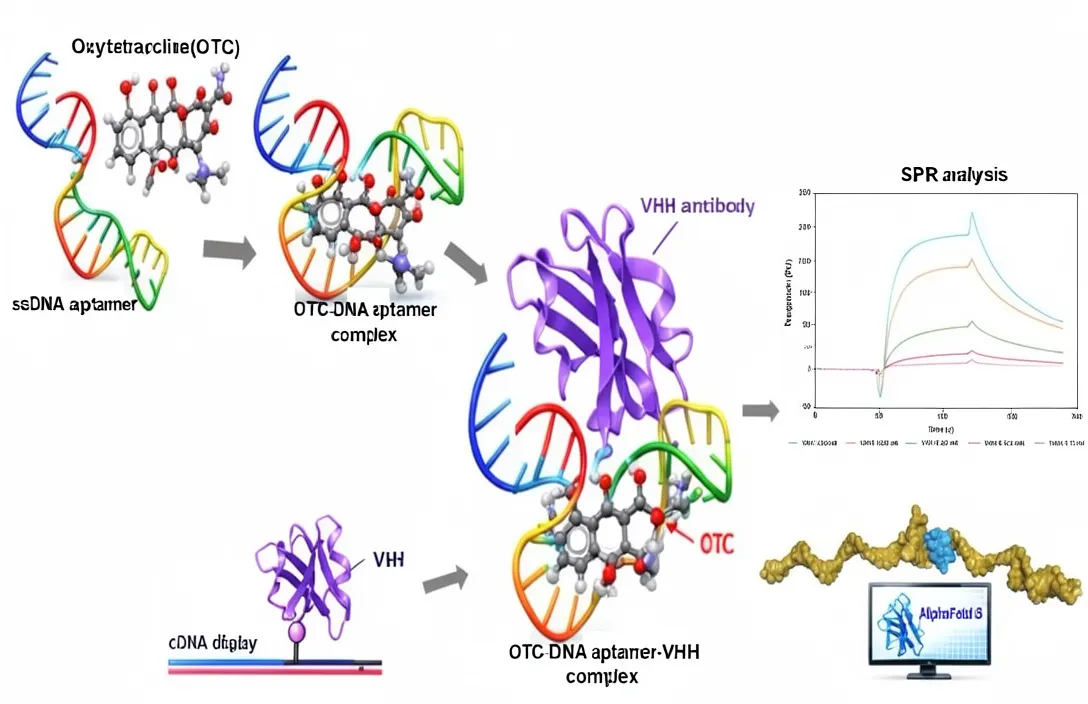

Researchers at Saitama University have identified a single-domain antibody, VHH6, that preferentially recognizes an oxytetracycline-bound DNA aptamer (source ID: 1). This discovery was made using cDNA display technology to screen antibody candidates, surface plasmon resonance to measure binding properties, and AlphaFold3 to predict molecular interactions. DNA aptamers are short, single-stranded DNA molecules that fold into specific shapes and selectively bind to target molecules, such as proteins or small chemical compounds. The ability of VHH6 to recognize the folded structure of a DNA aptamer represents a novel approach in molecular recognition, as most prior research has focused on DNA molecules recognizing targets rather than antibodies recognizing DNA structures. [1]
The study, published in the journal Antibodies, shows that the presence of oxytetracycline (OTC), an antibiotic used in veterinary medicine, influences the interaction between the DNA aptamer and the VHH6 antibody (source ID: 1). The findings suggest that the folded structure of a DNA aptamer, as well as the presence of a molecule bound to it, can influence its interaction with an antibody. This opens up new possibilities for understanding and engineering protein–nucleic acid interactions, as well as for developing molecular detection systems that combine the target-binding ability of DNA aptamers with the recognition capabilities of VHH antibodies. [1]
The research team led by Professor Naoto Nemoto and Professor Koji Matsuoka aimed to determine whether small, single-domain VHH antibodies could recognize the three-dimensional structural characteristics of DNA aptamers (source ID: 1). The study provides a starting point for developing molecular detection systems that could eventually be used in food safety, environmental monitoring, and biotechnology. However, additional research will be necessary to develop aptamers with more pronounced target-dependent structural changes and to establish reliable analytical performance. [1]
Researchers at Saitama University have identified a single-domain antibody, VHH6, that preferentially recognizes an oxytetracycline-bound DNA aptamer (source ID: 1). The study, published in the journal Antibodies, shows that the presence of oxytetracycline (OTC), an antibiotic used in veterinary medicine, influences the interaction between the DNA aptamer and the VHH6 antibody (source ID: 1). This discovery highlights a new approach to molecular recognition by exploring how antibodies can recognize the folded structures of DNA aptamers rather than using DNA to recognize targets (source ID: 1). [1]
Advertisement
DNA aptamers are short, single-stranded DNA molecules that fold into specific shapes and selectively bind to target molecules (source ID: 1). The research team, led by Professor Naoto Nemoto and Professor Koji Matsuoka, investigated whether VHH antibodies could recognize the three-dimensional structural characteristics of DNA aptamers (source ID: 1). The team focused on a DNA aptamer that binds to oxytetracycline and examined how its interaction with VHH antibodies changes depending on the presence or absence of OTC (source ID: 1). [1]
Using cDNA display technology, surface plasmon resonance, and AlphaFold3, the researchers identified VHH6, a promising antibody whose binding behavior is influenced by the structural characteristics of the DNA aptamer (source ID: 1). The study expands the scope of antibody recognition beyond proteins to folded nucleic acid structures, suggesting that the folded structure of a DNA aptamer and the presence of a molecule bound to it can influence its interaction with an antibody (source ID: 1). [1]
The study published in the journal Antibodies highlights the identification of a VHH antibody, VHH6, that preferentially binds to an oxytetracycline-associated DNA aptamer (source ID: 1). This discovery opens the door to developing molecular detection systems that utilize both the target-binding ability of DNA aptamers and the recognition capabilities of VHH antibodies (source ID: 1). The researchers explored how the presence of oxytetracycline (OTC), an antibiotic used in veterinary medicine, influences the interaction between the DNA aptamer and the VHH6 antibody (source ID: 1). [1]
Using advanced technologies such as cDNA display, surface plasmon resonance, and AlphaFold3, the team identified VHH6 as a promising antibody whose binding behavior is influenced by the structural characteristics of the DNA aptamer (source ID: 1). This research expands the scope of antibody recognition beyond proteins to folded nucleic acid structures, suggesting new possibilities for understanding and engineering protein–nucleic acid interactions (source ID: 1). [1]
Advertisement
The findings suggest that a DNA aptamer could first capture a small chemical compound, while an antibody could then recognize structural features associated with the resulting aptamer–target complex (source ID: 1). This approach might eventually enable the development of a sandwich-like detection system for small molecules that are difficult to measure using conventional antibody-based assays (source ID: 1). [1]
A research team led by specially appointed Professor Naoto Nemoto and Professor Koji Matsuoka of the Graduate School of Science and Engineering at Saitama University aimed to determine whether small, single-domain antibodies known as VHH antibodies could recognize the three-dimensional structural characteristics of DNA aptamers (source ID: 1). The researchers focused on a DNA aptamer that binds to oxytetracycline (OTC), an antibiotic used in veterinary medicine, and investigated how its interaction with VHH antibodies changes depending on the presence or absence of OTC (source ID: 1). [1]
Using cDNA display technology to screen antibody candidates, surface plasmon resonance to measure their binding properties and AlphaFold3 to predict molecular interactions, the team successfully identified a promising VHH antibody, designated VHH6, whose binding behavior is influenced by the structural characteristics of the DNA aptamer (source ID: 1). This study, published in the journal Antibodies, expands the scope of antibody recognition beyond proteins to folded nucleic acid structures (source ID: 1). [1]
The findings also provide a starting point for developing molecular detection systems that combine the target-binding ability of DNA aptamers with the recognition capabilities of VHH antibodies (source ID: 1). For example, a DNA aptamer could first capture a small chemical compound, while an antibody could then recognize structural features associated with the resulting aptamer–target complex (source ID: 1). [1]
Advertisement
The Cali Reporter newsletter
The stories worth your time.
California, the country, and what comes next. Join our free newsletter for reporting that keeps you informed.
More in Health & Medicine
- Understanding Fascia and the Evidence Behind Fascia Release
Fascia is a connective tissue that plays a structural role in the human body, but evidence supporting specific exercises or tools for 'fascia release' remains limited.
- Antidepressant Effectiveness and Long-Term Use
A new review suggests that some antidepressants may be more effective than others in helping people manage depression symptoms over the long term, according to a study published in The Lancet Psychiatry.
- Experimental Weight-Loss Drug Shows Promise for Knee Osteoarthritis Pain
A new study suggests that an experimental weight-loss drug, retatrutide, may significantly reduce knee pain in people with osteoarthritis and obesity.