AI-Generated Hospital Discharge Summaries Outperform Doctor-Written Versions
A study published in JAMA Network Open suggests that AI-generated discharge summaries may meet or exceed current clinical standards, with higher ratings for accuracy and completeness compared to those written by…

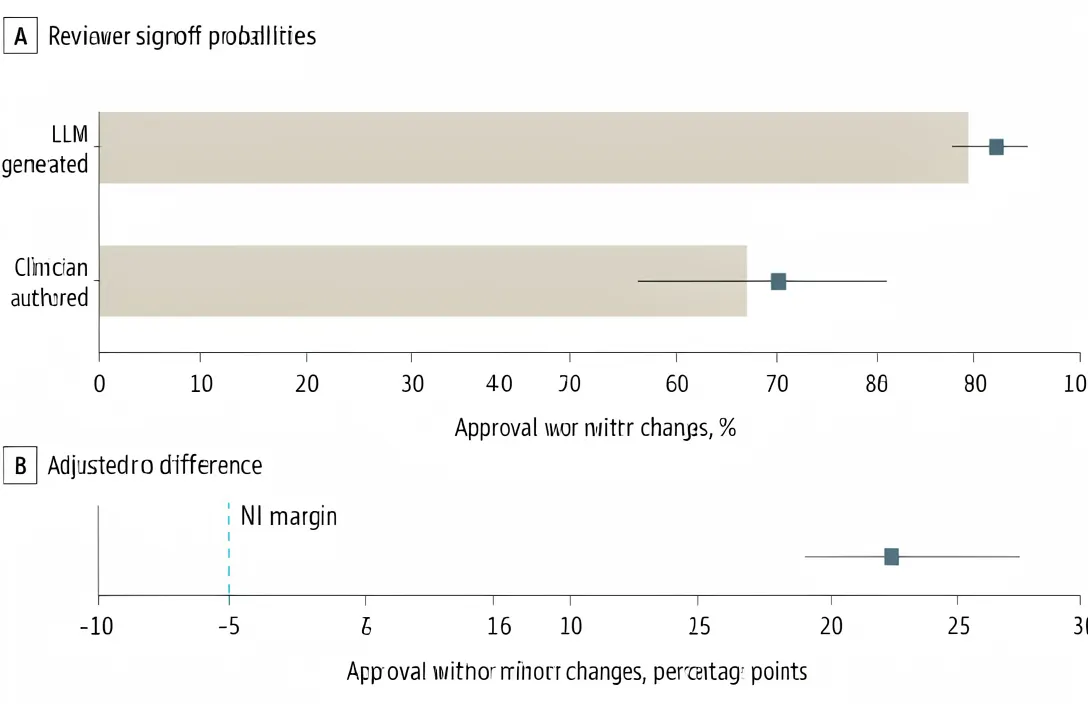

A study published in JAMA Network Open on Nov. 17 found that AI-generated discharge summaries can meet, and in some respects exceed, current standards of care. The research, led by iCARE (Imperial Clinical Analytics, Research and Evaluation), evaluated an AI system developed in partnership with resident doctors at Imperial College Healthcare NHS Trust. In a blinded evaluation involving 12 doctors and 1,294 discharge summaries, AI-generated summaries were more likely to be considered clinically acceptable and received higher ratings for accuracy, completeness, clarity, and tone than those produced through usual clinical practice (source ID: 1). [1]
Discharge summaries are critical for providing GPs and other healthcare professionals with a concise account of a patient's hospital admission, including diagnoses, treatments, and follow-up arrangements. They also help patients and families understand their care. Producing these summaries is complex, as clinicians must gather information from multiple sources under time pressure. Dr. Benjamin Atkins, a resident doctor at Imperial College Healthcare NHS Trust, noted that automation of administrative tasks like discharge summaries could be powerful on the wards (source ID: 1). [1]
Researchers assessed whether AI-generated discharge summaries met the standard required for routine clinical use. Twelve doctors independently reviewed 1,294 summaries in a blinded evaluation, assessing clinical acceptability, quality, and potential for harm. Ninety-two percent of AI-generated summaries met the threshold for clinical acceptability, requiring either no edits or only minor revisions before sign-off, compared with 70% of clinician-written summaries (source ID: 1). [1]
The study emphasized the importance of involving clinicians in the co-design and evaluation of AI tools. The application was developed and evaluated in partnership with resident doctors, ensuring that the technology met real clinical needs and workflows. This approach strengthens the relevance of the findings to practice and highlights the importance of clinician involvement in the development of AI-enabled documentation (source ID: 1). [1]
Advertisement
AI-generated discharge summaries can meet, and in some respects exceed, current standards of care, according to new research led by iCARE (Imperial Clinical Analytics, Research and Evaluation), as reported by Medical Xpress (1). Published in JAMA Network Open on Nov. 17, the study evaluated an AI system developed and assessed in partnership with resident doctors at Imperial College Healthcare NHS Trust. In a blinded evaluation involving 12 doctors and 1,294 discharge summaries, AI-generated summaries were more likely to be considered clinically acceptable and received higher ratings for accuracy, completeness, clarity and tone than those produced through usual clinical practice. [1]
The findings suggest that AI-assisted discharge documentation could represent a promising use case for generative AI in health care and demonstrate the importance of continued human involvement throughout the co-design, use and evaluation of AI tools, as stated by Medical Xpress (1). Discharge summaries give GPs and other health care professionals a concise account of a patient's hospital admission, including diagnoses, investigations, treatments, medication changes and follow-up arrangements. They can also help patients and families understand what happened during a hospital stay and what should happen next. [1]
Researchers assessed whether AI-generated discharge summaries met the standard required for routine clinical use, as noted by Medical Xpress (1). Twelve doctors working at Imperial College Healthcare NHS Trust who routinely prepare discharge documentation independently reviewed 1,294 summaries in a blinded evaluation, assessing clinical acceptability, quality and potential for harm. Ninety-two percent of AI-generated summaries met the threshold for clinical acceptability, meaning they required either no edits or only minor revisions before sign-off, compared with 70% of clinician-written summaries. [1]
A study published in JAMA Network Open on Nov. 17 evaluated an AI system developed in partnership with resident doctors at Imperial College Healthcare NHS Trust. In a blinded evaluation involving 12 doctors and 1,294 discharge summaries, AI-generated summaries were more likely to be considered clinically acceptable and received higher ratings for accuracy, completeness, clarity and tone than those produced through usual clinical practice (1). [1]
Advertisement
Ninety-two percent of AI-generated summaries met the threshold for clinical acceptability, meaning they required either no edits or only minor revisions before sign-off, compared with 70% of clinician-written summaries. AI-generated summaries also received higher ratings for accuracy, completeness, clarity and tone, with reviewers identifying fewer potentially harmful omissions and inaccuracies (1). [1]
The study emphasized the importance of involving clinicians in the co-design and evaluation of AI tools. The application was developed and evaluated in partnership with resident doctors, including Dr. Benjamin Atkins and Dr. Fidan Damirova, who regularly prepare discharge summaries at Imperial College Healthcare NHS Trust (1). [1]
Sources
Prepared with AI assistance from the cited sources.
The Cali Reporter newsletter
The stories worth your time.
California, the country, and what comes next. Join our free newsletter for reporting that keeps you informed.
More in Health & Medicine
- Understanding Fascia and the Evidence Behind Fascia Release
Fascia is a connective tissue that plays a structural role in the human body, but evidence supporting specific exercises or tools for 'fascia release' remains limited.
- Antidepressant Effectiveness and Long-Term Use
A new review suggests that some antidepressants may be more effective than others in helping people manage depression symptoms over the long term, according to a study published in The Lancet Psychiatry.
- Experimental Weight-Loss Drug Shows Promise for Knee Osteoarthritis Pain
A new study suggests that an experimental weight-loss drug, retatrutide, may significantly reduce knee pain in people with osteoarthritis and obesity.