AI and Nanotechnology Enable Five-Minute Drug Screening from a Single Drop of Urine
A new technology combining nanotechnology and artificial intelligence allows rapid identification of illicit drugs in urine samples within five minutes.

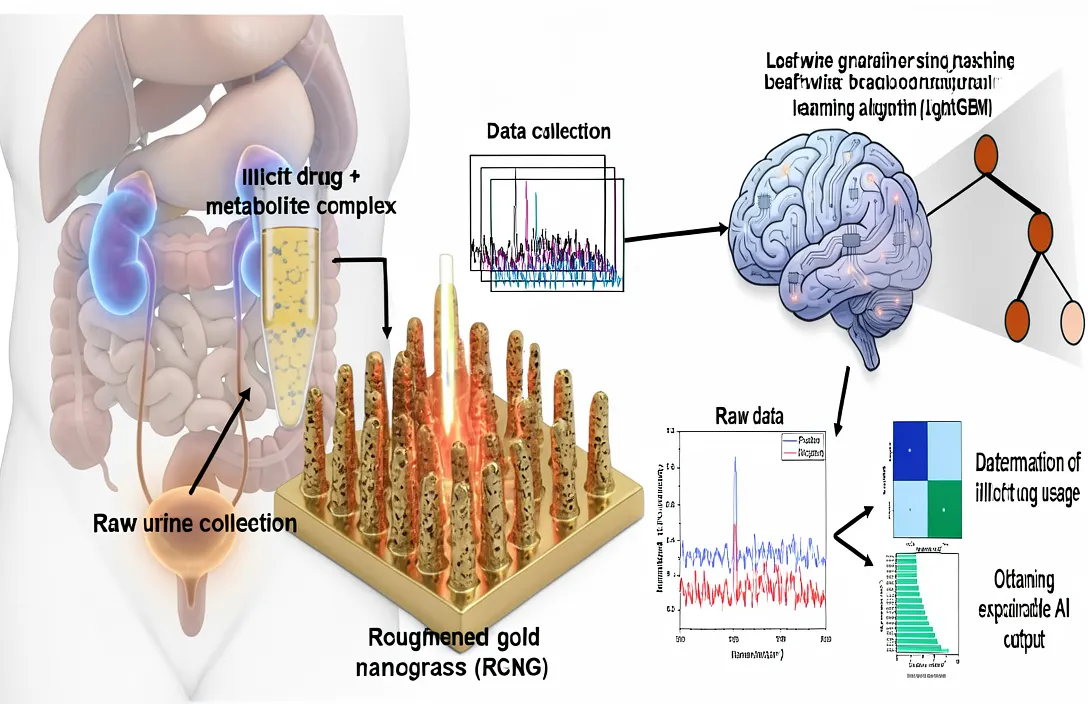

A research team led by Dr. Eun-Kyung Lim at the Bionanotechnology Research Center of the Korea Research Institute of Bioscience and Biotechnology (KRIBB) has developed a platform that combines nanotechnology and artificial intelligence to screen urine for illicit drug use within five minutes, without chemical pretreatment (source ID: 1). The study was conducted in collaboration with multiple institutions and is published in ACS Measurement Science Au. The researchers developed a nanostructured substrate that amplifies the faint light signals produced by drug molecules millions of times or more. They formed densely packed, grasslike nanopillars on a thin gold surface and roughened their surfaces by selective etching. [1]
When drug molecules settle on the substrate, their characteristic vibrational light signals become much stronger, allowing even trace amounts to be clearly identified (source ID: 1). The team also used an artificial intelligence model called LightGBM to distinguish the unique signal fingerprints of illicit drugs from the complex background signals in urine. This approach addresses a longstanding challenge: identifying drug-specific signals in samples containing a wide range of metabolic waste products and medication metabolites. [1]
In tests using real urine specimens, the AI-assisted platform identified drug-positive samples with approximately 80% accuracy, even among urine samples from patients taking nonnarcotic analgesics or multiple medications (source ID: 1). In experiments with rats, the researchers further demonstrated that drug components could be analyzed in urine collected within six hours after administration. The findings establish a core technology for rapid, precise onsite drug screening using a single drop of urine without sample pretreatment. [1]
A research team led by Dr. Eun-Kyung Lim at the Bionanotechnology Research Center of the Korea Research Institute of Bioscience and Biotechnology (KRIBB) has developed a platform that combines nanotechnology and artificial intelligence to screen urine for illicit drug use within five minutes, without chemical pretreatment (source ID: 1). The study was conducted in collaboration with professor Tae Hwan Kim at Daegu Catholic University, professor Joon Hee Lee at Seoul National University Bundang Hospital, and the AI Research Center at StoneLab, and is published in ACS Measurement Science Au (source ID: 1). [1]
Advertisement
The researchers developed a nanostructured substrate that amplifies the faint light signals produced by drug molecules millions of times or more. They formed densely packed, grasslike nanopillars on a thin gold surface and roughened their surfaces by selective etching (source ID: 1). When drug molecules settle on the substrate, their characteristic vibrational light signals become much stronger, allowing even trace amounts to be clearly identified (source ID: 1). [1]
The team also used an artificial intelligence model called LightGBM to distinguish the unique signal fingerprints of illicit drugs from the complex background signals in urine. In tests using real urine specimens, the AI-assisted platform identified drug-positive samples with approximately 80% accuracy, even among urine samples from patients taking nonnarcotic analgesics or multiple medications (source ID: 1). [1]
A research team led by Dr. Eun-Kyung Lim at the Bionanotechnology Research Center of the Korea Research Institute of Bioscience and Biotechnology (KRIBB) has developed a platform that combines nanotechnology and artificial intelligence to screen urine for illicit drug use within five minutes, without chemical pretreatment (source ID: 1). The platform utilizes a nanostructured substrate that amplifies the faint light signals produced by drug molecules millions of times or more, enabling the identification of even trace amounts of drugs (source ID: 1). [1]
The researchers formed densely packed, grasslike nanopillars on a thin gold surface and roughened their surfaces by selective etching. When drug molecules settle on the substrate, their characteristic vibrational light signals become much stronger, allowing even trace amounts to be clearly identified (source ID: 1). The team also used an artificial intelligence model called LightGBM to distinguish the unique signal fingerprints of illicit drugs from the complex background signals in urine (source ID: 1). [1]
Advertisement
In tests using real urine specimens, the AI-assisted platform identified drug-positive samples with approximately 80% accuracy, even among urine samples from patients taking nonnarcotic analgesics or multiple medications (source ID: 1). The findings establish a core technology for rapid, precise onsite drug screening using a single drop of urine without sample pretreatment (source ID: 1). [1]
A research team led by Dr. Eun-Kyung Lim at the Bionanotechnology Research Center of the Korea Research Institute of Bioscience and Biotechnology (KRIBB) has developed a platform that combines nanotechnology and artificial intelligence to screen urine for illicit drug use within five minutes, without chemical pretreatment (source ID: 1). The study was conducted in collaboration with professor Tae Hwan Kim at Daegu Catholic University, professor Joon Hee Lee at Seoul National University Bundang Hospital and the AI Research Center at StoneLab, and is published in ACS Measurement Science Au (source ID: 1). [1]
The researchers developed a nanostructured substrate that amplifies the faint light signals produced by drug molecules millions of times or more. They formed densely packed, grasslike nanopillars on a thin gold surface and roughened their surfaces by selective etching (source ID: 1). When drug molecules settle on the substrate, their characteristic vibrational light signals become much stronger, allowing even trace amounts to be clearly identified (source ID: 1). [1]
The team also used an artificial intelligence model called LightGBM to distinguish the unique signal fingerprints of illicit drugs from the complex background signals in urine. In tests using real urine specimens, the AI-assisted platform identified drug-positive samples with approximately 80% accuracy, even among urine samples from patients taking nonnarcotic analgesics or multiple medications (source ID: 1). [1]
Advertisement
The Cali Reporter newsletter
The stories worth your time.
California, the country, and what comes next. Join our free newsletter for reporting that keeps you informed.
More in Health & Medicine
- Understanding Fascia and the Evidence Behind Fascia Release
Fascia is a connective tissue that plays a structural role in the human body, but evidence supporting specific exercises or tools for 'fascia release' remains limited.
- Antidepressant Effectiveness and Long-Term Use
A new review suggests that some antidepressants may be more effective than others in helping people manage depression symptoms over the long term, according to a study published in The Lancet Psychiatry.
- Experimental Weight-Loss Drug Shows Promise for Knee Osteoarthritis Pain
A new study suggests that an experimental weight-loss drug, retatrutide, may significantly reduce knee pain in people with osteoarthritis and obesity.