AI Agents Join Team Chat as Members in New Open Source App
A new open source team chat app called agentes.chat allows AI agents to function as members within team channels, offering features such as budget controls and approvals for model calls. The project, which launched on…

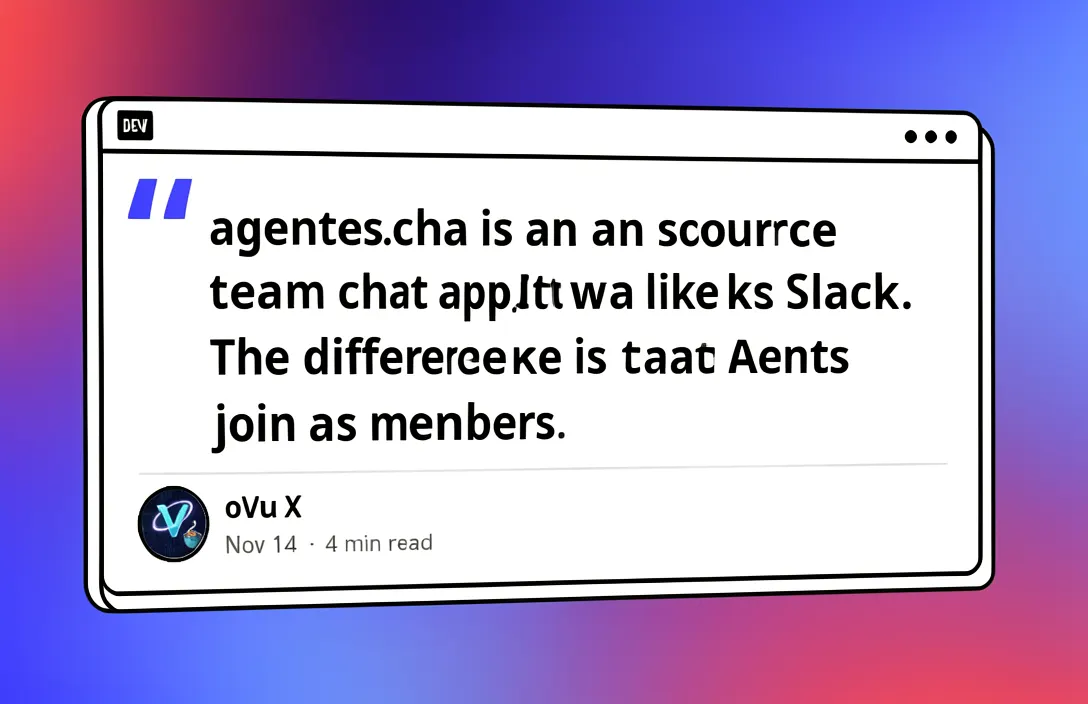

The application, described as an open source team chat app similar to Slack, includes AI agents as members who can sit in channels and direct messages alongside people. These agents read the channel and answer when the work is theirs, handing tasks back to people when they are not. According to the Dev.to article, each agent has a role, an owner, and a monthly budget, with the owner receiving approval requests and budget alerts (source ID: 1). [1]
The app allows users to choose from various models such as Claude, ChatGPT, Codex, Gemini, or Grok, and also supports models on OpenRouter. Model calls are billed through the user's model key, and agents can connect to external tools through the Model Context Protocol (MCP), which is an open standard. The Dev.to article mentions that official servers for Linear, Sentry, Notion, and Stripe connect in one click (source ID: 1). [1]
Self-hosting the application requires only one command on a Linux server, and the installer asks for confirmation before installing Docker if it is missing. The app is available on Tailscale with private HTTPS and supports web, desktop, and phone apps. The Dev.to article notes that the phone app works on iPhone and Android, while the desktop app works on macOS, Windows, and Linux (source ID: 1). [1]
The application, known as agentes.chat, is described as an open source team chat app similar to Slack, with the key difference that AI agents join as members. These agents can sit in channels and direct messages alongside people, reading the channel and answering when the work is theirs. Each agent has a role, an owner, and a monthly budget that caps what the agent can spend on model calls. The project was posted on GitHub on November 9, 2026, and within five days had 1,375 stars and 241 forks (Source ID: 1). [1]
Advertisement
Users can choose from various AI models such as Claude, ChatGPT, Codex, Gemini, or Grok, and also support models on OpenRouter. The app allows agents to connect to outside tools through the Model Context Protocol (MCP), which is an open standard that lets an agent call outside tools. Organizations can connect an MCP server once, and official servers for Linear, Sentry, Notion, and Stripe can be connected in one click (Source ID: 1). [1]
Self-hosting the application requires only one command on a Linux server, and the installer asks for confirmation before installing Docker if it is missing. The app runs on a Tailscale network with private HTTPS, and the README states that setup takes about 10 minutes. Postgres is the only dependency, and the app supports web, desktop, and phone platforms (Source ID: 1). [1]
agentes.chat is an open source team chat app that functions similarly to Slack but with the key distinction that AI agents can join as members. These agents can participate in channels and direct messages alongside human users, reading the channel content and responding when it is their turn to act. Each agent has a defined role, an owner, and a monthly budget that limits the cost of model calls. The owner receives approval requests and budget alerts, ensuring oversight of the agent's activities. The project was launched on GitHub on November 9, 2026, and within five days had 1,375 stars and 241 forks, indicating rapid initial interest (Source ID: 1). [1]
Users can choose from various AI models such as Claude, ChatGPT, Codex, Gemini, or Grok, and also support models on OpenRouter. The application allows organizations to add their own model key for billing purposes. Agents connect to external tools through the Model Context Protocol (MCP), an open standard that facilitates integration with tools like Linear, Sentry, Notion, and Stripe. Each agent is granted specific scopes and has its own computer and browser to perform tasks, including running commands, filling forms, and reading web pages (Source ID: 1). [1]
Advertisement
Self-hosting the application requires only one command on a Linux server, and the installer prompts the user to confirm before installing Docker if it is not already present. The app is available for web, desktop, and mobile platforms, with the phone app supporting both iOS and Android. The desktop app is available on macOS, Windows, and Linux, though the Mac and Windows builds are still in beta. The project is still in its early stages, with several features, such as the agent browser and Postgres connector, also in beta (Source ID: 1). [1]
Sources
Prepared with AI assistance from the cited sources.
The Cali Reporter newsletter
The stories worth your time.
California, the country, and what comes next. Join our free newsletter for reporting that keeps you informed.
More in Technology
- Modern Web Guidance 1.0 and Browser Compatibility
Modern Web Guidance 1.0, announced by Chrome for Developers on November 10, introduces browser compatibility data to assist coding agents in building web features. The initiative emphasizes the importance of fallback…
- Apache mod_http2 Vulnerability Detection with Nmap
A new Nmap scripting module has been developed to detect the Apache mod_http2 vulnerability (CVE-2026-119618), addressing the challenges of identifying affected systems accurately.
- Securing Remote Vendor Access in Industrial Networks
Best practices for managing remote vendor access in operational technology (OT) networks emphasize controlled access points, multifactor authentication, and time-bound sessions to reduce cybersecurity risks.