

1 Brain System For Words, 1 For Logic: MIT Study Reveals Why You Still Think When You Can’t Speak
New research from MIT shows that logical reasoning operates independently of language centers in the brain, offering a new perspective on intelligence and communication.

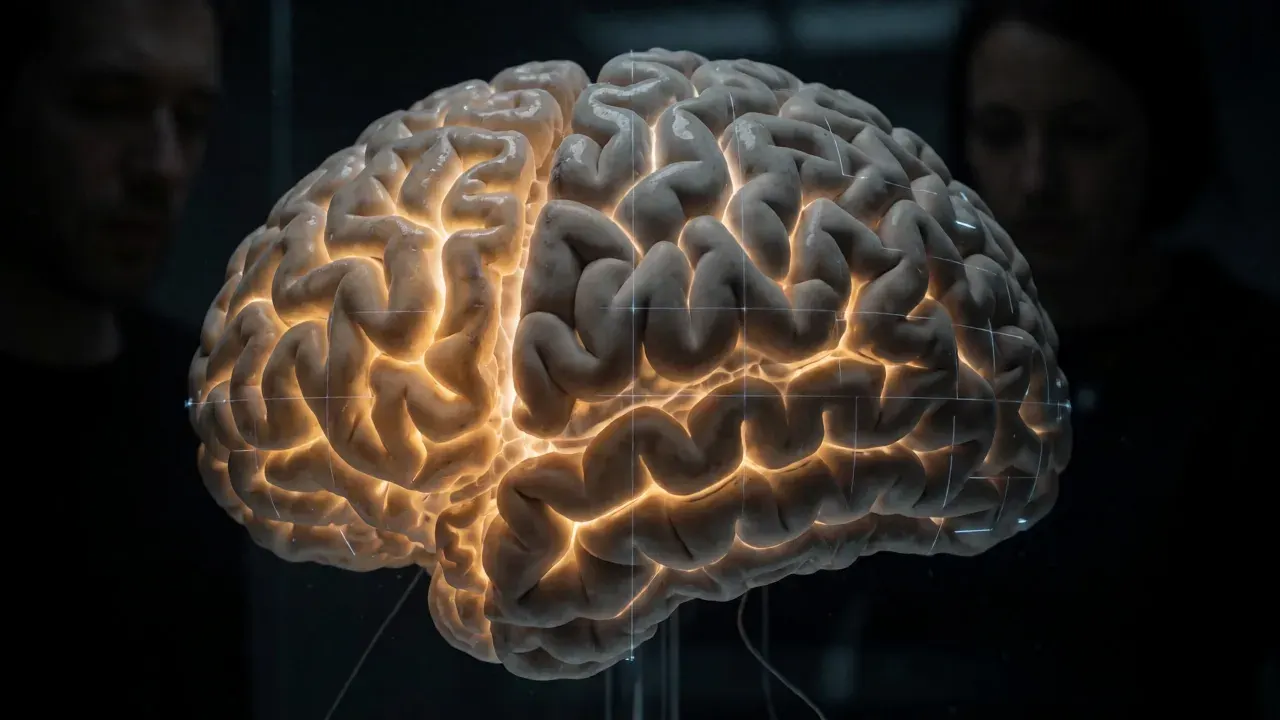
We often carry a quiet worry that silence equals emptiness. We assume that if we cannot find the words to explain how we feel or how we solve a problem then perhaps we lack the capacity to think at all. This intuition is comforting but it turns out it is not entirely true. Our minds are far more robust and complex than we allow ourselves to believe. Recent work from cognitive neuroscientists at the McGovern Institute for Brain Research at MIT suggests that you can possess a sharp, logical mind even when your language abilities are struggling to keep up. This discovery is not just a technical curiosity for scientists it is a deeply human revelation about the nature of intelligence itself.
The study published in the journal PNAS led by associate professor of brain and cognitive sciences Evelina Fedorenko offers a profound correction to how we view the connection between language and thought. The researchers worked with Rosemary Varley a neuroscientist at University College London who studies acquired language disorders. They focused on two individuals who had experienced strokes that damaged the language processing areas of the brain. These were not simple cases of hesitation. This was severe aphasia a condition where the ability to produce and understand language is dramatically impaired. For these individuals words often fail them leaving them with a profound sense of isolation and a fear that their capacity for reason had vanished along with their vocabulary. The researchers wanted to test if logic was a casualty of this damage.
They designed a series of ingenious logic games to bypass the need for language. In one task the participants were presented with two lists of numbers. The first list was transformed into the second and the goal was to discover the hidden rule that connected them. This rule might involve reversing the digits of each number or eliminating numbers that exceed a certain value. In another task the participants were shown a collection of geometric patterns and asked to select the one that correctly completed a matrix. These puzzles required a high level of abstract thought and pattern recognition. The results were striking. The participants with severe language impairments performed as well as a control group of healthy adults. They could identify the rules and complete the geometric puzzles with equal success. They could even convey the rules they had discovered through gestures or sketches. It was a stunning demonstration that the capacity for abstract logical thought can exist entirely outside the realm of language.

The researchers did not stop there. They also used MRI scans to observe the brains of healthy adults as they tackled similar problems. They specifically looked at the activity in the brain's language centers and a broader network known as the multiple demand network which supports complex problem-solving. The scans revealed a clear physical separation between the systems. When healthy participants engaged in logical reasoning the brain's language system remained largely dormant. The multiple demand network was active but it was not active during all types of reasoning. The scans showed that this network lit up during inductive reasoning where the goal was to discover a hidden rule but it did not show up during deductive reasoning where the goal was to assess the validity of a conclusion based on given premises. This distinction suggests that the brain uses different tools for different stages of logical processing.
Hope Kean a postdoc and former K. Lisa Yang Integrative Computational Neuroscience (ICoN) Center graduate fellow in Fedorenko's lab provided further insight into why this separation exists. She notes that abstract thinking shares structural properties with language. One can decompose a thought into subcomponents much like we break down sentences into words and clauses. However Kean and Fedorenko suspected that the brain might separate the communication of reasoning from the reasoning itself. Language unfolds in a linear sequence one word after another. But reaching a logical conclusion often requires considering several pieces of information in ways that are less linear. Logical reasoning also demands a level of precision that ordinary language does not provide. The brain appears to have evolved a separate system to handle these non-linear and precise demands.
The implications of this research extend far beyond the laboratory. Professionals who work with people who have aphasia have long understood that the loss of language does not equate to a loss of intelligence. Someone with aphasia may still enjoy playing chess or managing a family's finances despite their difficulty speaking. Yet others often misinterpret this silence as a sign of empty thoughts. This research adds to a growing body of work establishing that even severely aphasic individuals can preserve their ability for abstract logical thought a defining feature of our species. It serves as a gentle reminder to look past the words and see the mind working beneath the surface. We should educate ourselves and the people around us that linguistic difficulties are not indicative of how smart or capable someone is.
The findings also offer an interesting perspective on the rise of artificial intelligence. Large language models such as ChatGPT and Claude are trained entirely on text and produce text as their output. They can convincingly simulate certain forms of human reasoning because they are essentially mirroring the patterns of human language. The human brain operates differently. In people language and abstract logical thought appear to be distinct systems. Studying the differences between the human reasoning process and the way large language models operate could provide useful ideas for the development of future AI systems. It highlights the unique architecture of the human mind.
Understanding exactly how the human brain performs reasoning remains an open area of research. For Fedorenko and Kean the results provide strong evidence that language and logic rely on distinct systems in the brain. This knowledge is a new frontier in the geography of thought and one they are eager to explore. As we continue to untangle the threads of mind and language we gain a deeper appreciation for the resilience of human intelligence. We learn that our thoughts are not merely the sum of our words but a vast and independent landscape that exists beneath the surface of our communication.
First reported by ScienceDaily: Relationships.
More in Love & Relationships
- Clear requests and respectful boundaries belong in everyday relationships
NIH guidance highlights honest conversation, listening and limits as parts of supportive connections.
- How Eye-Tracking Revealed Hidden Social Skills in Severely Disabled Youth
A new study finds that personalized training can unlock social abilities in people often considered untestable.
- Sleep matters: Duration, timing, quality and more may affect cardiovascular disease risk
Healthy sleep includes multiple components, such as number of hours of sleep per night, how long it takes to fall asleep, daytime functionin