Whole-Blood NAD Tied to Heart Disease, Not Age, in 1,068 Adults
A Vilnius University study finds stable NAD in healthy men and a small rise in healthy women, lower levels in cardiovascular disease and hypertension; researchers caution that cause, tissue meaning and supplement benefits remain unproven.

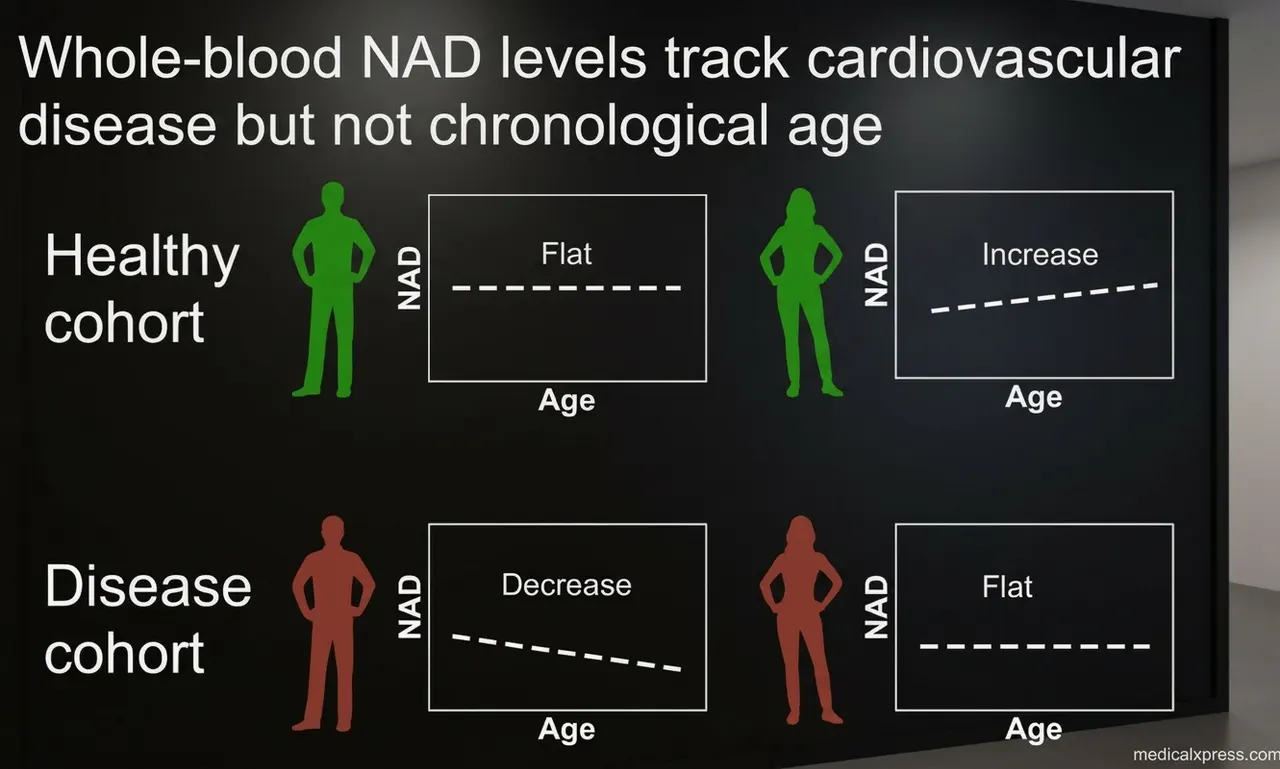

Vilnius University researchers analyzed 1,068 adults and 1,340 whole-blood NAD readings to test whether the molecule falls with age. They used dried blood spots gathered under a set protocol. Participants included healthy adults and people with long-term conditions. The paper appeared in Nature Metabolism in 2026, with Diana Romenskaja-Avgul and colleagues as authors and DOI 10.1038/s42255-026-01660-3. Its title states the central contrast: whole-blood NAD tracks cardiovascular disease, not calendar age. The design is large for this question and compares people by health status, which matters because earlier human blood results had been inconsistent. The study reports group patterns, not individual diagnoses or a clinical cutoff. It also measures whole blood, not muscle, brain or skin. Those boundaries frame every claim that follows, and they push back on the idea that a blood NAD drop is an inevitable, one-size-fits-all part of getting older. [1]
The count of readings is larger than the count of adults, so the dataset contains more measurements than participants; the source does not detail how repeat readings were assigned. The report describes dried blood spots gathered under controlled conditions, a format that can support large studies but does not turn a blood spot into a tissue biopsy. The sample mixed healthy people and people with long-term illness, giving the authors a way to compare age patterns by health status. The source report does not describe the sample as a random population sample, and it gives no clinical threshold for low or high NAD. It also does not give an effect size for the modest rise in healthy women. Those details limit how far the results can travel. They support a group-level finding, not a personal health score. [1]
Among healthy men, whole-blood NAD stayed level as age rose. Among healthy women, it rose modestly and the change was statistically significant. The pattern differed for people with long-term illness: their NAD was lower. Men with chronic disease showed an age-related decline, and among women with chronic disease the rise observed in healthy women was absent. The strongest tie was to cardiovascular disease, and hypertension stood out most clearly. The authors say cardiovascular health may shape how a whole-blood reading should be interpreted. They do not say every healthy man or woman follows the same curve. The contrast is between groups, and the paper presents it as an association. It does not establish that heart disease causes lower NAD or that low NAD causes heart disease. Nor does it show that the healthy pattern protects anyone. [1]
The study shifts attention from birthday count to cardiovascular status when whole-blood NAD is read. If the pattern holds, a low reading might eventually become a signal worth following rather than a routine mark of aging. That is a research possibility, not a clinical service. The authors describe the cardiovascular link as a potentially important question. They do not propose screening. The strongest signal involved hypertension, but the paper does not explain why. It also does not say the association is specific enough to separate one heart condition from another. The source does not report how many participants had hypertension or cardiovascular disease, nor the size of the between-group differences. The lead researcher, Dr. Dalius Ratautas, said the common story has been that NAD falls with age and must be restored; he said the blood data in healthy adults do not fit that story and raised whether NAD could say something about cardiovascular health. The practical takeaway is interpretive: age alone did not explain the blood pattern in healthy people; disease status did. [1]
Advertisement
NAD sits at the center of cellular energy handling and metabolism. Animal work found age-related declines in muscle, brain and skin tissue. That work helped fuel interest in boosters such as nicotinamide mononucleotide and nicotinamide riboside, sold with healthy-aging claims. Human blood evidence had been mixed. The Vilnius team tested a broad claim in a big sample. Its result is narrower than a claim that NAD never falls: it says whole-blood NAD did not fall with age in healthy adults. The authors note the result challenges the prevailing narrative that NAD declines with age and needs restoration. But they do not measure supplements. The paper also does not replace animal tissue findings; it adds human blood data. The gap between blood and tissue remains central. [1]
The authors explicitly state that causality was not established. It remains unclear whether lower NAD contributes to cardiovascular disease, results from the disease itself or reflects other underlying factors. Those three possibilities are different, and the data cannot choose among them. The study also does not show that raising NAD through supplements can prevent or treat cardiovascular disease or hypertension. A lower level in people with disease is not proof that restoring the level helps. The paper presents the heart link as a question for further work, not as a treatment pathway. It reports no intervention and no trial of NAD boosters. That limit applies even to the clearest hypertension finding. Without temporal or experimental evidence, direction and mechanism stay open. The reported data cannot say which came first. [1]
A commentary alongside the paper, by Stephen Gardell and Joseph Baur, flags the limits of treating blood NAD as a proxy for NAD in muscle or brain. Red blood cells carry most of the NAD measured in whole blood, and their metabolism differs from other cell types. Because red blood cells supply most of the signal, a whole-blood figure cannot be read directly as an organ-level measurement. The Vilnius authors acknowledge that whole-blood readings do not necessarily mirror concentrations in individual tissues. That caveat matters because much of the longevity case rests on tissue studies, including animal findings in skeletal muscle, brain and skin. A blood result cannot simply be projected onto organs. Still, the authors argue that a blood marker need not reproduce tissue measurements to be useful. Many clinical markers work through accessible blood samples rather than biopsies or specialized imaging. The debate is about what whole-blood NAD represents, not whether the molecule matters. [1]
The authors' defense of blood testing is practical. Direct tissue measurement can require invasive biopsies or specialized imaging; blood draws are easier to scale. That makes large monitoring studies possible. But accessibility is not validation. The paper does not show that whole-blood NAD is an established clinical test. It shows a statistical association in one large sample. The commentary and the authors' response leave a gap between a promising marker and a usable one. A useful test would need to predict something meaningful, be interpretable across people and hold up in further studies. The current paper lays groundwork for those questions. It does not answer them. The result is best read as a signal for research, not a label for patients. That distinction should guide coverage and marketing alike. [1]
Advertisement
NAD boosters are promoted as a way to counter age-related NAD loss and support healthy aging. The study found no evidence of a blanket whole-blood NAD decline among healthy adults. That weakens a simple marketing rationale based on universal depletion. It does not establish that supplements have clinical benefits. The paper reports no trial of NAD-boosting supplements and no outcome data on prevention or treatment. The authors also state that the study does not demonstrate that increasing NAD can prevent or treat cardiovascular disease or hypertension. Two questions should be kept separate: whether healthy adults have a general blood deficit, and whether raising NAD changes disease outcomes. The paper addresses the first more directly than the second. It complicates the story without supplying a replacement treatment claim. Anyone reading supplement claims should note that the study reports associations, not outcomes from supplementation. [1]
The team names two follow-up tasks: determine whether whole-blood NAD measurements can help predict cardiovascular risk, and investigate the biological mechanisms behind the NAD-cardiovascular association. Those are future questions, not findings. The authors frame prediction and mechanism as next steps; the source does not report that either has been achieved. Whether prediction will hold is open. Whether mechanisms will explain the link is open. Follow-up work would also need to clarify how blood NAD relates to tissue NAD. Other questions include whether the pattern holds in different samples and in designs that track people over time. The source report does not describe an intervention trial. It cannot show what happens when NAD is changed. A scenario worth watching is a longitudinal study that measures NAD before and after cardiovascular events. Another is mechanistic work on hypertension. Neither is established here, and neither should be reported as a likely outcome. [1]
The study's main contribution is to move cardiovascular health into the frame when whole-blood NAD is interpreted. Its main caution is equally important: a blood association is not a treatment, and a group pattern is not a diagnosis. The authors present the heart link as a potentially important question, not a settled clinical finding. Whether whole-blood NAD becomes more than a research signal depends on prediction studies, mechanism work and clearer tissue comparisons. For now, the evidence supports a narrower statement: in this sample, whole-blood NAD did not fall with age in healthy adults, and lower levels were tied to cardiovascular disease, especially hypertension. Cause, clinical use and supplement benefit remain unresolved. Those limits should travel with every headline. [1]
Sources
Prepared with AI assistance from the cited sources.
The Cali Reporter newsletter
The stories worth your time.
California, the country, and what comes next. Join our free newsletter for reporting that keeps you informed.
More in Health & Medicine
- Brain Energy Mismatches in Schizophrenia
A new study explores the potential role of energy bottlenecks in brain cells in explaining fragmented experiences of time, space, and self in schizophrenia.
- Brazil Reports First Mpox Death in 2026
Brazil has recorded its first mpox-related death in 2026, but public health officials are not classifying the current surge in cases as an outbreak, according to the Fiocruz Institute.
- Personalized Therapies for IBD May Target Specific Harmful Gut Bacteria
A study led by Dr. Lukas Mager and Prof. Kathy McCoy has identified two gut bacteria that promote inflammation in inflammatory bowel disease, opening the door for personalized treatments.