

Wall Street sees 'changing of the guard in AI' as Intel, AMD shares soar while Nvidia lags
Wall Street is dumping Nvidia's dominance for Intel, AMD and Micron as the AI buildout spreads to CPUs, memory and fiber optics, proof the boom has legs beyond one superstar chipmaker.
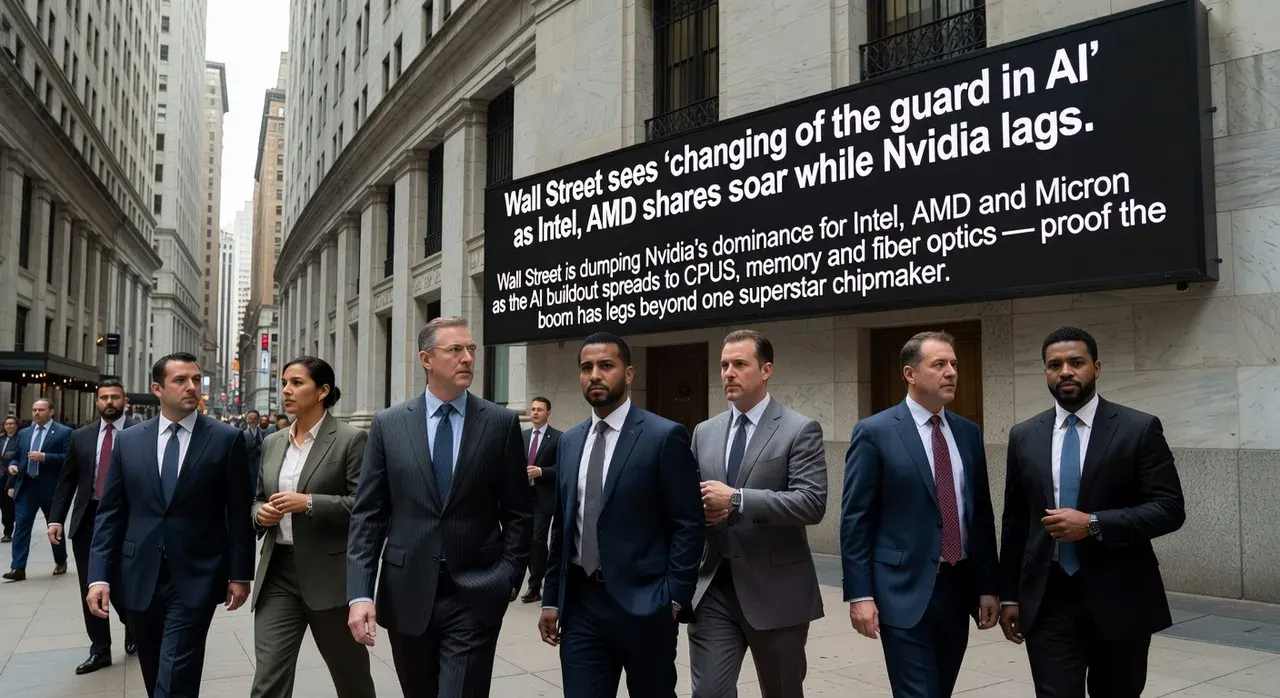
Wall Street just declared a regime change in artificial intelligence. While Nvidia still forecasts 70% revenue growth this fiscal year, its shares have gained only 15% in 2026, barely beating the Nasdaq. Meanwhile Intel has surged more than 200%, AMD and Micron have more than doubled, and memory shortages have turned a 47-year-old also-ran into one of the market’s hottest names.
The clearest signal came this week. AMD and Intel each jumped roughly 25%, Micron soared 37%, and Corning climbed 18%. Investors are no longer content to ride Nvidia’s GPUs alone. They are betting data centers will demand a broader stack of components for years, starting with the memory that powers everything else. Micron’s market cap crossed $800 billion for the first time; its stock is up more than 750% in the past year.
CEO Sanjay Mehrotra told CNBC in March that key customers are receiving only “50% to two-thirds of their requirements” because supply cannot keep pace. Mizuho analyst Jordan Klein spelled out the math: when a market snaps into shortage, prices surge while expenses rise only modestly, producing windfall profits for those positioned early. “That is what happens,” he wrote, “when new capacity cannot be added fast enough.”

The shift extends beyond memory to CPUs. Bank of America projects the data-center CPU market will more than double from $27 billion in 2025 to $60 billion in 2030, fueled by the move from chatbots to AI agents. AMD’s latest results crushed estimates on data-center strength; CEO Lisa Su raised her three-to-five-year server CPU growth forecast from 18% to 35%. “Agents are really driving tremendous demand in the overall AI adoption cycle,” she said on CNBC, “and we’re very excited to be in the middle of it.” Goldman Sachs, Bernstein and JPMorgan all upgraded or cheered the structural inflection.
Intel, long eclipsed in the AI race, is staging its own comeback. A major U.S. government investment last year, followed by reports of an Apple manufacturing deal, sent shares up 33% in early May alone. Separately, Corning’s 175-year-old glass business signed a pact with Nvidia to build three new U.S. factories for optical interconnects, part of Jensen Huang’s push from copper to fiber. Huang told CNBC the economy is in “the single largest infrastructure buildout in human history.”
The frenzy invites comparison to the late 1990s. BTIG’s Jonathan Krinksy warns the semiconductor rally looks even more extreme than 1999 and predicts a 25-30% correction in the PHLX Semiconductor Index, already up 66% this year. The money keeps flowing, but the guard has already changed.
Original reporting: CNBC.
More in Business
- IMF Chief Warns of Economic Divergence and Debt Risks Amid Artificial Intelligence Boom
Kristalina Georgieva suggests that while AI could significantly boost global growth, it simultaneously threatens to widen inequality and exacerbate inflationary pressures and public debt burdens.
- California Limits Utility Profits and Expands Home Energy Role
Gov. Gavin Newsom signed laws capping utility returns on lower-risk projects and accelerating virtual power plant development.
- Lyft to Pay $272.5 Million in Record California Wage-Theft Settlement
Largest such settlement in state history resolves claims that Lyft misclassified drivers as independent contractors from 2016 to 2020, denying them core wage protections.