Voyager 1 Reaches One Light-Day from Earth
NASA’s Voyager 1 probe has achieved a historic milestone by reaching one light-day from Earth, marking a significant achievement in space exploration.

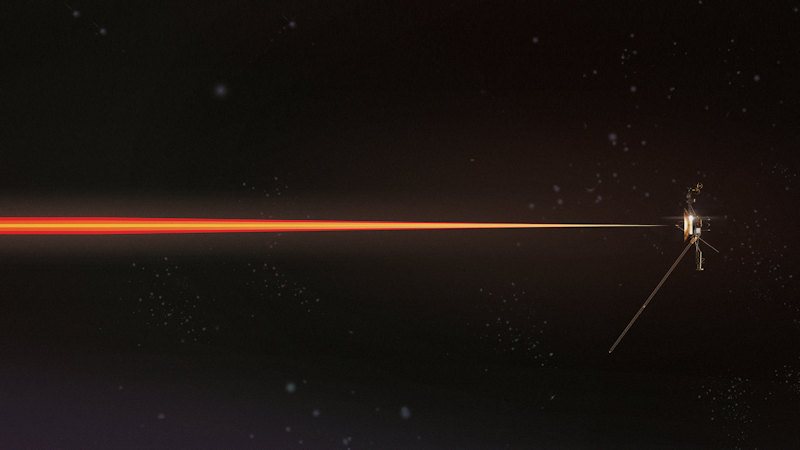
On Nov. 18, 2026, NASA’s Voyager 1 probe, launched in 1977, reached one light-day from Earth, after more than 49 years of constant travel. A light-day is the distance light travels in 24 hours, equaling about 16.1 billion miles (25.9 billion kilometers). The spacecraft achieved the milestone at 2:16 a.m. PST (5:16 a.m. EST) Nov. 18. Mission engineers used the carrier signal and trajectory calculations to confirm the light-day milestone (source ID: 1). [1]
Scientists use light to measure the vast distances of space. Light travels at about 186,000 miles (299,000 kilometers) a second in a vacuum. A ray of sunlight passing Earth takes about 1.3 seconds to reach the Moon, about four hours to reach Neptune, and another 20 hours to reach Voyager 1. For comparison, a light-year is 5.88 trillion miles (9.46 trillion kilometers) (source ID: 2). [2]
Even though the team has not received science and engineering data from Voyager 1 since Nov. 14, the spacecraft is sending what is called a carrier signal, which typically conveys that data to Earth. Mission engineers used the carrier signal and trajectory calculations to confirm the light-day milestone. They continue to analyze the issue impacting the science and engineering data (source ID: 4). [4]
The Voyager 1 and Voyager 2 spacecraft were launched from Cape Canaveral, Florida, in August and September 1977, respectively, aboard Titan-Centaur expendable rockets. Voyager 2 was launched first on August 20, 1977, and Voyager 1 followed on September 5, 1977, on a faster trajectory designed to reach Jupiter more quickly. The two spacecraft were launched to take advantage of a rare planetary alignment in the late 1970s and early 1980s, which allowed for a gravity assist maneuver to visit all four outer planets—Jupiter, Saturn, Uranus, and Neptune—with minimal fuel consumption. This alignment occurs approximately every 175 years, making the Voyager mission a unique opportunity for interplanetary exploration. [5]
Advertisement
The Voyager mission was initially planned as a two-planet mission focusing on Jupiter and Saturn. However, due to the successful execution of the original objectives and the possibility of extending the mission to include Uranus and Neptune, the mission was expanded. This expansion was made possible by the use of gravity assist maneuvers, which allowed the spacecraft to gain velocity from the gravitational pull of each planet they flew by, enabling them to reach subsequent destinations without the need for additional propulsion. The mission was renamed the Voyager Interstellar Mission in 1990, reflecting its new focus on exploring interstellar space beyond the solar system. [5]
Voyager 1 and Voyager 2 are identical spacecraft, each equipped with a suite of scientific instruments designed to conduct ten different experiments. These instruments include television cameras, infrared and ultraviolet sensors, magnetometers, plasma detectors, and cosmic-ray and charged-particle sensors. The spacecraft are powered by radioisotope thermoelectric generators (RTGs), which convert the heat from the radioactive decay of plutonium-238 into electricity. This power source was essential for the spacecraft to operate in the distant reaches of the solar system, where solar panels would be ineffective due to the low intensity of sunlight. [5]
The Voyager missions have provided unprecedented data on the outer planets and their moons. Voyager 1 made its closest approach to Jupiter on March 5, 1979, and to Saturn on November 12, 1980, while Voyager 2 flew by Jupiter on July 9, 1979, and Saturn on August 25, 1981. The spacecraft then continued on to Uranus and Neptune, with Voyager 2 making its closest approach to Uranus on January 24, 1986, and to Neptune on August 25, 1989. These encounters provided detailed images and data on the planets' atmospheres, magnetic fields, and their many moons, including the discovery of active volcanism on Io, the largest moon of Jupiter, and the detection of geysers on Triton, the largest moon of Neptune. [5]
The Voyager spacecraft are currently traveling through interstellar space, having crossed the heliopause—the boundary where the solar wind meets the interstellar medium—in 2012 for Voyager 1 and expected to do so in the near future for Voyager 2. The spacecraft are continuing to send back data on the interstellar medium, including measurements of cosmic rays, magnetic fields, and plasma waves. The Deep Space Network (DSN), a global system of large radio antennas operated by NASA's Jet Propulsion Laboratory, is used to communicate with the spacecraft and receive their data. The DSN has antenna complexes located in California's Mojave Desert, near Madrid, Spain, and in Tidbinbilla, near Canberra, Australia, ensuring continuous communication with the Voyagers as they travel through the cosmos. [5]
Advertisement
Sources
Prepared with AI assistance from the cited sources.
The Cali Reporter newsletter
The stories worth your time.
California, the country, and what comes next. Join our free newsletter for reporting that keeps you informed.
More in California
- Survivors Support Governor Newsom's Commutation of Death Sentences
Survivors of violent crime in California have expressed support for Governor Gavin Newsom's decision to commute all death sentences, emphasizing the need for healing and resources over state-sanctioned killing.
- Caltrans Announces Winter Closure of Mountain Passes
Caltrans has officially closed several mountain passes in California due to recent snowfall and adverse weather conditions, ensuring the safety of drivers and maintenance crews.
- Documentary Explores Indigenous History of California
A new documentary series, 'People of the West,' delves into the history of California's Indigenous communities through Native voices and perspectives, highlighting overlooked aspects of their past and ongoing struggles…