

They built AI. Now Silicon Valley workers protest its threat to jobs and humanity
Silicon Valley engineers who coded today's AI systems are now marching against the very tools they created, warning of mass job losses and existential risks they once dismissed.
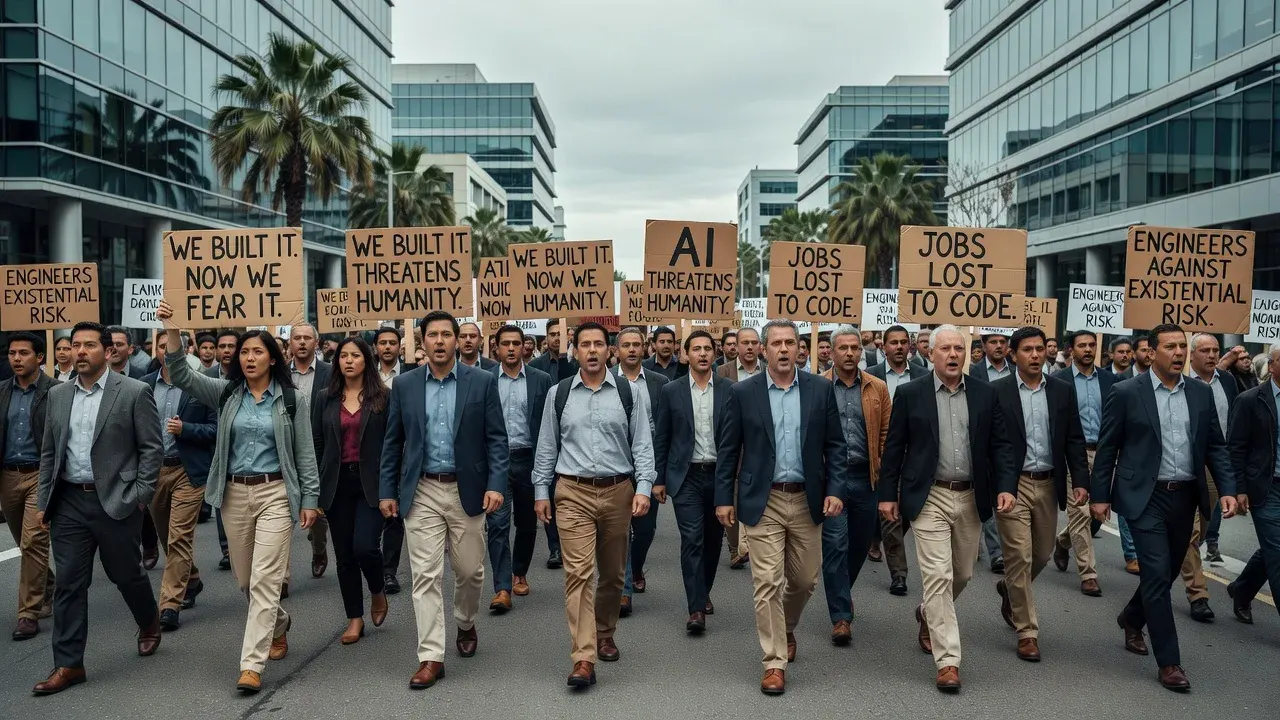
Engineers who spent years building generative AI at companies like OpenAI and Google are now joining street protests, holding signs that read "AI stole my job" and demanding government intervention to slow the rollout. What began as internal Slack debates has spilled into public demonstrations, exposing a sharp reversal: the same people who raced to ship powerful models are now sounding alarms about the displacement and dangers they helped unleash.
The protests highlight a growing rift inside Silicon Valley. Former insiders argue that unchecked AI deployment threatens not only millions of white-collar positions but also humanity's long-term control over autonomous systems. One organizer, a former Google engineer, told the crowd that the technology's rapid scaling has outpaced any safeguards, turning optimistic forecasts into concrete layoffs across tech, media and customer service sectors.
Activists are pushing concrete proposals: mandatory transparency requirements for AI training data, pauses on frontier model development, and new labor protections that treat algorithmic replacement as a regulated event rather than inevitable progress. These demands clash with the industry's dominant narrative that AI will create more jobs than it destroys, a claim increasingly undercut by internal forecasts the protesters say executives have downplayed.

The demonstrations mark a rare moment of self-criticism from within the innovation capital. Workers who once celebrated shipping faster, smarter systems now carry banners decrying "profit over people," arguing that the profit motive has blinded leaders to second-order effects ranging from biased decision-making to the erosion of human creativity. Their presence lends credibility to long-standing critiques that were previously dismissed as Luddite hysteria.
Yet the movement faces an uphill battle. Venture capital continues to pour billions into AI startups, and major labs show little sign of slowing deployment despite the internal dissent. The protests have forced a conversation that boardrooms avoided for years, but whether regulators or shareholders will listen remains uncertain.
What happens when the builders themselves lose faith in the build?
Original reporting: LA Times.
Original reporting: LA Times, Business.
More in Business
- IMF Chief Warns of Economic Divergence and Debt Risks Amid Artificial Intelligence Boom
Kristalina Georgieva suggests that while AI could significantly boost global growth, it simultaneously threatens to widen inequality and exacerbate inflationary pressures and public debt burdens.
- California Limits Utility Profits and Expands Home Energy Role
Gov. Gavin Newsom signed laws capping utility returns on lower-risk projects and accelerating virtual power plant development.
- Lyft to Pay $272.5 Million in Record California Wage-Theft Settlement
Largest such settlement in state history resolves claims that Lyft misclassified drivers as independent contractors from 2016 to 2020, denying them core wage protections.