

The Hidden System Saving California From the Next Water Crisis
Lake County tests portable hydrants as state agencies fail to update water codes for wildfire

The air in Lake County tastes of pine and ash, a constant reminder of the wildfire season that has scorched two-thirds of this rugged, remote county in less than 15 years. As the Lucas Fire tore through Mendocino and Lake Counties, a scene unfolded that defied the old ways of fighting fire. Two portable fire hydrants sprouted from Lake County’s Keeling Park. They pumped water directly from Clear Lake, a visual testament to a homegrown solution to a problem the state is only beginning to reckon with. This was the first test of an alliance built by Fire Chief Willie Sapeta. No state agency required it and the state did not pay for it. Yet as flames consumed dry brush and threatened homes, these pumps offered a lifeline that traditional infrastructure lacked.
The situation in Lake County is not an isolated anomaly. It is a symptom of a broader crisis gripping California. Wildfires have burned vast swaths of the landscape, straining already overburdened water systems that were never designed for the intensity of climate-fueled conflagrations. When lightning struck and the Lucas Fire sparked, Chief Shannon Banks of the Northshore Fire Protection District did not wait for permission. He called local water companies to set up the new hydrants. “We always in the past have looked for alternative water sources,” Banks said. “These pumps just make it a lot easier.” The scene at Keeling Park was chaotic and dangerous, but it was also necessary. It proved that without a specific mandate or funding from the state, local leaders must improvise.
The failure of water systems became painfully obvious nearly two years ago during the catastrophic Eaton and Palisades fires in Los Angeles County. Everyone from wealthy developer Rick Caruso to then-President-elect Donald Trump wanted to know where the water was. The questions fueled a cycle of misinformation and blame. Gov. Gavin Newsom called for an investigation and directed state water and fire officials to identify measures that local governments can implement to provide adequate water supply for emergency response. The report that dropped last November concluded that Los Angeles’ water supplies were robust. However, the report noted that local water systems are not designed to suppress “firestorm conditions impacting an entire neighborhood of homes at the same time.”

Despite the report, state agencies have not issued specific recommendations or guidance beyond the basics. “There’s no rules, there’s no guidelines or best practices that are out there, much less a clear delineation of responsibilities,” said Gregory Pierce, director of the UCLA Water Resources Group. Pierce urged the state to start collecting information that could inform guidance or best practices. “I don’t want a rush to just create draconian standards (so) the Legislature can high five themselves.” The gap has left local fire services and water suppliers on their own to figure out how to fight the growing threat of wildfires in their own communities.
Willie Sapeta, fire chief of the Lake County Fire Protection District, knows the challenge firsthand. He led a strike team deployed to Altadena last January, when the Eaton Fire killed 19 people, injured firefighters and razed entire neighborhoods. “Eaton Fire rocked me a little bit,” Sapeta said. “I’m in downtown Altadena, and I have no water. So we pulled from swimming pools.” The logistics of fighting a fire without a reliable water source are grueling. “But the turnaround time for getting domestic water was about 45 minutes to an hour with a water tender,” he said. That, he said, cemented his decision to find a new strategy for Lake County. “It was really after the Park and the Eaton Fire that it really came to light. It’s like, how prepared are we?”
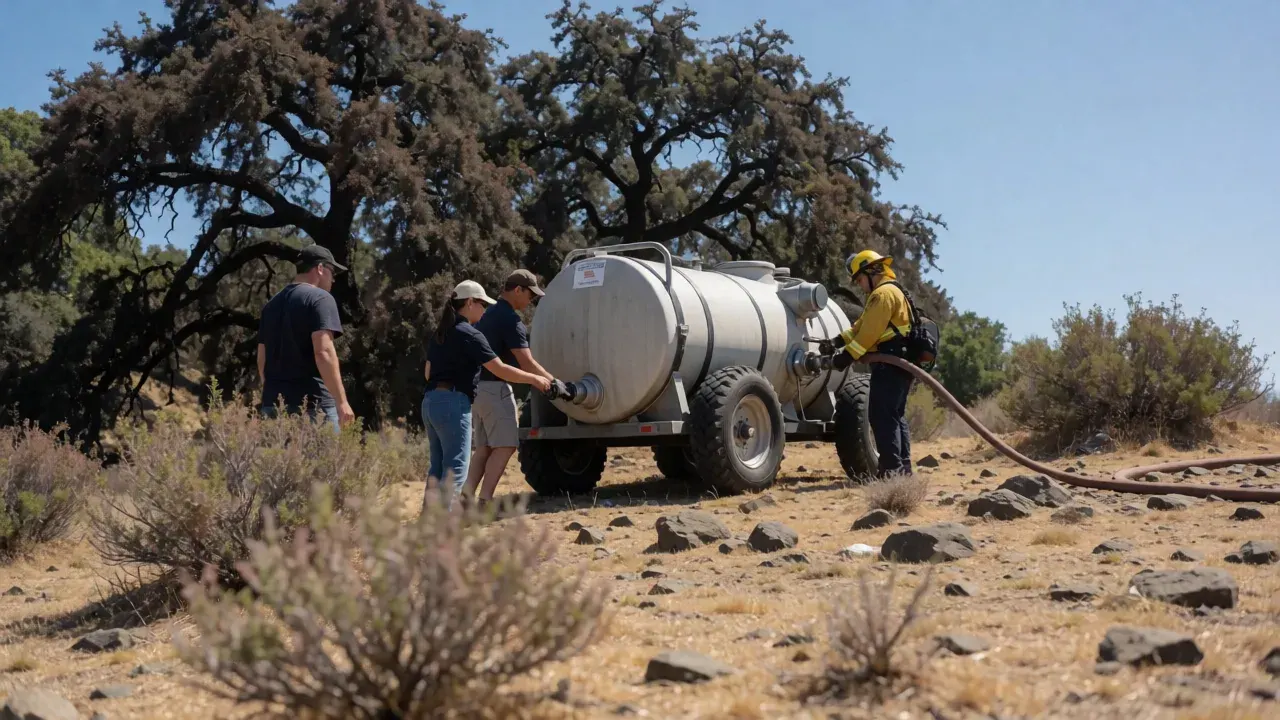
Firefighters and other workers learn how to use remote hydrants on the shore of Clear Lake in Clearlake Oaks on Aug. 27, 2026. The tactile experience of connecting hoses to makeshift pumps is a stark contrast to the high-tech battle against climate change. Sapeta grew up in Lake County, started working as a volunteer firefighter in high school, maintained hydrants and knows the local contractors who run water tenders. When he became fire chief, he found himself coordinating an effort to run hoses from one water system to refill another that was hemorrhaging water during wildfire. Sapeta remembers the homes and buildings destroyed in each fire he’s fought, roughly 3,200 countywide from 2012 through 2024. “Every house has a name and a face to it,” said Sapeta, tall and soft-spoken. As the fire count mounted, the water companies in Sapeta’s district began meeting more frequently with his firefighters, crafting plans to keep their storage tanks filled and staff on-call during red flag days, when the air itself feels ready to ignite.
The coalition plumbed raw water hydrants and built connections between their separate systems. Other water suppliers and fire agencies joined in, expanding the alliance across the county. But the fires kept coming, and as they grew, Sapeta worried that though his district had prepared, his county still wasn’t ready. In 2024, Sapeta deployed to the foothills north of Chico during the Park Fire, which burned nearly 430,000 acres. For weeks, firefighters Sapeta supervised used portable tanks and water tenders and pumped from a creek to fight the flames. Then, in January 2025, came Eaton and Palisades. In the Northshore district, Banks saw the same conversation play out after the Los Angeles fires. “People got scared, and the public started asking questions … Who’s maintaining this? And who’s responsible for that? A lot of the questions are hard to answer, because the laws are vague.”
California’s towns and cities built their water supplies generations ago to supply houses and businesses. The state has fire codes, flow requirements and emergency water standards. But these are aimed at putting out structure fires and ensuring water access for firefighters in remote parcels and subdivisions, not fighting climate-fueled conflagrations in neighborhoods. Lawmakers have taken stabs at closing this gap. One law by Assemblymember Steve Bennett, a Democrat from Oxnard, requires water providers in fire-prone parts of Ventura County to secure enough backup power or water to keep running for 24 hours. But Bennett’s attempt this year to require more detailed fire preparedness information from water suppliers statewide failed after substantial opposition from business groups and water agencies. “I thought the reporting would give us the information that would help us have a well-informed, next-step policy. But instead, they didn’t want to reveal that information,” Bennett said. Opponents feared the bill would “set a new and unrealistic standard on public water suppliers and would increase legal liability following a wildfire event,” and said another measure by state Sen. Anna Caballero was more practical, according to a bill analysis.
The Merced Democrat’s bill, still awaiting Newsom’s signature, requires larger urban water suppliers to add wildfire-specific procedures to their existing disaster preparedness plans. It also clarifies that dwindling supply and flagging pressure shouldn’t “be considered a substantial cause of the damages resulting from a wildfire.” But the bill fails to reach smaller rural water agencies like many in Lake County. And it doesn’t pay for upgrades. In fact, over and over, California lawmakers rejected, or, in one case, Newsom vetoed, bills that would have directed grants to water suppliers in places especially at risk for fire. Cal Fire said state agencies do offer guidance and money. The Department of Water Resources said it’s funded a number of projects, including upgraded mainlines serving homes and fire hydrants on the Tuolumne Rancheria, with more funding opportunities coming. But Pierce, of UCLA, was skeptical. “I get annoyed at this point because yeah, you can name some funding programs that you could theoretically get money from. But it won’t happen. So you need to do something different.”
Bennett’s own attempt to create a matching grant program to help rural water systems prepare for wildfire died in the Senate last fall despite overwhelming support from local governments and water suppliers. Bennett said he doesn’t know why. The landscape of Lake County is changing. The portable hydrants at Keeling Park stand as a physical reminder of the risks. They also stand as a statement of local autonomy. As the state debates the next steps, the firefighters on the ground continue to build the systems that will keep their communities safe. The Lucas Fire proved that when systems fail, ingenuity can fill the gap. However, the question remains whether the state will eventually provide the roadmap and resources to make that ingenuity a standard part of California’s wildfire defense.
First reported by CalMatters.
More in California
- UC Berkeley Lab Proposes New Civic Framework for California’s Next Governor
A research-driven agenda calls for institutionalizing 'co-governance' to address low public trust and lack of resident influence in state decision-making.
- Five Tax Measures on California’s Ballot Aim to Reshape State Finances
Propositions 3, 40–43 would alter income, wealth and local taxation rules—marking the highest number of tax measures on a general election ballot since 1994.
- Catalina Helicopter Crash Highlights Risks of Island Medevac Flights
A medical evacuation chopper carrying Catalina Romero, pilot, and nurse Jessica Devries crashed into the ocean shortly after takeoff, killing all three; federal investigators are assessing causes including night flying, spatial disorientation, and the island’s challenging Pebbly Beach heliport.