

The $65 Million Studebaker Experiment: Why Long Beach Citizens Call the New Bike Lanes 'Malicious'
The city transforms five miles of road into a Dutch-style dream, but the construction dust and cost are turning neighbors into critics.

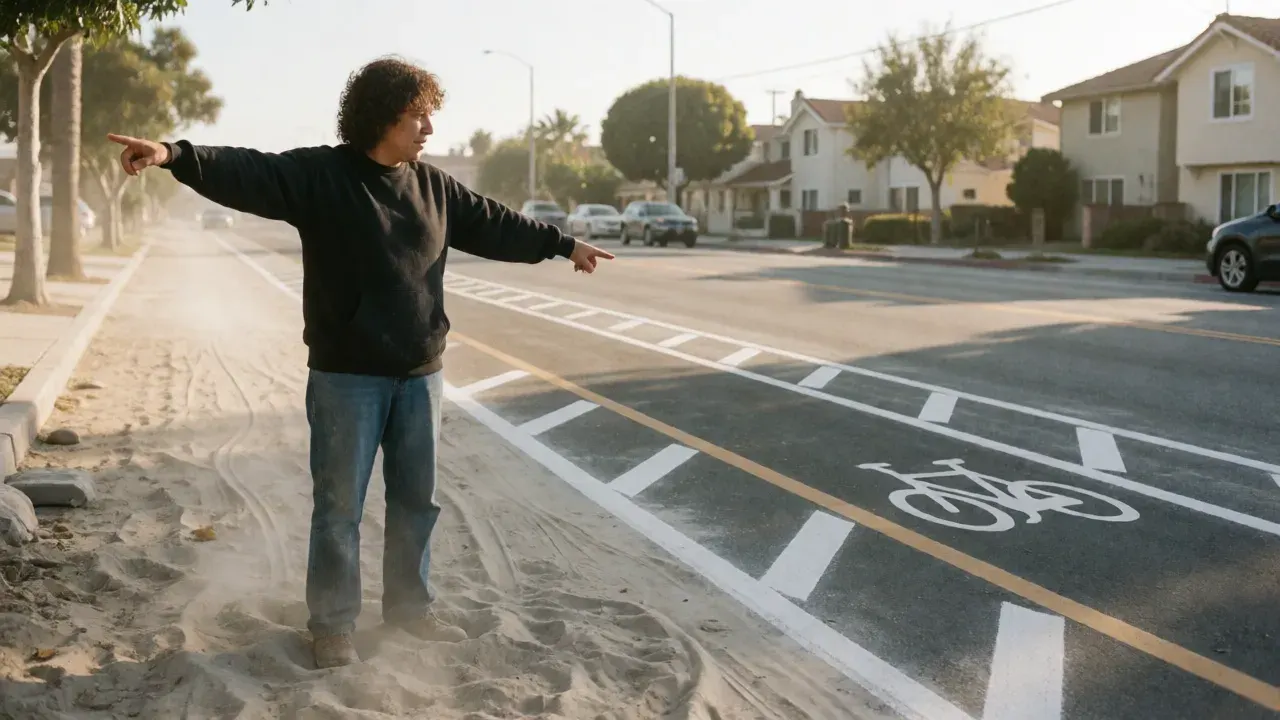
The asphalt here radiates a fierce Southern California heat, a tangible reminder of the reliance on internal combustion engines that has defined this city for decades. Yet beneath the exhaust and the noise, there is a distinct architectural shift taking place. Officials here are attempting to rewrite the physical layout of the city, aiming to create a network of roomy, landscaped bike lanes that resemble a European dream. This vision is not just a pipe dream but a multi-million-dollar infrastructure overhaul currently unfolding on Studebaker Road. The goal is to transform Long Beach into a top-five global cycling city by adopting a plan that was first drafted 25 years ago. However, as the concrete pours and the dust settles, the implementation of this ambitious plan has sparked a fierce debate about cost, practicality, and the very soul of the city’s streets.
At the center of this transformation is the $65-million Studebaker Road Transformation Project. This massive endeavor stretches over five miles, connecting 2nd Street at one end and Carson Street at the other. It serves as the centerpiece of a larger strategy to knit together 300 miles of bikeways by the year 2040. The project is not an isolated event but part of a broader puzzle funded by a consortium of 13 federal, state, and local agencies. It includes specialized greenways, a unique stonescape, and even fiber-optic cable running beneath the surface. Despite the grandeur of the vision, the project has drawn criticism from those who live and drive along the corridor. One resident, who drives the road six days a week, described the intent of the design as malicious and immoral. This critique reflects a growing frustration among drivers who feel that non-users are dictating the rules of the road.
Former city traffic engineer Paul Van Dyk helped usher in the current traffic-calming street plan, bringing with him a specific rationale for the design choices. One of the most contentious elements is the bike lane width. The new lanes are nine feet wide, compared to the old six-foot-across version. Proponents argue this allows riders to travel two abreast for a better ride and makes them easier to clean. Debris-filled lanes have long been a sore spot for cyclists, and the city learned that its old bike lane sweeper was notoriously difficult to move and use. A new approach uses concrete medians instead of the green bollards that were previously used on Bellflower Boulevard and Studebaker. These old green bollards often got hit by cars and could resemble thick blades of stomped grass. Residents did not like the way they looked, and officials agreed with their frustrations, leading to the shift toward more durable concrete solutions.

The physical changes to the road go beyond just the lanes. The project features raised bus stops that are about five inches off the ground and separated from the road by a curb. Buses will stop in the No. 2 lane, halting traffic behind them, while cars wait for the bus to pick up passengers. Van Dyk explained that this system evolved from talks with Long Beach Transit, which revealed that buses would sometimes get hit when pulling into traffic. The logic is simple, he argues. It comes down to a math problem a second-grader can understand. “What’s better, 40 people on a bus wait or four people in cars,” Van Dyk asked. “Which is the greatest cost to society? The bus is going to be more efficient.” He contends the new system is safe because there is less ambiguity. A bus slowing down in front of a car is more likely to be seen than a bus easing out of a turnout.
Despite the engineering logic, the reality on the ground has been messy for some. David Raslevich, a 41-year-old cyclist who frequently rides on the new lanes on Clark Avenue, has noticed branches, leaves, and other debris accumulating in the protected space. He feels safer riding with the traffic because cars move debris out of his way. However, he has also seen cars turn into the curb by the raised bus stop, hitting the island pretty much daily. This suggests that drivers are still adjusting to the lowered curbs. “They don’t know that there’s an island there,” Raslevich noted. Similar issues have been observed on the Clark Avenue work, where new bus lane curbs show missing chunks likely caused by drivers who did not see them.
For Long Beach Fourth District Councilmember Daryl Supernaw, the project represents a necessary evolution. His district encompasses the $65-million project, and he had reservations about the price tag before ultimately supporting it. “All anyone asked for is a repave, to get rid of potholes and have a smooth surface to drive on,” Supernaw said. The city decided to use the grant money for bike lanes rather than just doing a straight repave. The vision is to weave together state and federal grants with $8.5 million in local sales tax money to improve how all people can move through the city. The city’s Public Works Department emphasizes that the work is not just for recreational cyclists. “It’s not just ‘I wanna ride a bike for fun.’ People need it to get to work,” said Jocelin Padilla, a spokesperson for the department.
Community engagement has been a mixed bag for the city. A series of community meetings in 2024 drew limited feedback. However, when residents saw painted pavement markings showing the planned curbs and bike lines, they got involved in a big way. “We call this communication via spray paint,” Supernaw quipped. Constituents see lines marked out and contact the council office. This grassroots response highlights the disconnect between the planning phase and the on-the-ground experience for residents. The physical presence of the project has created significant hardships for some neighbors. Leslie Goldman, who lives near Studebaker and Stearns, pointed out that large piles of dirt have at times been higher than cars. These piles have blocked residents from crossing the street or seeing oncoming traffic.
The
First reported by LA Times: California.
More in California
- UC Berkeley Lab Proposes New Civic Framework for California’s Next Governor
A research-driven agenda calls for institutionalizing 'co-governance' to address low public trust and lack of resident influence in state decision-making.
- Five Tax Measures on California’s Ballot Aim to Reshape State Finances
Propositions 3, 40–43 would alter income, wealth and local taxation rules—marking the highest number of tax measures on a general election ballot since 1994.
- Catalina Helicopter Crash Highlights Risks of Island Medevac Flights
A medical evacuation chopper carrying Catalina Romero, pilot, and nurse Jessica Devries crashed into the ocean shortly after takeoff, killing all three; federal investigators are assessing causes including night flying, spatial disorientation, and the island’s challenging Pebbly Beach heliport.