

Tesla’s China Recall Reveals a Simple Fix for a Deadly Door Problem That US Regulators Missed
California regulators are asleep while Tesla fixes a defect elsewhere.

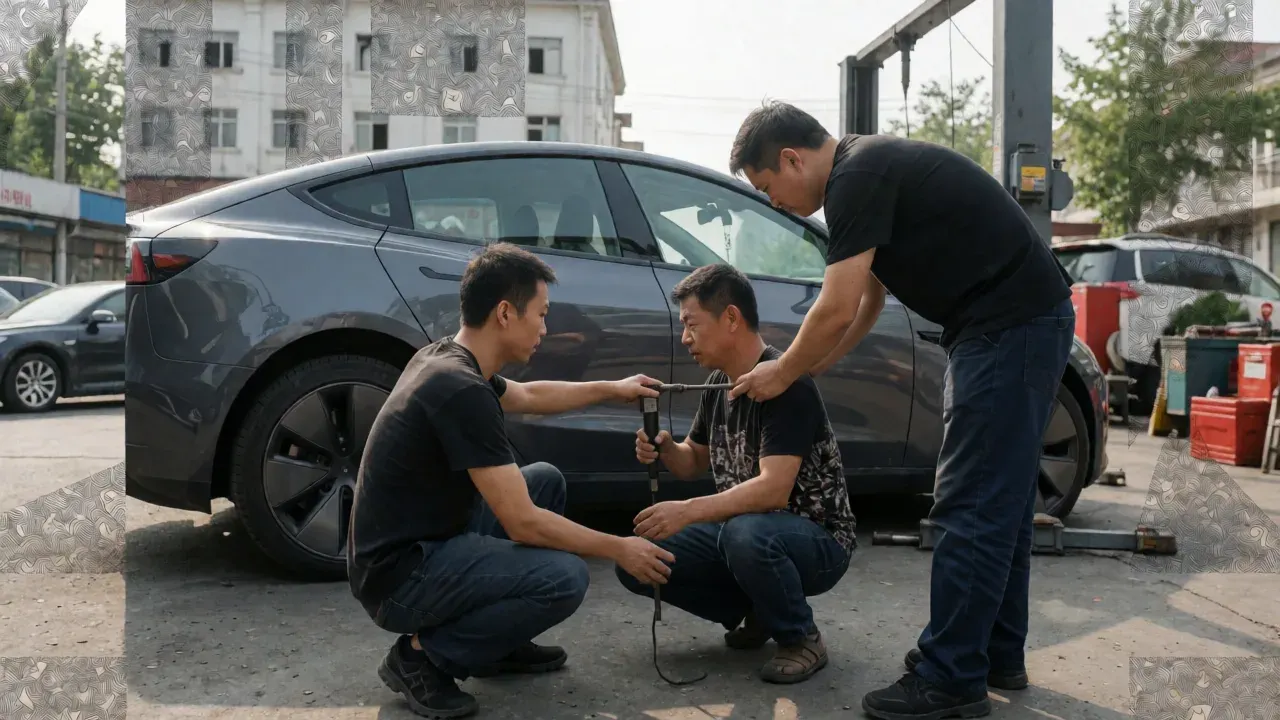
Elon Musk’s company finally admitted it. Tesla filed a recall with China’s State Administration for Market Regulation covering nearly 3 million vehicles. In a public filing, the automaker admitted that the emergency mechanical door releases inside its cars are too hard to find and operate. The company stated that interior trim colors make these critical releases blend in. It admitted that without power, occupants might not escape. This is a huge admission for a company that treats its design choices as gospel.
The filing details a specific hazard. In an emergency such as a severe collision, the electronic door releases may impede occupants from quickly opening doors. It creates a safety hazard when the vehicle’s low voltage system fails. The Chinese regulators demanded a fix. Tesla agreed to add warning labels and a software update. China’s new door handle standard, published in January, is even more specific. It requires a permanent symbol in sharp contrast with its background. It must be unobstructed and clearly visible at night. This is a stark contrast to the current situation in the United States.
I have spent years as an attorney arguing that Tesla’s doors are defective. I currently represent the family of a college student who died in a 2024 Cybertruck crash in Piedmont. Two other people died in that crash. Our complaint alleges that the occupants survived the impact only to die in the fire. They could not get the doors open. The case is in the early stages of discovery in the Superior Court of Alameda. Bloomberg has documented at least 15 deaths in the United States involving Tesla doors trapping occupants. The heart of our case is not what caused the crash in Piedmont, but our contention that design choices led to people being trapped inside the vehicle once it caught fire.

The remedy Tesla agreed to in China is a label and a software update. A label is no help in a dark, smoke-filled cabin to someone who has never practiced finding it. A window does not lower if the impact knocks out the power. The real fix is a mechanical release. China’s new regulations require flush exterior door handles to be paired with an independent mechanical release. This can open the door without power. By Jan. 1, 2027, newly approved vehicle models in China must meet all requirements except the hand-operating-space rule. That exception closes on Jan. 1, 2028. By Jan. 1, 2029, China will require all vehicles already on sale to be retrofitted into full compliance.
Currently, when a crash or fire cuts low voltage power, Tesla’s flush exterior handles become inoperable. Though manual releases exist inside the vehicle, they are not easy to find. Occupants can be effectively trapped in a sealed box. Tesla’s owner’s manual for the 2017 through 2023 Model 3 states that only the front doors have a manual release. The Model Y manual states that not all Model Y vehicles have a rear one. The company later added rear releases in awkward places. They are behind a speaker grille in a Model X and under a map-pocket liner in a Cybertruck. None of them were labeled or intuitive.
Last September, Tesla’s chief designer, Franz von Holzhausen, stated publicly that the company was working to combine the electronic and mechanical releases into a single control. However, the company has not announced plans to bring that design to the millions of Teslas already on American roads. This is a political choice. The company prioritizes aesthetic minimalism over human survival. Regulators in the U.S. have not moved quickly on this issue. In July, the National Highway Traffic Safety Administration granted a petition to begin writing a federal rule on emergency door egress for all automakers. The agency stated that a vehicle with electric handles and no accessible mechanical release creates a risk to safety when the electric door handle becomes inoperative due to loss of power.
“The potential risk for entrapment,” the agency added, “can result in a severe injury or death of the operator and other occupants of the vehicle.” But granting a rulemaking petition is not the same as issuing a rule. The door-egress standard is not on the agency’s 2026 regulatory agenda. Safety advocates note that comparable vehicle safety standards have taken as long as 15 years to finish. Meanwhile, administration Administrator Jonathan Morrison has said the agency would consider dropping the steering-wheel requirement for purpose-built robotaxis. The agency is quick to entertain removing a safety requirement in the name of innovation and slow to impose one in the name of escape.
Cars sold in China are not worse than those sold in the U.S. The difference is that China swiftly wrote and adopted a rule requiring a mechanical release inside and outside every door. Congress does not have to wait for the traffic safety agency to act. The SAFE Exit Act cleared the House Energy and Commerce subcommittee in February. Its provisions passed the full committee with a 48-to-1 vote in May as part of the Motor Vehicle Modernization Act. It would require what the agency is only now willing to consider. It would require a power-independent manual release in every door. It must be something that ordinary people can find and operate. It must also include a way for first responders to reach trapped occupants when power is gone.
If you drive an electric car, go find the manual release for the rear doors. Time yourself. Then imagine doing it in the dark, blinded by smoke, with the power gone. People who survive collisions should not die in the aftermath because they are trapped in their cars. I urge the National Highway Traffic Safety Administration to expedite its work and require a real mechanical remedy here. I also urge the House to advance the SAFE Exit Act before more people die inches away from a door they cannot open.
First reported by r/bayarea.
First reported by r/bayarea.
More in California
- UC Berkeley Lab Proposes New Civic Framework for California’s Next Governor
A research-driven agenda calls for institutionalizing 'co-governance' to address low public trust and lack of resident influence in state decision-making.
- Five Tax Measures on California’s Ballot Aim to Reshape State Finances
Propositions 3, 40–43 would alter income, wealth and local taxation rules—marking the highest number of tax measures on a general election ballot since 1994.
- Catalina Helicopter Crash Highlights Risks of Island Medevac Flights
A medical evacuation chopper carrying Catalina Romero, pilot, and nurse Jessica Devries crashed into the ocean shortly after takeoff, killing all three; federal investigators are assessing causes including night flying, spatial disorientation, and the island’s challenging Pebbly Beach heliport.