Tape Night in Portland
A sold-out Cinemagic screening, regional swaps, a large tape shop and a 2027 move show how physical media is kept public in one Oregon city.

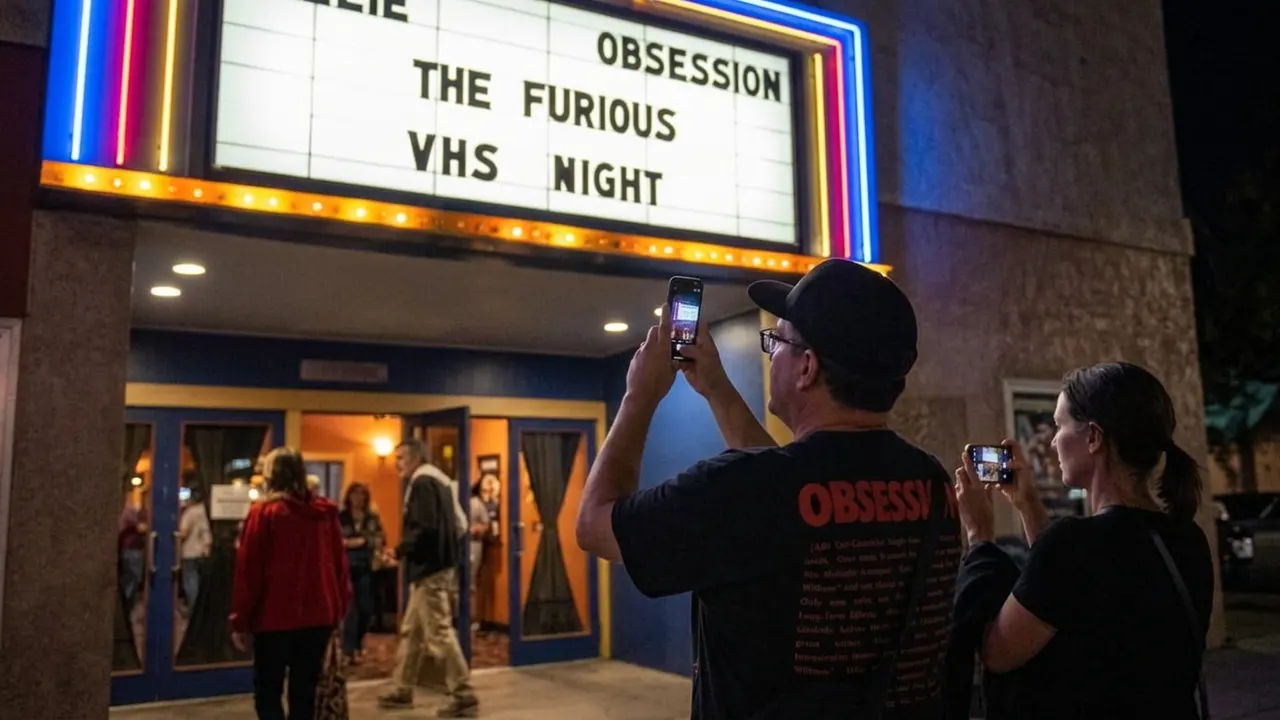

On a hot August evening in Southeast Portland, moviegoers lined up under the Cinemagic Theater marquee and filled its single auditorium. The draw was not a new summer release but VHS Night, a first-Friday gathering built around the 1996 horror film Bad Moon. Co-owner Ryan Frakes told the crowd that a 35mm showing of Oppenheimer had not sold out, while the werewolf movie on tape had. Then he asked whether the audience was ready to start the VCR. The room had come for the format as much as the film. [1]
For nearly five years, Frakes and co-owner Nicholas Kuechler have used the monthly slot to screen features and trailers from VHS cassettes that might otherwise sit outside circulation. Their slate has included Rumpelstiltskin and Shakma, plus Philippe Mora’s Pterodactyl Woman from Beverly Hills. Frakes described Bad Moon as an underseen movie with his favorite werewolf design. The program is built around titles that might otherwise be lost to time and obscurity. [1]
The projection booth makes the method visible. A single VCR rests on a music stand alongside the theater’s digital and film projectors. When a tape wobbles or jumps, the audience treats the flaw as part of the show; OPB reports that the crowd enjoys the imperfections. The setup is physical: the movie is not a file but an object with a temperament. [1]
The monthly screening has regulars. Frakes said he knows at least 20 people by name who return each month and that relationships form around the event. Olivia Salazar, who has attended with her husband Romeo, described Cinemagic as an important community hub, particularly after the pandemic. She said a room full of people sharing a movie offers something streaming alone cannot. Their wedding party at the theater paired Brainsmasher…A Love Story with Voyage of the Rock of Aliens. [1]
Advertisement
That wedding party is one measure of attachment. Another is Salazar’s description of Portland as a strong movie town. The evidence here is local and specific: a single-screen theater, a monthly tape night, a crowd that knows the host and the format. It does not show that every city has the same appetite. It shows one place where the appetite has a standing date. [1]
OPB describes the monthly event as a pillar of Portland’s VHS scene and notes that the analog revival may look recent while VHS culture has been active for years among Northwest cinephiles and collectors. The supporting institutions are varied. Regular tape swaps take place at bars such as Cult Classics, a VHS-themed establishment where cassettes and old analog televisions decorate the walls. Neighborhood lending libraries run tape exchanges, and a VHS-themed haunted house exists. Hundreds of titles at the rental store Movie Madness are scheduled to move to a new Hollywood District home in 2027. [1]
Retro Release Video adds a production strand. Portland artist Billy Organ runs the operation and works with studios to issue officially licensed VHS editions of new and reissued films. Organ said he has seen more younger viewers turn toward tape and analog horror. He framed the format as a rejection of synthetic, AI-generated material and said holding a movie is unfamiliar to young people who are used to intangible access. That is Organ’s account, not a measured market trend. [1]
Collectors and vendors offer overlapping explanations. Bill Kilby, who runs the Portland pop-up shop Pictureshow Collections with his wife, said the present feels frightening to many people amid political and environmental uncertainty. He sees millennials and Gen Z film fans reaching for media that feels simpler. Pictureshow appears at regional swaps with dozens of tapes, including The Mummy starring Brendan Fraser and Oregon-shot titles such as Stand by Me and The Goonies. Hillary Buckholtz, his partner in the business, said the work involves cleaning, testing and restoring tapes that some people treat as refuse, so the cassettes can circulate again. [1]
Advertisement
Ownership is another theme. Alex Burnett, who helped start the horror podcast Brothers in Blood, said people value owning media and not having to sort out which subscription holds a given title. He also acknowledged a tradeoff: tape is less sharp than other formats and lesser than Blu-ray. What he values is the grain, the hum of the television and the grittiness. The source does not show how widely that preference is shared. [1]
The appeal lands against a streaming landscape the source describes as increasingly expensive and crowded with choices. For tape users, ownership means the movie is not subject to a subscription decision. That does not make VHS superior by default; Burnett’s own comparison puts Blu-ray ahead on image quality. It makes tape a different bargain: lower fidelity, more control and a physical object in hand. [1]
VHS is the vintage video format of the 1980s and 1990s. Many popular horror films from those decades first reached viewers on cassette, and OPB names Halloween III, The Thing and They Live as collector favorites. Alex Burnett, co-founder of Brothers in Blood, and his brother Logan founded Drive-In of the Dead, one of the larger tape swaps in the Portland region. This year’s edition at the 99W Drive-In in Newberg brought 55 vendors together around horror. Logan Burnett said the genre’s fans value practical effects and tangible media, qualities he associates with tape. [1]
The swap’s scale is concrete but bounded. Fifty-five vendors at a drive-in is a regional market, not proof of national demand. The source does not report attendance, revenue or repeat rate. What it documents is a gathering organized around horror and physical media in a region where collectors already have habits. That is enough to show activity; it is not enough to show a boom. [1]
Advertisement
Variety Records shows the retail side. The Southeast Portland shop stocks DVDs, Blu-rays, vinyl, CDs and a large VHS inventory. Co-owner Gilbert Zimmerle said there must be at least 25,000 VHS movies in two rooms alone, probably 10,000 titles. He runs the store with Richard McClellan in the Foster-Powell neighborhood; the two men were 65 and 71 at the time of the reporting. Zimmerle called the shop a passion project of a lifetime. [1]
The store opened in 2004 from Zimmerle’s personal collection of 10,000 records. Movies followed when Blockbuster and Hollywood Video locations closed and a large tape collection arrived. Zimmerle described preserving physical media as a life mission and sharing it with younger film fans as the point. He said the media had never left and had not died in his world, and that he would keep trying to save it as long as he could. That is one person’s commitment, not an institutional guarantee. [1]
The preservation labor across these sites is human-scale. A pop-up restores tapes. A shop co-owned by two men holds tens of thousands. A theater gives one night a month to the format. A swap fills a drive-in with vendors. OPB does not give budgets, membership figures or a long-range plan. The reporting shows the work happening in public, but it does not show who would sustain it if the named individuals stepped away. [1]
The Portland scene matters because it turns a format into a recurring civic arrangement. A single-screen theater can sell out for a 1996 werewolf movie. Regulars become a community around a monthly date. A wedding party can be built around B-movies. A bar, lending libraries, a haunted house, a swap and a record shop all participate in keeping tapes visible. The evidence does not prove that every city could do this. It shows one West Coast city where the demand has places to go. [1]
Advertisement
It also matters because the revival is not only consumption. Organ’s licensed releases, Pictureshow’s cleaning and restoration, and Variety Records’ inventory all involve work around physical media. The source gives no revenue figures or growth rates, so describing a booming market would be an overreach. What can be said is that people are testing, restoring, selling, screening and swapping cassettes in public. That is an economy of care, but the source does not measure its size. [1]
There are limits in the source itself. Burnett calls tape lesser than Blu-ray on quality; the pleasure he describes is grain, hum and grit. The main institutions are small: a single-screen theater, a pop-up shop, a two-man record store. The source offers no evidence that these operations could absorb a much larger audience or replace streaming for most viewers. Nor does it show that younger buyers are numerous enough to sustain licensed reissues over time. [1]
Questions remain. How large is Portland’s VHS community? The source supplies vivid markers — a sold-out auditorium, 55 vendors, at least 20 named regulars, at least 25,000 tapes in two rooms — but no survey or attendance series. Those numbers describe specific sites and events. They do not establish a national trend, a stable customer base or a generational shift. The source also does not say whether the 2027 Movie Madness move will broaden access, disrupt rental habits or both. [1]
Cinemagic’s VHS Night remains a first-Friday fixture; the source does not name the next program. Watch whether the Bad Moon crowd becomes a repeatable audience and whether the theater’s community role deepens. Watch the scheduled 2027 relocation of Movie Madness’s tape titles to the Hollywood District. Watch the next Drive-In of the Dead and whether its vendor count holds. Watch whether Retro Release’s licensed tapes and the analog-horror interest Organ describes keep finding younger buyers. [1]
Scenarios, not forecasts: if the 2027 move and the monthly screenings reinforce each other, Portland could strengthen a durable physical-media scene. If the move disrupts rental access or the audience proves event-specific, the scene could remain a lively niche. The source supports neither outcome. What it supports is a present-tense fact: in Portland, VHS is not only a curiosity. It is a room people fill, a shelf people keep and a monthly date people hold. [1]
Sources
Prepared with AI assistance from the cited sources.
The Cali Reporter newsletter
The stories worth your time.
California, the country, and what comes next. Join our free newsletter for reporting that keeps you informed.
More in West Coast
- Diwali Celebration at Tigard Mandir Draws Large Crowd
Hundreds of people gathered at the BAPS Shri Swaminarayan Mandir in Tigard, Oregon, for a Diwali celebration featuring a large cultural exhibition and traditional offerings.
- Midterm Elections Shift State Legislative Power to Democrats
The 2022 midterm elections marked a significant shift in state legislative power, with Democrats gaining control in several states and ending long-standing Republican dominance.
- Boise State Secures Pac-12 Championship Host Spot
Boise State's victory over Oregon State on November 14, 2026, solidified their position as the host for the Pac-12 championship game, marking a significant milestone for the team.