Portland's School Closure List Shrinks to 10, but the $65 Million Hole Doesn't
Superintendent Kimberlee Armstrong's revised plan would shut five elementaries in 2027 and five in 2028, spare four campuses and keep Mandarin at MLK. The board votes Dec. 15; the budget gap waits for spring.


Portland Public Schools Superintendent Kimberlee Armstrong on Friday put a smaller closure list on the table: ten elementaries across two autumns, beginning with the 2027-28 year, down from earlier proposals that would have shut as many as 14. The school board takes up the recommendation Dec. 15, and community input sessions are scheduled to continue between now and then. This is a recommendation, not a decision, and the report does not say whether trustees may amend it or only accept or reject it. [1]
The first wave, if approved, would close Beach, Peninsula, Sabin, Creston and Buckman next fall. The same season would bring moves for several dual-language immersion programs and convert six K-8 campuses to K-5s. Beverly Cleary and César Chávez are on that conversion list, along with Faubion, Laurelhurst, Sunnyside and Vernon. [1]
A second wave in fall 2028 would close Rose City Park, Lewis, Marysville, Woodmere and Irvington. Bridger K-8 would become a K-5 then, and the focus-option program Odyssey K-8 would move to Forest Park Elementary. [1]
Four campuses would stay open under the revision: Sellwood Middle, plus James John, Maplewood and Stephenson elementaries. Sunnyside would keep its environmental focus designation even as it becomes a K-5. The Mandarin Dual Language Immersion program at Martin Luther King Jr. Elementary would remain in place. Armstrong said the revisions reflect what families, students and staff told the district. She described school closures and consolidations as personal and hard, and said the district remains fixed on the long-range needs of the whole system. [1]
Advertisement
The recommendation arrives more than a month after PPS presented two proposals to resize the state's biggest district, where enrollment has fallen 11% since 2019. The district has since held feedback sessions with students, families and staff. Support for closures exists in some quarters. So does anger: the district has taken heat for its handling of the process, and the result is broad mistrust across Portland. [1]
Closing schools has drawn objections from local elected officials and Gov. Tina Kotek, many of whom stress what a school means to its neighborhood. The report does not say how that opposition will affect the Dec. 15 vote, or whether the governor or city officials have proposed an alternative funding path that would spare buildings without cutting classrooms. [1]
Portland is not alone. Salem-Keizer's board is expected to take up its own closure plan next month, and districts nationally are rolling out closure plans tied to falling enrollment. The arithmetic is national; the attachment to a particular gymnasium, cafeteria and crossing guard is distinctly local. [1]
The budget does not wait for a two-year building plan. PPS forecasts a $65 million shortfall for the coming school year and will draft cost reductions next spring to balance the budget. A no vote on Armstrong's list would not erase that forecast; the financial picture stays bleak either way. Armstrong said maintaining the status quo will not protect students from the money problems ahead. What the report does not identify is what would fill the gap if the list fails — whether staffing, programs or classrooms absorb the spring reductions. [1]
Advertisement
The report also does not translate the closure list into dollars. It says rightsizing will lead to better allocation of resources and more balanced class sizes, but it gives no savings estimate for the ten schools, no per-building figure, and no explanation of how those savings would interact with the $65 million gap. A reader can reasonably ask whether the closures are meant to close part of that gap, or whether they are a separate exercise in staffing and class size that leaves the budget work for spring. The report does not answer that question. [1]
The district's case rests on promised gains: resources spread more sensibly, steadier staffing for counselors and social workers, and class sizes that even out. Those are claims in the report, not measured outcomes. No target ratios, distribution formula or definition of a balanced class appears in the account. Rightsizing, as presented, has a direction but no yardstick. [1]
Trust is the other deficit. The report describes months of strain, including a costly contract to farm out management of the district's bond program and worries about officials using the messaging app Signal. School closures, the report says, will only make that environment harder. It does not describe how the district plans to rebuild confidence while asking families to change schools, nor whether the board has sought additional oversight of the bond program or messaging practices. [1]
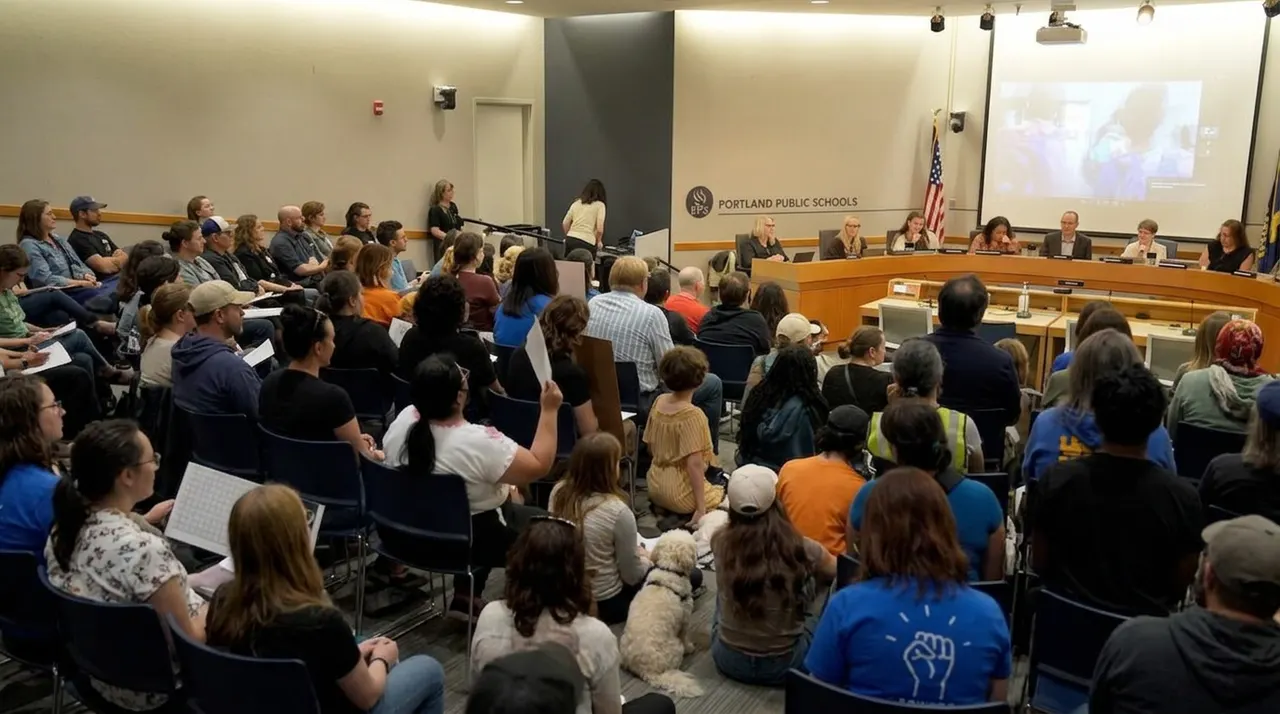
The public temperature showed at the Oct. 6 board meeting at the Dr. Matthew Prophet Education Center. The room was packed, and attendees attempted to enter; according to the report, they got past security and into the room. If civic affection can be measured by a strained door and a full chamber, Portland supplied it. The caption also catches Palikulani Soileau and Eliza Janowitch, both 7 and both second graders at Maplewood Elementary, holding hands at the meeting. Maplewood is one of the four schools the revised plan would spare. [1]
Advertisement
Staffing and students with disabilities are named as unknowns. The district promises tailored help for children whose schools close, whose programs move or whose boundaries shift, with extra attention to students who have Individualized Education Plans. The report does not say how staffing or disability services change, who delivers the help, on what schedule, or how success would be judged. [1]
Whether families will leave PPS for other educational options is another open question. Enrollment is already down 11% since 2019. The report does not link family departures to the spring budget, nor does it forecast whether closures would slow or accelerate that outflow. [1]
The report does not break the 11% decline down by grade level, neighborhood or program, and it offers no enrollment forecast for the years covered by the closure list. That leaves an obvious question: whether the 2028 closures rest on projections the public has not seen, and whether the district will publish them before the board vote. [1]
The dual-language details are thin. Several immersion programs would move in fall 2027, and the Mandarin program at Martin Luther King Jr. Elementary stays, but the report does not name the other programs, say whether students move with them, or describe what happens to their staff. Boundary changes are mentioned but not drawn. The report does not say how new attendance lines will be set or whether children at closing schools get priority at a receiving campus. Odyssey K-8's move to Forest Park Elementary raises a question the report leaves open: whether Forest Park has room and how the two programs would share a building. The same gap applies to the six K-8 conversions, where the report does not describe how middle-grade students are reassigned. [1]
Advertisement
The list is confined to elementary and K-8 buildings. Nothing in the report covers high school closures, and nothing describes what happens to emptied buildings — whether the district has a reuse plan, or whether an empty school becomes a budget asset or a neighborhood grievance. [1]
The report does not quantify the savings expected from closing ten schools, and it does not tie specific closures to the $65 million shortfall. The plan is described as producing better resource allocation, not a specific sum. If trustees reject the recommendation, the shortfall remains, and PPS would still need spring cost reductions. Rejection could change the closure list; the report offers no sign that it changes the financial outlook, and it does not describe a contingency plan that would spare schools while closing the gap. The four spared schools raise their own question: whether their reprieve is permanent or simply deferred, and whether the district will revisit them if enrollment projections shift again before 2028. [1]
Watch the Dec. 15 vote first. The recommendation is not a decision, and input sessions continue in the meantime. The report says trustees will accept or reject it; it does not say whether they can amend the list. [1]
Watch the input sessions between now and then. The report says community input sessions are scheduled to continue, but it does not say whether feedback gathered after the recommendation can change the list before trustees vote, or whether the board will publish the feedback and its response. [1]
Watch Salem-Keizer next month, where a closure proposal goes before its board, and watch the wider wave of districts nationally responding to declining enrollment. [1]
Watch the spring budget work. PPS projects a $65 million shortfall for the coming school year and will draft cost reductions then. Whatever happens to the closure list, that number does not disappear. [1]
Watch enrollment itself. The district has lost 11% since 2019, and the report lists family departures for other educational options as an open question. A scenario the report leaves open is that closures accelerate departures, which would make the projections behind the plan wrong in a painful direction; the report does not predict that outcome. [1]
Watch the promise of tailored transition help. In a district with a documented trust problem, that promise will be tested against schedules, bus routes and IEP meetings rather than a press release. The report says more community pushback is likely to follow; it does not say the plan will succeed or fail. [1]
The odd local detail is this: the state's largest district, down 11% in enrollment since 2019, has a recommended list of ten elementaries to close across two autumns, four spared buildings, a Mandarin program staying put, a middle school spared alongside three elementaries, and a $65 million gap that this proposal will not close on its own. [1]
Sources
Prepared with AI assistance from the cited sources.
The Cali Reporter newsletter
The stories worth your time.
California, the country, and what comes next. Join our free newsletter for reporting that keeps you informed.
More in West Coast
- Diwali Celebration at Tigard Mandir Draws Large Crowd
Hundreds of people gathered at the BAPS Shri Swaminarayan Mandir in Tigard, Oregon, for a Diwali celebration featuring a large cultural exhibition and traditional offerings.
- Midterm Elections Shift State Legislative Power to Democrats
The 2022 midterm elections marked a significant shift in state legislative power, with Democrats gaining control in several states and ending long-standing Republican dominance.
- Boise State Secures Pac-12 Championship Host Spot
Boise State's victory over Oregon State on November 14, 2026, solidified their position as the host for the Pac-12 championship game, marking a significant milestone for the team.