Oceanwide Plaza’s Paint Is Mostly Gone, but the Finish Still Rests on a Loan
The downtown Los Angeles complex has cleared most of its spray paint, yet completion still depends on a January bankruptcy closing, a construction loan and roughly $850 million of remaining work.

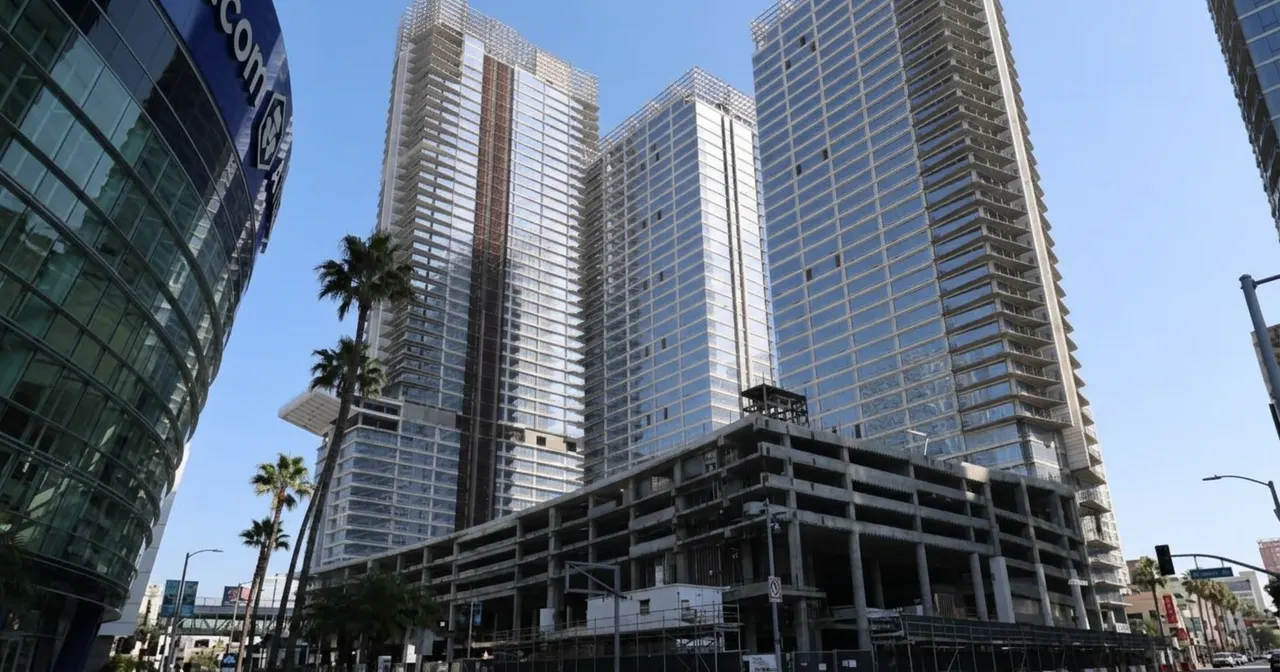

Crews have removed most of the spray paint from Oceanwide Plaza, the stalled downtown Los Angeles complex, but the job is not quite finished, the Los Angeles Times reported Nov. 12. City officials joined the expected buyers, KPC Group and Lendlease, at a Thursday event marking the cleanup. Paint had reached as high as 54 stories on the complex. Removal was a top city priority and a condition of the bankruptcy sale, which is set to close in January. John Petty, a KPC executive, said completion work would begin after that closing. The report gives no final cleanup date, cleanup budget or precise sale-condition language. [1]
Petty described removal as laborious, done by hand with a biodegradable solution. Most paint was applied by taggers who reached outdoor balconies in the two residential towers, he said. Some was sprayed on windows by people who sidled from balconies onto ledges little more than a foot wide. Crews could not safely reach those marks, so cleaners will next lower themselves on window-washing platforms known as swing stages. That explains why a celebration could occur while paint remains. The report does not say how many windows or ledges remain, how long the suspended work will take or whether the city will inspect the result before closing. [1]
The buyers intend to complete Oceanwide Plaza as designed, Petty said: 504 residential units, a luxury hotel and a shopping center in three skyscrapers across Figueroa Street from Crypto.com Arena and L.A. Live. He called the original design amazing and said the finished property would transform the area. Kali Chaudhuri, chairman of KPC Group, said removing graffiti was about more than appearance, restoring pride, rebuilding confidence and demonstrating commitment. Councilwoman Ysabel Jurado said the project promises housing, jobs, economic opportunity, investment and energy downtown. Those are stated goals, not completed outcomes. The report gives no opening dates, rents or hotel operator; it does state a $517-million bankruptcy sale price. [1]
The history explains the stakes. Beijing-based Oceanwide Holdings spent about $1.2 billion before running out of money in 2019 and halting construction at about 60% completion. Petty put the cost to finish at about $850 million. The expected buyers would pay $517 million in the bankruptcy sale. Closing depends on a construction loan, and Petty said the developers are negotiating financing terms with domestic institutional and private-equity lenders. The report does not name lenders, disclose terms, say how much equity the buyers will provide or give a loan amount. Those omissions leave the central capital variable unresolved. [1]
Advertisement
Early in 2024, taggers began turning the towers into canvases, the report says. BASE jumpers parachuted from the structures, and a performance artist recorded himself teetering on a one-inch-wide slackline strung between two 42-story towers. Reactions diverged. Some found the graffiti-clad towers an engaging art installation; other downtown residents and stakeholders regarded the paint as embarrassing blight that signaled disorder and unpunished mischief. The report does not quantify either view, say how long those activities lasted or report injuries. No police or injury data is included. Those details matter because the graffiti became both a visual problem and a test of control at a prominent site. [1]
The public celebration carried a civic message but did not resolve the capital question. For nearly two years, the stalled complex has been a visible sign of unfinished business downtown. City officials treated the paint as a priority, and the buyers presented its removal as evidence of commitment. Yet the work is not quite complete. The milestone removes most visible paint; it does not by itself establish that the sale condition is fully satisfied. Nor does it show that remaining construction is funded. The sale is still set for January, and financing remains a condition. Cleanup changes appearance; it does not change the need for a construction loan. [1]
The capital figures describe different things and should not be collapsed. The $517 million is the bankruptcy sale price described in the report. The roughly $850 million is Petty’s estimate of remaining work. Oceanwide’s earlier spending was about $1.2 billion before the 2019 halt at about 60% completion. The report does not reconcile these numbers into one project budget, say whether the completion estimate includes cleanup, financing costs or contingency, or allocate spending among homes, hotel and retail. It gives no final budget adopted by the buyers. It does not combine the sale price and completion estimate into a disclosed total. [1]
The arithmetic frames the tradeoff. The buyers would pay $517 million for a complex that consumed about $1.2 billion and, by Petty’s estimate, needs about $850 million more. The report does not say whether the sale price plus the completion estimate captures the full cost, how the buyers would fund the gap or what return they expect. Nor does it say whether the earlier spending is impaired, written down or carried at a different value. Those are financing and accounting questions, not cosmetic ones. The cleanup milestone does not answer them. [1]
Advertisement
The Olympic calendar adds a public target, not a guaranteed deadline in the report. Officials want Oceanwide Plaza completed before the summer 2028 Games. After the January closing, Petty said the buyers would aim to make the property presentable for the Games. Their plan includes a large electronic facade sign intended to bring a Times Square flavor to Figueroa Street. A new name is expected eventually, though none is given. The report supplies no sign design, dimensions, content or schedule beyond the stated hope. The Olympic timing is a hope, not a commitment; it does not say what happens if financing or building slips. [1]
Several questions remain unanswered. How much did graffiti removal cost, and when will the swing-stage work end? Will the bankruptcy sale close in January, and what size and terms will the construction loan carry? When would construction restart, and what completion date follows from the hope of finishing before summer 2028? What will the facade sign look like, and what name will replace Oceanwide Plaza? Who will operate the hotel? What will the 504 homes cost to rent or buy? These are questions, not outcomes, and the report supplies no answers. [1]
The report also does not specify loan security, the final project budget, residential pricing or the sign’s dimensions and content. It does not say whether the city has a remedy if the buyers miss cleanup or completion conditions. It does not say whether similar access to the towers remains open, a gap that bears on property condition and the credibility of the completion plan. Nor does it say whether the final cleanup must be finished before the sale closes. Those omissions are part of the record and show how much of the plan remains conditional. The sale price and the completion estimate are not a financing plan. [1]
For downtown, the tradeoff is visible but not quantified. The complex is planned to hold 504 homes, a hotel and retail across from Crypto.com Arena and L.A. Live. Unfinished, it has been a large, paint-covered sign of delay; the report says some residents and stakeholders saw it as blight. Completed, it would add the uses the buyers and officials describe. The report does not estimate the economic effect, the tax revenue, the construction employment or the effect on nearby property. Those are scenario questions, not established outcomes. [1]
Advertisement
The next checkpoints are the January bankruptcy closing, the construction-loan negotiation with domestic institutional and private-equity lenders, and the swing-stage removal of the last paint. After that, watch for the start of completion work, a new name and progress on the proposed sign. Concrete indicators would be a disclosed loan amount, a construction start date, a swing-stage completion notice, a new name, sign details and a hotel operator. Officials want the complex finished before summer 2028. The report does not say what happens if financing or construction slips, and it offers no alternative timetable. The January closing and the Olympic target are separate gates. [1]
The graffiti milestone is best read narrowly. It removes a visible sign of neglect and moves the property toward meeting a sale condition. It does not establish full satisfaction because Petty said the work is not quite complete. Nor does it show that the roughly $850 million completion estimate is funded, that the January closing will occur or that the Olympic target will be met. Those remain separate tests. The report supports the cleanup milestone and the stated plans; it does not support treating completion as assured. The celebration answers a visual question; it does not answer the capital question. [1]
The project’s future depends on documents and events not yet in the record: a construction loan, a closing, a construction restart and a new schedule. Until they appear, the safest reading is that the paint is nearly gone and the finish remains conditional. The buyers’ and officials’ statements describe what they intend to deliver. The numerical qualifiers—about $1.2 billion spent, about 60% complete in 2019, about $850 million still needed and a $517 million sale price—frame the size of the bet without resolving its financing. The next report should be checked against those numbers, not against the celebration alone. [1]
Sources
Prepared with AI assistance from the cited sources.
The Cali Reporter newsletter
The stories worth your time.
California, the country, and what comes next. Join our free newsletter for reporting that keeps you informed.
More in Business
- Nvidia CEO Resignation Sparks Market Volatility
The sudden resignation of Nvidia CEO Jensen Huang has triggered significant market reactions, with both the company’s stock and Bitcoin experiencing notable declines.
- Nvidia CEO Resignation Highlights Leadership and Governance Challenges
The resignation of Jensen Huang, CEO of Nvidia, has sparked discussions about corporate governance and leadership development, with insights from McKinsey's global managing partner, Bob Sternfels.
- Unocoin Suspends Services Amid Security Probe
Unocoin, an Indian cryptocurrency exchange, has suspended deposits and withdrawals following the detection of unauthorized activity and a potential breach of its systems.