NVIDIA Posts Show AI at Work in Recycling, Hospitals, Korea and Agent Security
The accounts describe pilots, deployed systems, a clinical study and announced or planned investments, while leaving performance and rollout questions open.

NVIDIA's newsroom and blog posts assembled here describe four separate technology stories: machine-vision sorting at recycling firms, a clinical-record tool used in a hospital study, announced and planned startup investments in Korea, and security software for autonomous agents. The material is published by NVIDIA or on its blog, so the performance figures and rollout descriptions are company or NVIDIA accounts, not independent audits. The posts span a pilot line, deployed robots, active systems, a research study, investment plans and exploration. The common element is AI applied to operational work. [1] [2] [3] [4]
The recycling post tied the startups to COP31's zero-waste focus in Türkiye. It put the recycled or reused share of material inputs below 7%. It said municipal solid waste exceeds 2 billion tons annually and could nearly double by 2050. NVIDIA's Josh Parker said AI can help identify recoverable material and automate sorting; the post describes that as a way to improve circularity. The examples are not one deployment. [1]
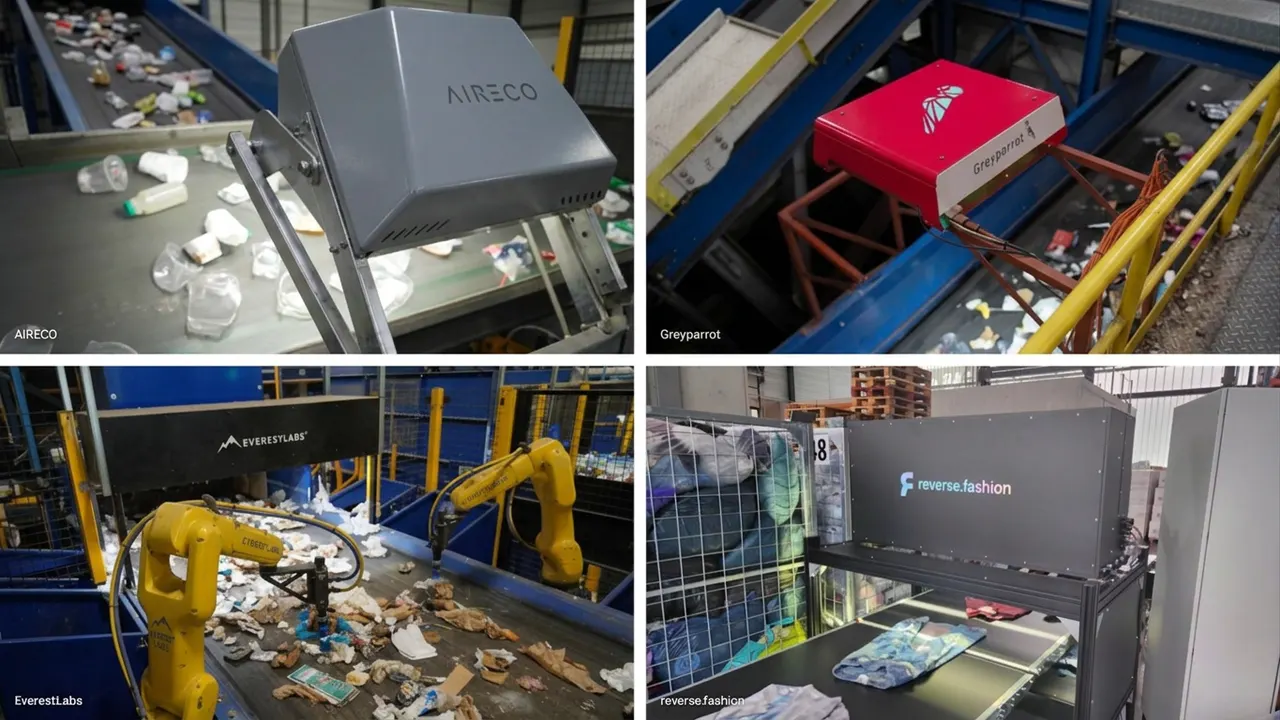
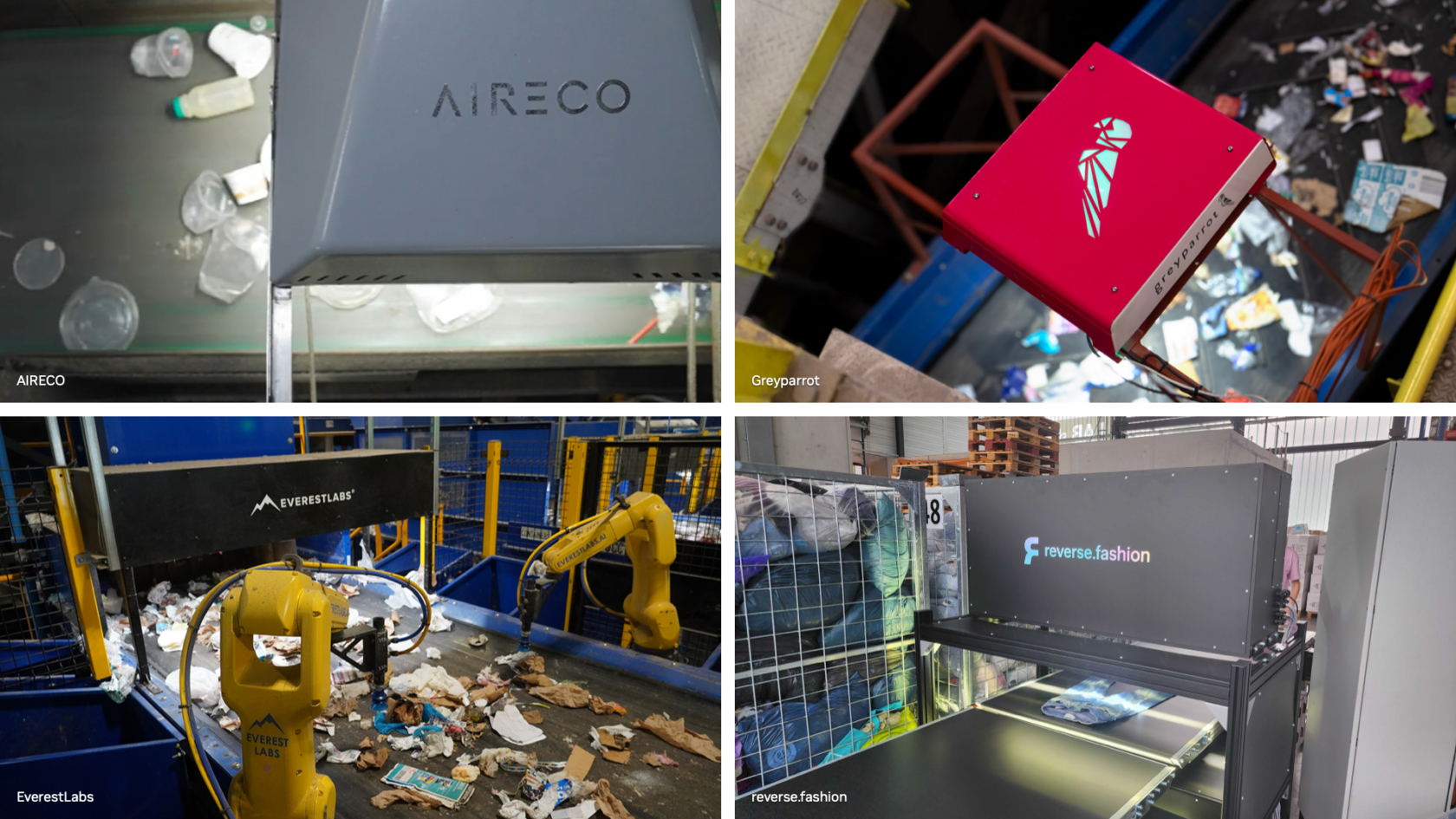
AIRECO, based in Taiwan, applies machine vision to separate plastic fractions with greater precision so used plastic can return to closed-loop recycling. The pilot at a Tainan recycling plant runs inference on NVIDIA Jetson Orin NX modules and drives robotic arms that pick items from a conveyor. NVIDIA reported recognition accuracy above 95% on that test line. A planned full-scale line aims to raise annual processing from 18,000 to 48,000 tons and lower operating costs by 85%; those are targets, not completed results. [1]
EverestLabs AI, a U.S. company, places computer-vision-guided robots on material recovery facility lines. About 150 robots are deployed across North America and Australia, the post said. EverestLabs estimates its systems have identified about 40 billion objects, recycled roughly 25,000 tons and avoided about 30,000 metric tons of carbon dioxide. It runs inference on NVIDIA RTX GPUs at the edge and trains models on data-center GPUs. It is also shipping agentic AI tools intended to give facility staff actionable data. [1]
Advertisement
Greyparrot, a U.K. startup, mounts its Analyzer platform above conveyors to classify passing items by material and brand, including in dusty or poorly lit sites and on belts running as fast as four meters per second. More than 300 systems in over 20 countries have made more than a trillion bounding-box detections, according to the post. The system cut inspection time for a 15-ton batch from 375 hours to six. Facilities using its data report efficiency gains of 10% to 30%, and Amcor saw a 12% increase in food-grade plastics yield. [1]
reverse.fashion, based in Berlin, targets used textiles. NVIDIA's post said Europe produces nearly 7 million tons of used textiles annually; about a quarter is collected separately and hand-sorted into hundreds of categories for resale, downcycling or other uses. The startup's high-resolution vision system reads garment type, defects, color, size, brand, fabric construction, season and style, then assigns a value category. At three meters per second, each item passes through more than a dozen models optimized with NVIDIA TensorRT and run on Jetson modules at the edge. The company estimates the system sorts in an hour what took a week and is rolling out in Europe. [1]
NVIDIA's healthcare post describes Synapsis AI from New Jersey-based Dyania Health as a clinical reasoning engine that reads notes, operative reports, imaging, pathology reports and discharge summaries. The post says it connects findings that may be years apart and outputs clinical signals traceable to source records. It runs on NVIDIA-accelerated computing inside a health system's firewall, so records are processed onsite and do not leave the hospital, according to the post. Clinicians review the evidence and make decisions. [2]
Cleveland Clinic used the tool in a study of more than 7,800 aortic valve replacement patients treated from 2005 to 2021. The system reviewed each record, including later echocardiograms, and supported a predictive model of valve deterioration and reintervention risk at three, five and ten years. NVIDIA said the chart review would have taken clinicians years by hand. Dr. Lars Svensson, chief of the Heart, Vascular & Thoracic Institute at Cleveland Clinic, said using technology to analyze information that may predict implanted valve duration is a promising step toward better outcomes and more personalized care. [2]
Advertisement
In Korea, the Ministry of Science and ICT and NVIDIA held the MSIT-NVIDIA AI Startup Partnership Forum at COEX with more than 20 Korean startups working on foundation models, physical AI, AI infrastructure and AI semiconductors. NVIDIA announced an investment in Point2 Technology and said it plans additional investments in Motif Technologies, RLWRLD and Upstage. Point2 makes radio-frequency interconnects for moving data between chips and racks in AI factories. Motif develops foundation models for agents, including the open-weight Motif-3. RLWRLD develops robotics foundation models for humanoid and industrial robots that need five-finger dexterity. Upstage develops Solar language models and document AI. NVIDIA cited more than 1,000 Korea-based Inception members. [3]
On agent security, NVIDIA said Hyundai Motor Group is exploring NemoClaw blueprints and the OpenShell runtime. Korean security company AIM Intelligence is integrating its Starfort platform with OpenShell. OpenShell is part of NVIDIA's Open Agent Safety Platform and provides sandboxed execution and policy-based controls intended to protect sensitive data, manage access to enterprise tools and govern autonomous agent actions. AIM is also considering a preliminary proof of concept for the public energy sector, with possible uses in enterprise, industrial and robotics settings. LG AI Research is opening API access for K-EXAONE-2.5, developed with NVIDIA Nemotron datasets including Nemotron-Personas-Korea, a synthetic dataset of 7 million Korean personas grounded in official statistics. [4]
The through line is AI placed at operational bottlenecks: high-speed sorting, text-heavy medical records and agents that need controlled access to tools. That is an observation about the posts, not a claim that one deployment proves another. The maturity levels differ. Recycling includes a pilot, a deployed robot fleet, active analyzer systems and a European rollout. The hospital item is a study. The Korea items include announced investment, planned investment, exploration, integration and API access. Readers should keep those categories separate. [1] [2] [3] [4]
The posts supply measurable categories. Recycling cites tons processed, objects identified, efficiency ranges and yield changes. Healthcare cites a patient cohort and a chart-review task. Agent security cites sandboxing and policy controls. These are useful diligence categories, but the supplied material does not include independent audit details. A 95% test-line recognition rate, a 10% to 30% efficiency range, an 85% cost-reduction target or a 12% yield increase at one packaging company should be treated as claims to verify in production, with variable waste streams and maintenance. [1] [2] [4]
Advertisement
For operators, a practical approach is to begin with a bottleneck that has a measurable cost and a human review path. Recycling facilities can ask about pick rate, material quality and downtime. Hospitals can ask about clinician time saved and traceability to source evidence. Enterprises can ask what an agent can access, what it cannot and how policy is enforced. Those questions are recommendations for diligence, not findings from the posts. The technology choices differ because the work differs. [1] [2] [4]
The posts also point to integration work beyond the model. Greyparrot's offering includes real-time data for facility staff. EverestLabs is shipping agentic tools for floor managers and executives. Dyania's output is clinical signals traceable to the record, which clinicians must confirm. NVIDIA's agent stack pairs open models with runtime controls. For small and midsize businesses, the evidence shows ecosystems forming around these capabilities; it does not show off-the-shelf pricing or implementation timelines. That gap is a diligence item. [1] [2] [3] [4]
Governance appears as a design requirement, not an afterthought. Autonomous agents need permissions before they can handle enterprise workflows. OpenShell's sandboxed execution and policy controls are aimed at protecting data and managing tool access. AIM Intelligence's Starfort integration is intended to combine runtime access controls with detection of malicious instructions and data leakage. Hyundai's use is described as exploration. In healthcare, the system stays inside the hospital firewall and clinicians remain decision-makers. The adoption question is whether AI works within institutional controls. [2] [4]
The background facts in the posts are specific. NVIDIA put the recycled or reused share of material inputs below 7% and said municipal solid waste exceeds 2 billion tons a year, with a possible near-doubling by 2050. Europe generates nearly 7 million tons of used textiles annually, with about a quarter collected separately and sorted by hand. Hospitals hold decades of patient history in free text. Korea's ecosystem includes more than 1,000 Inception members. These facts describe context; they do not by themselves establish why any particular investment or deployment occurs. [1] [2] [3]
Advertisement
Several questions remain open. Will AIRECO's planned full-scale line hit its 48,000-ton capacity and 85% operating-cost reduction targets? Will EverestLabs' object and emissions estimates be independently verified? Will Greyparrot's 10% to 30% efficiency gains hold across facilities and waste streams? Will reverse.fashion's hour-versus-week sorting estimate scale beyond its European rollout? Will Cleveland Clinic's predictive modeling approach generalize beyond that study? Will OpenShell's sandboxing and policy controls prove sufficient for real enterprise agents? Will the planned Korean investments close? [1] [2] [3] [4]
The evidence that would answer them is specific: independent audits of recycling installations, production data from full lines, additional clinical validation beyond the Cleveland Clinic cohort, and details about which Korean investments are completed and how agents are deployed. Until then, the announcements are best read as descriptions of direction and early results, with performance claims attributed to the companies and NVIDIA. The posts do not supply independent verification, customer counts beyond those cited, deployment economics or contract values. [1] [2] [3] [4]
Watch AIRECO's full-scale line against its capacity and cost targets. Watch reverse.fashion's European rollout for throughput and defect-detection performance. Look for independent evaluations of EverestLabs and Greyparrot deployments, including uptime and material-quality outcomes. In healthcare, watch whether Dyania's work expands beyond the study toward care-gap or trial-matching uses. In Korea, watch whether NVIDIA's planned investments in Motif, RLWRLD and Upstage are completed, and whether Hyundai and AIM Intelligence move from exploration and integration to production deployments of OpenShell. [1] [2] [3] [4]
For business buyers, diligence should ask where a deployment sits on the pilot-to-production path, what outcomes have been measured independently, how data residency and human review are handled, and what happens when models meet new waste streams, document formats or agent tasks. The supplied evidence does not answer those questions. It does show categories worth tracking: throughput, yield, clinician time, traceability, sandboxing and policy control. Those categories are a recommendation for evaluation, not a conclusion that any specific product is ready. [1] [2] [4]
Sources
Prepared with AI assistance from the cited sources.
The Cali Reporter newsletter
The stories worth your time.
California, the country, and what comes next. Join our free newsletter for reporting that keeps you informed.
More in Technology
- Google Play's Closed Testing Requirements and the Importance of Feedback
Google Play's closed testing rule emphasizes the need for developers to gather meaningful feedback from testers, not just track app installs. This approach ensures that real user experiences are evaluated and addressed…
- World Diabetes Day 2026 Focuses on Early Diagnosis and Awareness
The 2026 World Diabetes Day campaign emphasizes the importance of early diagnosis, equitable access to care, and reducing diabetes stigma, according to the WHO. The theme 'Early action on diabetes' highlights the need…
- Understanding Memory Usage on Linux VPS
This article explains how to accurately interpret memory usage on a Linux VPS, focusing on the importance of the 'available' metric and the potential pitfalls of relying on the 'free' column.