Newsom Takes California’s Fire Playbook Abroad, With Washington Missing
At COP31 in Türkiye, the governor touts wildfire tech and climate deals. The record is substantial; the proof points are mostly official.
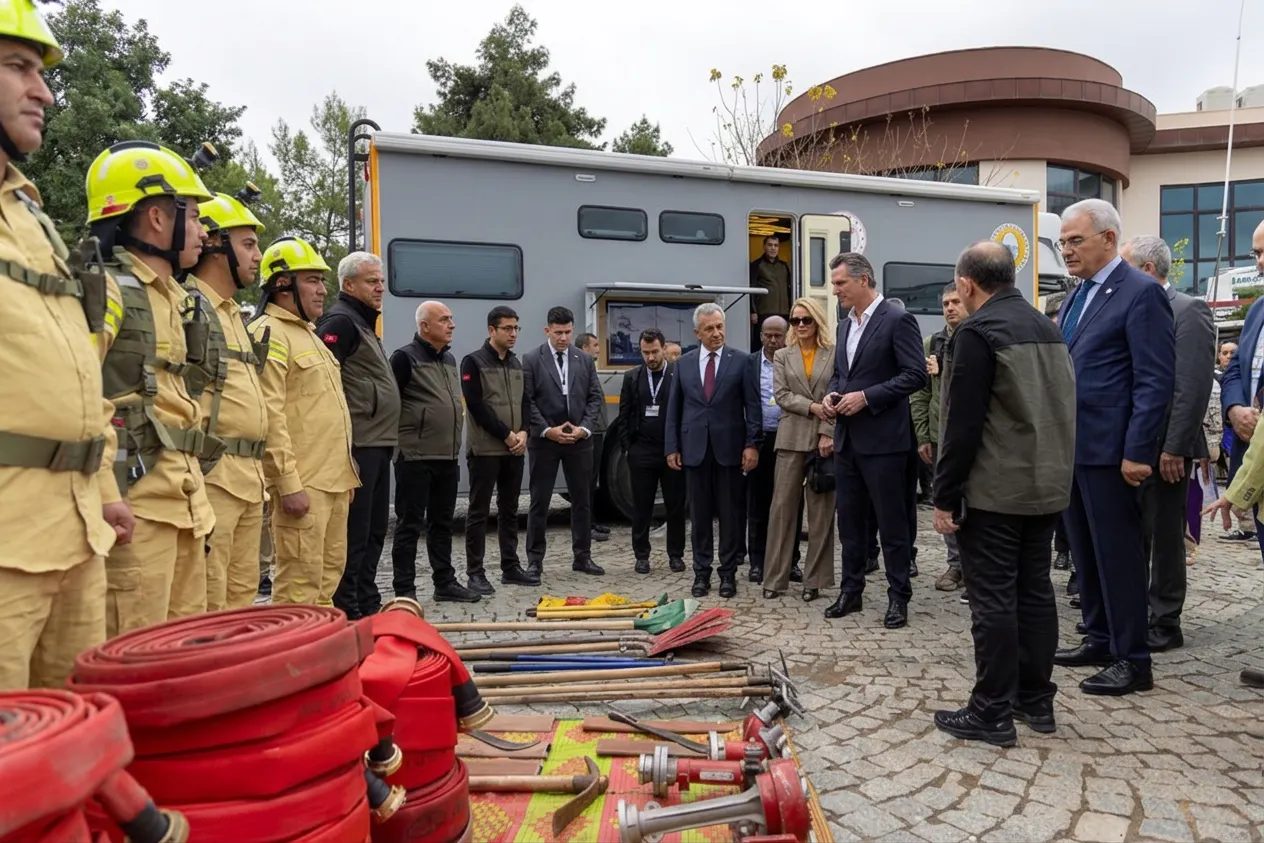
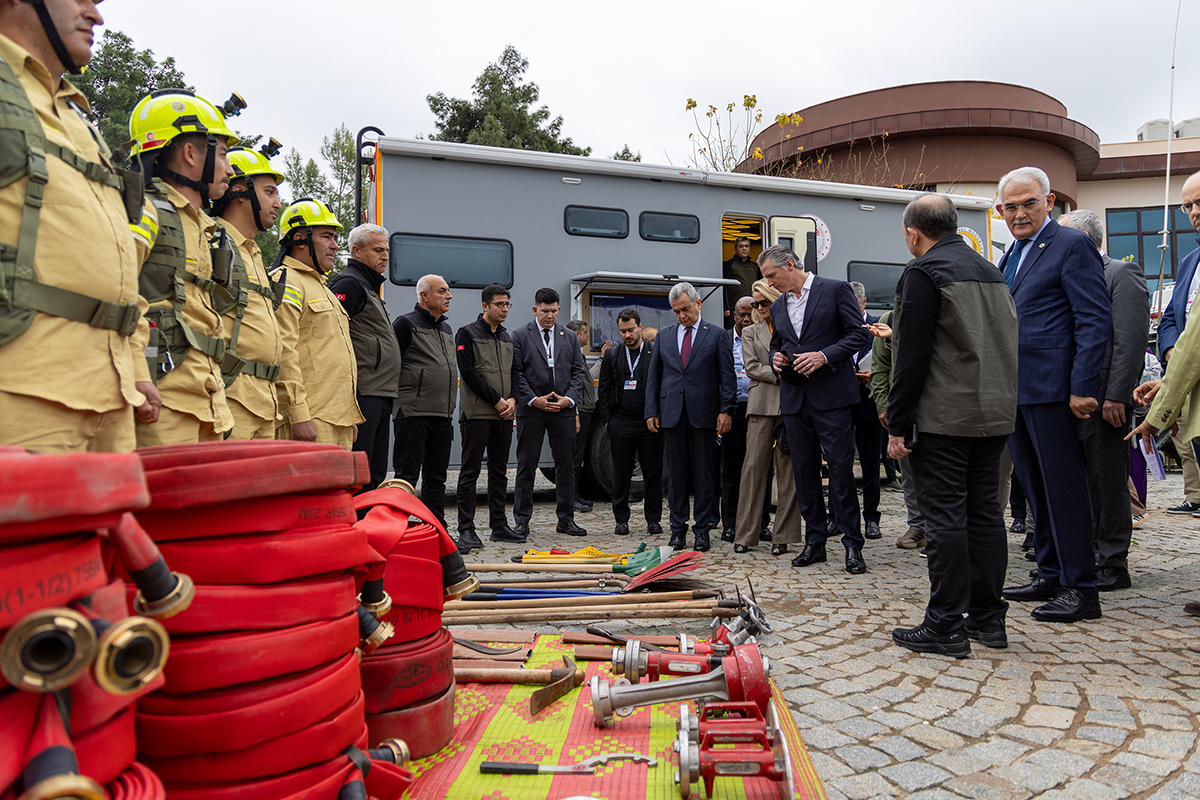
Newsom and Jennifer Siebel Newsom, California’s first partner, opened their COP31 schedule at Türkiye’s International Forestry Training Centre in Antalya. The stop mixed simulator tours, training grounds, and a meeting with roughly three dozen trainee firefighters. They also joined the UN Food and Agriculture Organization, the Under2 Coalition, and regional leaders for a wildfire-resilience exchange. The governor’s office framed the federal government as willfully absent and California as the reliable partner. [1]
The center is a working Turkish forestry hub. Turkish forestry officials have operated it since 2011, and the 50-hectare campus sits at a forest edge. It has classrooms, firefighting and flight simulators, and driving courses for large fire trucks. FAO support is helping it widen international training, with a focus on Central Asia and the Caucasus. [1]
Newsom reached back to the 2018 Camp Fire, which destroyed Paradise. His office says Türkiye battled large wildfires that burned nearly 20,000 hectares across a few days in July and September. It also says about 15 million hectares of Turkish forest remain under threat. The California release says Türkiye, like California, has invested heavily in forest management, firebreaks, clearing, and crews. That is California’s characterization, not a statement from Ankara. [1]
COP31 runs Nov. 9–20, 2026, in Antalya. Türkiye hosts; Australia leads negotiations; the theme is implementation. California’s delegation includes Newsom, Natural Resources Secretary Wade Crowfoot, Food and Agriculture Secretary Karen Ross, Public Utilities Commission President John Reynolds, Air Resources Board Chair Lauren Sanchez, and Samuel Assefa, who leads the Governor’s Office of Land Use and Climate Innovation. [1]
Advertisement
The political frame is the point. The governor’s newsroom drew the line sharply: Washington stayed home; California came to work. Newsom met Brazil’s President Lula, joined the Netherlands’ climate envoy, and signed a partnership with Portugal, according to the governor’s office. He also declared America’s climate fight far from over and announced $81 million for climate-smart agriculture projects across 55 counties. Those are official characterizations, not neutral findings. [2]
The record Newsom is selling is real on paper. The administration and Legislature say they have invested more than $5 billion in wildfire and forest resilience since 2019. CAL FIRE’s payroll has grown by an average of 1,800 full-time slots and 600 seasonal slots a year across five years. FIRIS has logged over 2,000 missions since 2019. California says it is the first state to own and operate C-130H airtankers; four are in service with a planned fleet of seven. Three FireSat detection satellites launched in June. The state has 3D LiDAR maps and is testing AI-guided drones for low-visibility firefighting. [1] [4]
The beneficiaries are not hard to spot. Newsom gets a world stage and a clean contrast with Trump. California’s wildfire agencies get a diplomatic showcase for programs the administration already funds. Firms named in state releases, including ICEYE and the Earth Fire Alliance, get public visibility; the releases do not include contract terms. The clean-energy industry gets a favorable frame from the governor’s broader COP31 pitch. [1] [2] [4]
The Under2 Coalition is not a new prop. California co-founded it in 2015 to organize states and regions on climate action. California is also a founding member of the U.S. Climate Alliance and co-chair of America Is All In. COP31’s stated focus is implementation: turning commitments into concrete, measurable results. The governor’s office says the Newsom administration has formed more than 70 international partnerships. The list includes a 2026 UK memorandum on clean energy and resilience, a 2025 Chile deal on methane, a 2025 Colombia partnership on forests and clean power, and a 2025 Brazil agreement on carbon pricing, clean transportation, and air quality. [1]
Advertisement
At least one partnership has produced operational results. British Columbia dispatched incident-management specialists to California during the 2025 Palisades Fire. California crews, in turn, went to British Columbia during its 2025 fire season. That exchange grew from a 2023 wildfire-assistance memorandum. The Antalya release does not announce a new California-Türkiye agreement or a specific training exchange; it describes dialogue, a tour, and a meeting. [1]
The partnership list runs well beyond fire. A 2023 Australia memorandum helped inform Australia’s first vehicle carbon emissions standards through CARB input, according to the state, and the CPUC and California ISO advised Australia on electricity market reform. A 2021 Denmark agreement on groundwater mapping and leak detection has informed California’s Airborne Electromagnetic Survey. In 2023 California signed five memoranda with China’s National Development and Reform Commission, Guangdong, Jiangsu, Beijing, and Shanghai on emissions and clean energy. The China announcements describe areas for cooperation, not quantified joint targets. [1]
Back home, Newsom has moved to make his wildfire emergency actions permanent. On Sept. 29, 2026, he signed legislation codifying streamlining that his office says has fast-tracked more than 500 priority prevention projects. The release credits the earlier emergency order with moving those projects across nearly 130,000 footprint acres and over 310,000 activity acres. The package creates a Fire Innovation Unit at CAL FIRE, establishes a low-interest loan program for home hardening and defensible space, extends State-Certified Prescribed Fire Burn Boss certification from one year to three, requires the CPUC to update rules on removing permanently abandoned transmission lines, and requires urban retail water systems in high- and very-high-fire-hazard zones to fold wildfire into emergency plans. The package also includes AB 1749, which addresses interfering with wildfire suppression and emergency response by drone, and SB 973, which creates a Wildfire County Coordinator Program. [3]
The state is also buying new eyes. On Oct. 6, Newsom announced that Cal OES struck a deal with ICEYE, a satellite-imaging company that helps governments assess disaster damage from space. The feed is meant to show flood and fire damage through cloud cover, smoke, and darkness. He opened a modernized State Operations Center in Mather that expanded operational seating from 54 to 64 positions, and the budget added 73 permanent positions for incident support teams. Federal forecasters put the odds above 90% for a very strong El Niño this fall and winter. They assign a 75% chance it reaches historic strength. [4]
Advertisement
Transmission is the quiet bottleneck behind the clean-energy claims. The CPUC’s Tracking Energy Development Task Force, a joint effort with the Energy Commission, CAISO, and GO-Biz, tracks new projects and barriers. Executive Order N-33-25 told the CPUC to flag critical generation and storage projects due online within three years and ask utilities to prioritize interconnection. The CPUC’s annual RPS reports have carried a transmission-delay assessment since 2023. Those reports identify delayed projects and network upgrades expected to affect multiple gigawatts of in-development resources. [5]
The clean-energy numbers are substantial but official. The administration says utility-scale clean energy additions since 2019 exceed 39,000 megawatts. It says 67% of retail electricity sales came from clean sources at the end of 2024, and that clean energy met 100% of demand for part of the day on 279 days last year. It counts 552,300 clean-energy jobs, nearly twice Texas’s total, based on a 2025 E2 report. The clean-energy payroll expanded by about 7,300 people in 2024, more than three times the rest of the state’s job growth. Those figures are not an independent audit. [1]
The same caution applies to wildfire performance. The releases say what California has invested and deployed. They do not quantify avoided losses, risk reduction, or earlier detection attributable to FIRIS or FireSat. The Antalya exchange produced dialogue and site visits, not a published joint target. That gap matters because the governor is asking voters and international partners to accept his administration’s what’s-working brand. [1] [3] [4]
Unanswered questions start with the exchange itself. Did California and Türkiye agree to any follow-up training, technical exchange, or procurement? Will the FAO partnership expand to California crews? What metrics will California use to judge the Antalya visit? How much did the delegation trip cost, and who paid? The governor’s releases do not say. They also do not name a new California-Türkiye memorandum, unlike the Portugal partnership announced the same week. [1] [2]
Advertisement
There are implementation questions at home. The wildfire streamlining law is meant to preserve environmental safeguards; the release asserts it does, but the test is project-level litigation and agency practice. The home-hardening loan program’s reach depends on terms the release does not specify. The CPUC’s abandoned-transmission rules depend on a future commission update. The FEMA cuts are a proposed fiscal 2027 budget, not an enacted appropriation, though the proposal to cut $1.3 billion and eliminate the Next Generation Warning System Grant Program shows Washington’s direction. [3] [4]
What to watch at COP31: the conference runs through Nov. 20. Watch whether the wildfire exchange yields a signed follow-up, whether the Portugal partnership produces specifics, and whether the $81 million agriculture program is detailed beyond the 55-county headline. Watch, too, whether Newsom uses the closing days to amplify the contrast with Washington. The political purpose of the trip is already clear from the rollout. [1] [2]
Back in California, watch El Niño preparations and the State Operations Center’s first heavy-storm test; the implementation of the September wildfire laws; CAL FIRE’s hiring against the five-year clip of 1,800 full-time and 600 seasonal slots per year; and transmission and interconnection delays that the CPUC tracks. The state’s wildfire and climate diplomacy is real. So is the political benefit. Both things are true. [1] [3] [4] [5]
Sources
California Governor announcements
Prepared with AI assistance from the cited sources.
The Cali Reporter newsletter
The stories worth your time.
California, the country, and what comes next. Join our free newsletter for reporting that keeps you informed.
More in California
- Elderly Man Robbed in Costco Parking Lot, Four Arrested
A 91-year-old man reported a theft of a ring during an interaction at a Costco in Modesto, leading to the arrest of four individuals.
- Federal Court Halts Closure of East Potomac Park
A federal court has issued a temporary restraining order to prevent the Trump-Vance administration from closing East Potomac Park as part of a plan to convert the area into an exclusive golf course.
- CMS Announces Optional Six-Month Delay for Medicaid Work Requirements
The Centers for Medicare and Medicaid Services (CMS) has announced an optional six-month delay for states implementing Medicaid work requirements, according to a report by KFF.