Mountain Lion in Calabasas Sparks Community Concern
Residents in a Calabasas neighborhood are alarmed by the repeated sightings of a large mountain lion, though state wildlife officials have stated that no action can be taken at this time.

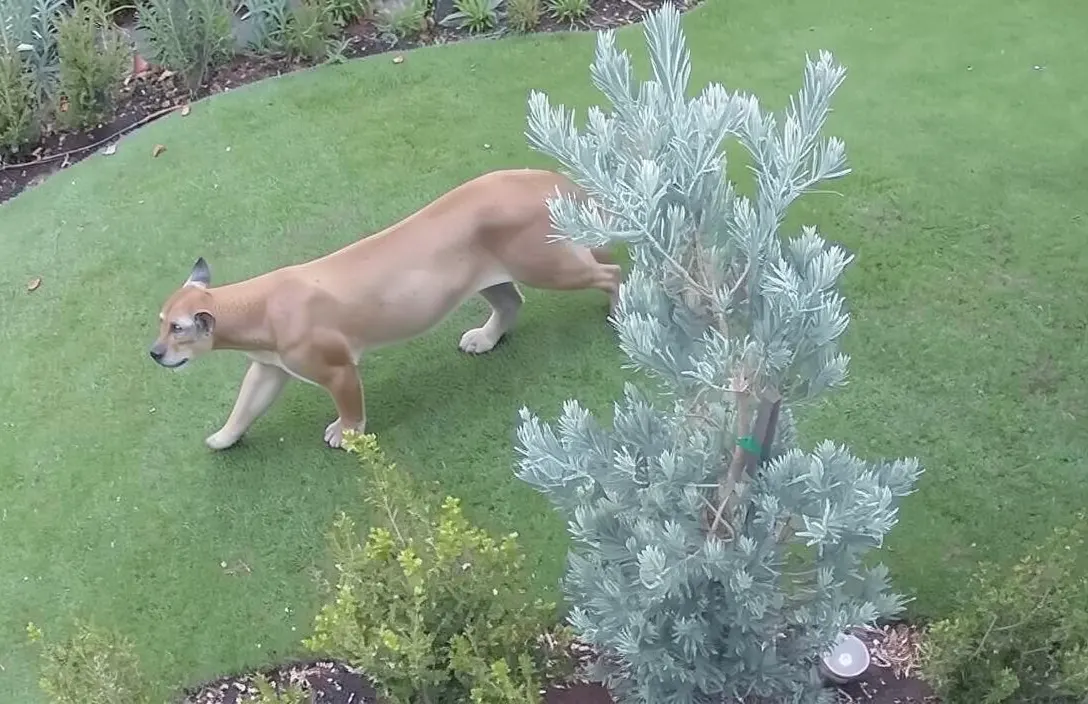

Residents of a gated community in Calabasas, California, have expressed alarm after a large mountain lion was spotted repeatedly in the area, including on a front lawn and near a grocery store parking lot. The animal was first reported over the weekend near Mulholland Highway and has since been seen multiple times (KTLA: Los Angeles, 2026). According to resident Nancy Pardo, the sight of the mountain lion on her front lawn was 'extremely terrifying.' While no attacks on pets or people have occurred, the animal has reportedly eaten some koi fish, prompting concerns among local officials and neighbors. [1]
Calabasas City Council member Alicia Weintraub stated that the mountain lion has become 'very comfortable' in the neighborhood and suggested that collaring and relocating the animal could be beneficial for both wildlife and residents. However, under California law, wildlife officials typically intervene only when an animal poses an imminent threat to public safety or is linked to attacks on people, pets, or livestock (KTLA: Los Angeles, 2026). In this case, none of those criteria have been met, and relocation is not guaranteed to be a safer option due to the risk of the animal becoming disoriented or facing dangers such as vehicle collisions. [1]
Residents have been advised to keep pets indoors, particularly at night, and to supervise them closely when outside. Livestock should be kept in fully enclosed shelters between dusk and dawn. Officials also recommend removing attractants and hazing mountain lions to discourage them from becoming accustomed to human proximity (KTLA: Los Angeles, 2026). The mountain lion’s presence highlights the challenges of coexistence in areas where human development encroaches on natural habitats, a concern that is being studied by various research projects across the state (wildlife.ca.gov). [1] [2]
The Northeastern California Lion Project, based in Modoc and northern Lassen counties, focuses on investigating mountain lion ecology and predator-prey interactions involving pronghorn, elk, mule deer, and feral horses, with research ongoing since 2016 (wildlife.ca.gov). [2]
Advertisement
The Mountain Lion Research Project, led by UC Davis, operates in southern and central California, including the Eastern Peninsular Range, Santa Anna Mountains, Tehachapi Range, Gabilan Range, and Pacheco Pass, examining how urban development, highways, and light-rail infrastructure affect mountain lion connectivity and disease exposure, with research ongoing since 2000 (wildlife.ca.gov). [2]
The Assessment of Native Ungulate and Carnivore Densities within and Nearby Wolf Occupied Areas, conducted by UC Berkeley, spans Alpine, El Dorado, Placer, Nevada, Sierra, Plumas, Lassen, and Siskiyou counties, using a 300-camera trap network to study carnivore and ungulate densities, with research ongoing since 2024 (wildlife.ca.gov). [2]
The Investigation of Non-Lethal Techniques for Managing Mountain Lion Depredation, based in El Dorado, Sierra, Placer, Nevada, Calaveras, Amador, and Yuba counties, evaluates methods such as hound pursuit, loud noises, paintballs, and turbo fladry to deter mountain lions from preying on livestock, with research ongoing since 2024 (wildlife.ca.gov). [2]
The Santa Cruz Puma Project, led by UC Santa Cruz, operates in the Santa Cruz, Gabilan, Santa Lucia, and Diablo Mountain Ranges, examining how landscape features and foraging strategies influence the physiology and ecology of mountain lions in fragmented habitats, with research ongoing since 2009 (wildlife.ca.gov). [2]
Advertisement
The North Bay Mountain Lion Project, led by True Wild in Marin, Napa, Sonoma, Lake, and Mendocino counties, assesses mountain lion habitat and foraging patterns to promote public awareness of their ecological benefits and strategies for safe coexistence, with research ongoing since 2016 (wildlife.ca.gov). [2]
The Statewide Biopsy Darting Project, managed by USDA-APHIS Wildlife Services, collects genetic samples from mountain lions involved in depredation events across California to refine genetic population structuring and human-wildlife conflict understanding, with research ongoing since 2019 (wildlife.ca.gov). [2]
The Bay Area Livestock-Carnivore Interactions Project, led by Panthera and UC Cooperative Extension, operates in San Mateo, Santa Clara, and Santa Cruz counties, evaluating non-lethal deterrents on preserve lands to reduce livestock predation by mountain lions, with research ongoing since 2022 (wildlife.ca.gov). [2]
The Statewide Integrated Population Modeling project, led by the University of Nebraska–Lincoln, spans 23 counties from San Francisco to San Diego, analyzing demographic and genetic data to model mountain lion population dynamics and viability, with research ongoing since 2024 (wildlife.ca.gov). [2]
Advertisement
The Urban Mountain Lion Research in the Santa Monica Mountains, managed by the Santa Monica Mountains National Recreation Area, studies the genetics, reproductive biology, and road impacts on mountain lions in the Santa Monica Mountains and surrounding areas, with research ongoing since 2000 (wildlife.ca.gov). [2]
The Serosurvey of Mountain Lions, led by Utah State University and the San Diego Zoo Wildlife Alliance, examines spatial risk factors for pathogen and toxicant exposure across California, with research ongoing since 2021 (wildlife.ca.gov). [2]
The Human Mobility Data project, led by the US Forest Service and Colorado State University, uses human movement data in the Sierra Nevada to identify high-risk areas for human-mountain lion interactions and inform management strategies, with research ongoing statewide (wildlife.ca.gov). [2]
The Restoring and Assessing Puma Connectivity in the Northern Diablo Range, led by the Conservation Biology Institute, spans Contra Costa, Alameda, and Santa Clara counties, aiming to identify movement barriers and linkages for mountain lions in the East Bay area, with research ongoing since 2023 (wildlife.ca.gov). [2]
Advertisement
The 30-Day Mountain Lion Research SCP Notice, managed by the Felidae Conservation Fund, is part of broader efforts to gather data on mountain lion health and movement, though specific locations and objectives are not detailed in the provided text (wildlife.ca.gov). [2]
Residents of a gated community in Calabasas, California, have expressed alarm after a large mountain lion was spotted repeatedly in the area, including on a front lawn and near a grocery store parking lot. The cougar was first reported over the weekend in the community near Mulholland Highway. Residents said it has since appeared several times, including on a front lawn in Braewood and near a grocery store parking lot Tuesday morning (Source ID: 1). [1]
Calabasas City Council member Alicia Weintraub stated that the mountain lion has become 'very comfortable' in the neighborhood and suggested that collaring and relocating the animal could be beneficial for both wildlife and residents. Residents have been advised to keep pets indoors, particularly at night, and to supervise them closely when outside (Source ID: 1). [1]
Under California law, mountain lions have special protections. Wildlife officials generally intervene only when an animal poses an imminent threat to public safety or is linked to attacks on people, pets or livestock. In this case, none of those boxes have been checked (Source ID: 1). [1]
Officials say relocation is not necessarily a safer outcome since mountain lions can travel great distances while attempting to return to their established territory, increasing the risk of starvation or a deadly vehicle collision. Although the neighborhood is residential, it borders the Santa Monica Mountains, part of the animal’s natural habitat (Source ID: 1). [1]
Sources
Prepared with AI assistance from the cited sources.
The Cali Reporter newsletter
The stories worth your time.
California, the country, and what comes next. Join our free newsletter for reporting that keeps you informed.
More in Los Angeles
- Afghan Journalist's Asylum Case Sparks Press Freedom Concerns
An Afghan journalist detained in California faces deportation to Afghanistan, where he could face persecution by the Taliban, according to advocacy groups and legal representatives.
- Oakland Incident Sparks Outrage Over ICE Actions
A video showing federal immigration agents using force against civilians in Oakland has raised concerns about immigration enforcement tactics.
- Los Angeles Zoo Celebrates 60th Anniversary with Discounted Admission
The Los Angeles Zoo is commemorating its 60th anniversary with discounted admission during the Thanksgiving holiday weekend, offering a promotional rate for visitors.