Mount Sinai structural study of AASS points to a hinge, not yet a therapy, for GA1
Cryo-EM and biochemical work reveal the full-length enzyme and a regulatory hinge; the authors call it an early discovery step, with animal and potentially human testing still ahead.

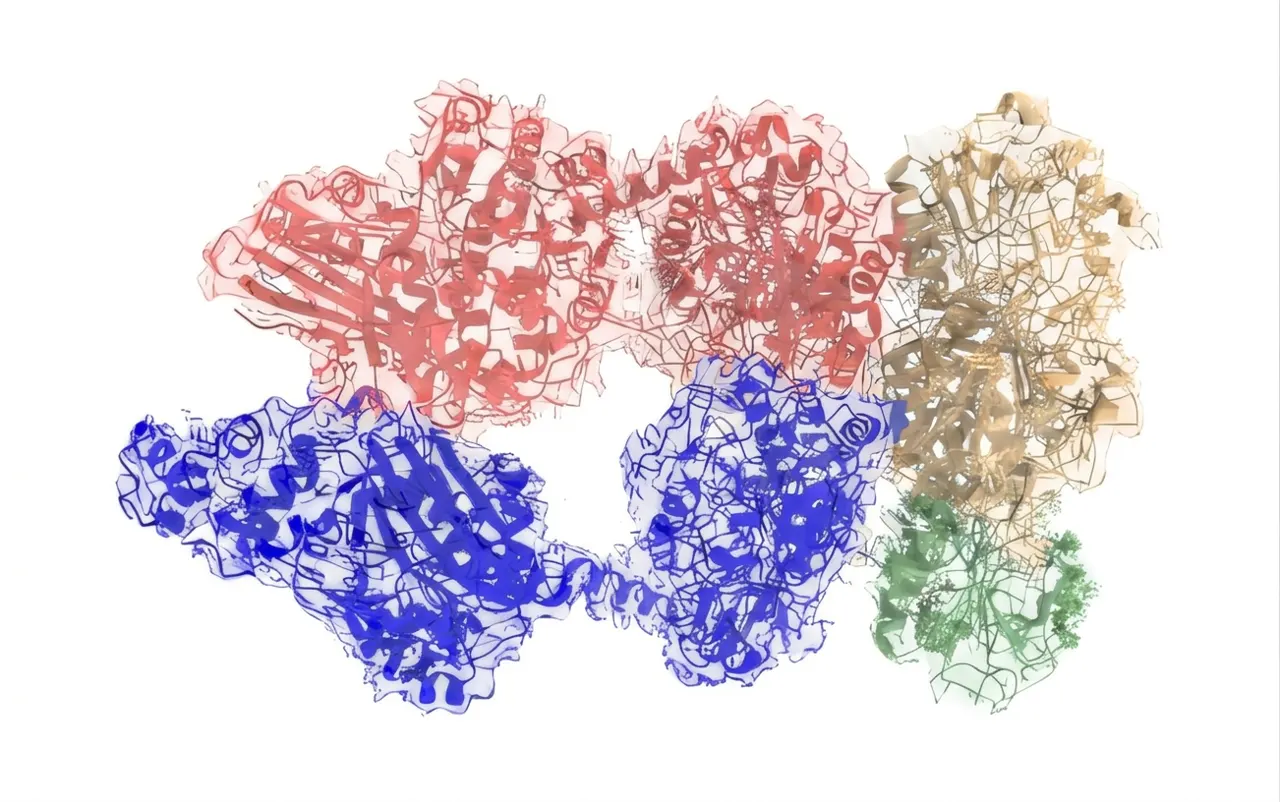

A research group at the Icahn School of Medicine at Mount Sinai has generated a high-resolution structural map of full-length human AASS (alpha-aminoadipic semialdehyde synthase), an enzyme in lysine catabolism, and located a flexible segment that influences its activity. The report appears in Science Advances, according to the source, which identifies Ruoxi Wu and colleagues as authors and gives DOI 10.1126/sciadv.aej2268. The senior and co-corresponding authors named in the source are Michael Lazarus, Sander Houten and Robert J. DeVita. The work combines structural biology with biochemical assays; it does not report a new medicine, a clinical trial, or patient outcomes. [1]
The source describes a sequence of experiments rather than a single observation. The investigators established a purification method for the full-length human enzyme, then examined it by cryo-electron microscopy, a technique that produces high-resolution images of biological molecules. They also ran biochemical assays to see how AASS behaved when exposed to substances that inhibit or activate it. Computational simulations were used to explore conformational changes and how those motions might affect function. According to the source, these approaches together produced a detailed view of the enzyme and evidence that a flexible hinge segment helps control activity. [1]
The hinge finding is the centerpiece. The source states that minor shifts at this flexible junction can markedly alter how the enzyme behaves. Lazarus is described as saying the work provides the first comprehensive view of full-length AASS and that small perturbations in a flexible domain can have a large effect on activity. Houten is described as saying the investigation identified several routes for modulating catalysis. Those are author characterizations of laboratory findings, not clinical results. [1]
GA1 is described in the source as a rare genetic metabolic condition marked by accumulation of toxic compounds. It can cause permanent brain injury and serious neurologic sequelae. The source does not provide prevalence, incidence, or patient-outcome statistics, and it does not describe current standards of care. Its relevance to GA1 is as a drug-target rationale: AASS participates in lysine breakdown, and the authors suggest that blocking the enzyme might lower the load of disease-linked toxic compounds. That is a hypothesis for future drug discovery, not evidence that inhibition helps patients. [1]
Advertisement
The distinction matters because a target is not a treatment. The source describes DeVita as saying the structural knowledge lets the team begin exploring chemical strategies to block AASS and to evaluate whether such compounds might someday yield a GA1 therapy. The same source explicitly cautions that the findings are an early step toward a therapy, not a treatment or cure. No candidate molecule is reported as having been tested in animals or humans. No numerical estimate of benefit, absolute or relative, is provided. [1]
The study is bench-level structural biology and biochemistry. According to the source, all experiments were laboratory-based; the team isolated the complete human enzyme, mapped it by cryo-electron microscopy, tested function under different biochemical conditions, and used computer simulations to examine structural movement. This design can answer questions about enzyme architecture, regulatory regions, and behavior in controlled conditions. It cannot by itself establish whether an inhibitor will be safe or effective in a living organism. [1]
The study design is discovery-stage. Combining cryo-electron microscopy, biochemical assays and computer simulations is well suited to generating hypotheses about where and how to interrupt enzyme function, but it does not measure clinical outcomes, dose-response in patients, or adverse events. The source reports no randomization, no control group of patients, no blinding, and no follow-up. These omissions are expected for this kind of laboratory work, but they mean the findings cannot support absolute or relative risk estimates for GA1 treatments. The authors' own language frames the work as an early step. [1]
Cryo-electron microscopy is powerful for visualizing molecular shape, but a structure is a snapshot or a set of snapshots, not proof of therapeutic effect. Biochemical assays can show how an enzyme responds to inhibitors or activators in a test tube, yet they do not capture the complexity of a whole organism. Computer simulations can suggest how a protein might move, but they are models. The source presents these methods as complementary; none of them substitutes for animal or human testing. [1]
Advertisement
The source reports no animal models and no human participants. It reports no candidate drug tested in a living system, no dosing, no treatment duration, and no clinical endpoints. Those absences are not flaws in the study’s stated purpose; they define the boundary between discovery-stage structural work and clinical evidence. The authors themselves say animal studies and, possibly, human trials must establish whether AASS-targeting is safe and effective. Until such data exist, claims about clinical benefit would outrun the evidence. [1]
The source also provides no absolute or relative risk estimates for GA1 or for any future therapy. Absolute risk describes the actual probability of an outcome in a group; relative risk compares probabilities between groups. Neither can be estimated from a laboratory structural study without clinical outcome data. The same limitation applies to numbers needed to treat, effect sizes, and subgroup differences. The study can generate mechanistic hypotheses, not estimates of patient benefit. [1]
The historical claim supported by the source is specific and attributed: the authors describe this as the first detailed picture of the complete AASS enzyme. The source does not review earlier AASS structures, prior drug candidates, or historical GA1 trials, so those details cannot be verified from the supplied evidence. It also does not establish how long AASS has been studied or whether other groups have produced partial structures. The safe reading is that the authors present their full-length structural map as new, while the source supplies no independent historical survey. [1]
The source does provide a basic biological context: AASS is involved in breaking down lysine, and the researchers identified a region that regulates its activity. It also states that the findings offer wider lessons about enzyme control through small conformational shifts. That is a general mechanistic implication, attributed to the research team. It is not a claim that the mechanism has been validated as a therapeutic strategy in GA1. [1]
Advertisement
The practical implication is for drug discovery, not immediate care. The hinge-like region and the enzyme’s regulatory behavior give medicinal chemists a specific structural feature to study when attempting to design AASS inhibitors. The source says mechanistic insight may aid design of more effective AASS inhibitors. That is a plausible research direction supported by structural and biochemical observations. It is not a demonstration that an effective inhibitor exists or that inhibiting AASS improves outcomes. [1]
A further implication concerns target validation. Showing that AASS can be inhibited in biochemical experiments is not the same as showing that inhibition changes disease course. The source states that animal and possible human studies are needed to determine safety and effectiveness, which is a reminder that target identification, chemical optimization, preclinical toxicology and clinical testing are separate evidence steps. None of those later steps is reported here. The source provides no data on how AASS inhibition would affect lysine levels, metabolite accumulation, brain injury, or neurologic function in patients. [1]
A future scenario, clearly a scenario rather than an asserted outcome, is that carefully designed AASS inhibitors might someday lower the buildup of harmful metabolites in GA1. The source says the immediate next step is to leverage the map to find and optimize enzyme-blocking compounds, and that animal and possible human studies would be required to assess safety and effectiveness. Whether that scenario is realized depends on evidence not yet reported. The source gives no timeline and no forecast of success. [1]
The study also has a broader scientific implication: it adds to understanding of how small conformational changes can regulate enzyme activity. The source says a better understanding of how nature controls lysine degradation will help with development of treatments for the disease. That statement is an attributed expectation about future research. It does not establish clinical benefit, a mechanism validated in patients, or a route to market. Readers should treat it as a research lead. [1]
Advertisement
The core unresolved question is the safety and efficacy of AASS targeting. The source explicitly says animal and possible human studies are required to establish this. It does not report whether any AASS inhibitor has been identified that is suitable for clinical testing, nor whether such a molecule can achieve the intended biochemical effect without unacceptable effects elsewhere. It also does not say how much inhibition would be therapeutic or how that might vary among patients. [1]
Other open questions include how much reduction in metabolite buildup would be needed to prevent or limit brain damage, whether changing lysine degradation could have unintended consequences, and whether the hinge region is a practical drug-binding site. The source does not answer these questions. It also provides no patient-level data, no subgroup analyses, and no clinical outcomes. Those gaps mark the distance between a structural map and a validated therapy. [1]
What to watch next is concrete but uncertain. The source identifies the immediate next step as using the structural map to discover and optimize enzyme-blocking compounds. After that, the evidence needed would include animal studies and potentially human trials to assess safety and effectiveness. Readers should watch for reports of candidate molecules, preclinical testing, and eventually clinical studies, while recognizing that the source does not predict when or whether those steps will succeed. For now, the work is best understood as early-stage structural biology with relevance to drug discovery, not a treatment or cure. [1]
Sources
Prepared with AI assistance from the cited sources.
The Cali Reporter newsletter
The stories worth your time.
California, the country, and what comes next. Join our free newsletter for reporting that keeps you informed.
More in Health & Medicine
- Brain Energy Mismatches in Schizophrenia
A new study explores the potential role of energy bottlenecks in brain cells in explaining fragmented experiences of time, space, and self in schizophrenia.
- Brazil Reports First Mpox Death in 2026
Brazil has recorded its first mpox-related death in 2026, but public health officials are not classifying the current surge in cases as an outbreak, according to the Fiocruz Institute.
- Personalized Therapies for IBD May Target Specific Harmful Gut Bacteria
A study led by Dr. Lukas Mager and Prof. Kathy McCoy has identified two gut bacteria that promote inflammation in inflammatory bowel disease, opening the door for personalized treatments.