Longer Inhibitory Links Shift Simulated Networks Past Criticality
A University of Tokyo modeling study reports that longer inhibitory connections, through transmission delays, can shift simulated networks toward supercritical activity, adding spatial layout to the excitation-inhibition story.

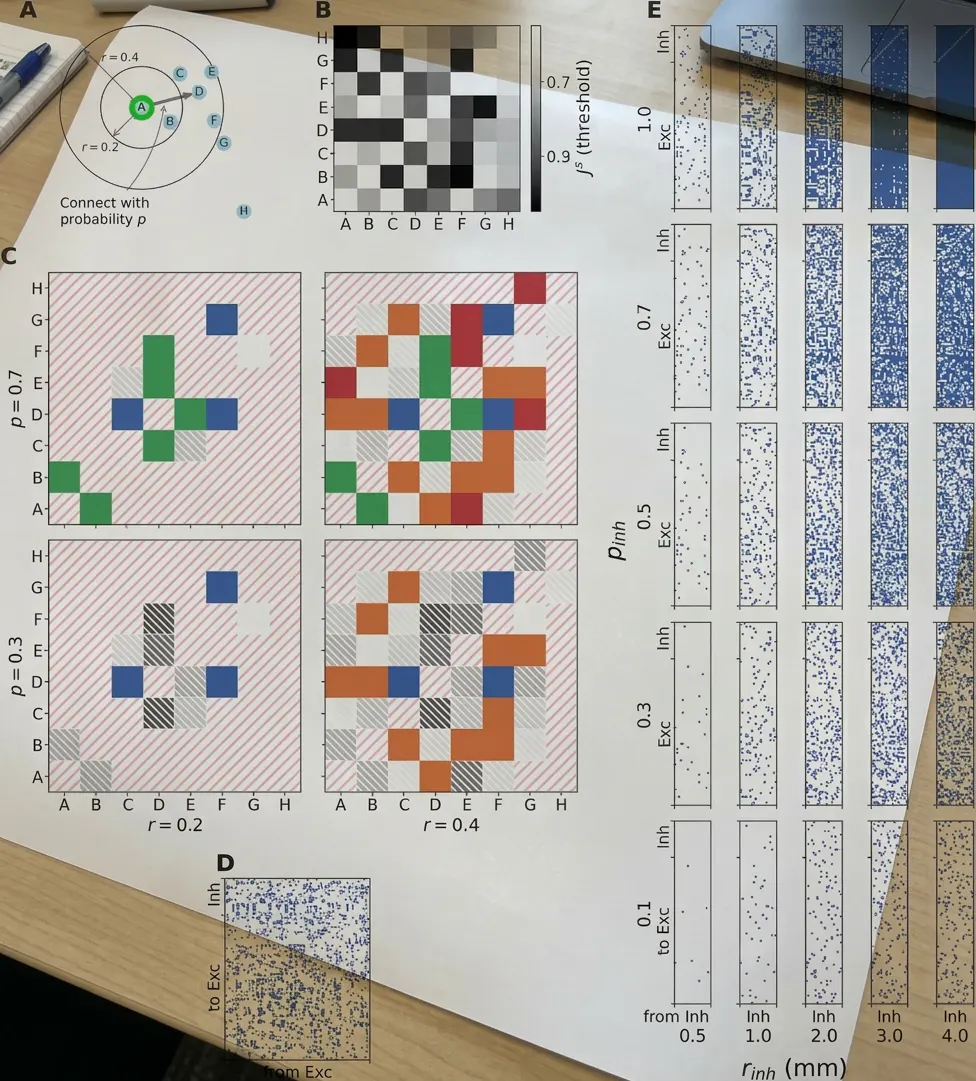

A computational study led by Zenas C. Chao, an associate professor at the International Research Center for Neurointelligence at the University of Tokyo, examined how the spatial layout of inhibitory wiring and synaptic plasticity together shape critical activity. The co-authors were Felix Benjamin Kern and Takahisa Date. The paper appeared in PLOS Computational Biology on Oct. 1, 2026, and Medical Xpress reported on it on Nov. 13, 2026. [1]
The model was small and explicitly spatial. It placed 80 excitatory and 20 inhibitory neurons on a two-dimensional disk with a 2 mm radius. Excitatory connectivity parameters were fixed. The researchers varied the maximum distance and probability of inhibitory connections across a 5-by-5 grid, giving 25 inhibitory conditions. They generated 10 network prototypes, each carrying the same set of 25 conditions, and simulated each one. [1]
Every network ran for 15 hours, starting with all synaptic weights at zero. The researchers analyzed the final two hours, after the networks had reached a steady state. The design therefore tracks how wiring and plasticity settle into an activity regime in the simulation. [1]
Most parameter settings produced supercritical activity. Criticality was relatively scarce, but it appeared most often at intermediate-to-high inhibitory connectivity densities. At the highest inhibitory connectivity densities, subcritical behavior dominated. The researchers noted that this result is consistent with previous studies showing that criticality typically emerges when excitation and inhibition are balanced. [1]
Advertisement
The simulations also found that the physical reach of inhibitory connections influenced whether a network settled below, near or above criticality, independent of connection density. Networks with longer inhibitory connections tended to become more supercritical than networks with a similar number of shorter-range inhibitory connections. The team attributed this to synaptic delays: longer travel times make long inhibitory connections weaker, and weaker inhibition allows larger neural avalanches. [1]
The brain criticality hypothesis proposes that neurons are arranged so activity sits near a border between two regimes. In an ordered state, activity dies out quickly. In a disordered state, signals can spread quickly and potentially grow uncontrollably. The border is criticality; the regimes on either side are subcritical and supercritical. [1]
Think of a sandpile. A dropped grain may do nothing, or it may set off a small or large avalanche. Near criticality, a small burst of neural activity can sometimes remain local, while at other times it can spread through much of the network, producing neural avalanches of many sizes. [1]
Criticality can offer several computational advantages to neural networks. Near this state, networks can exhibit maximum computational and information-transmission capacities, high information storage capacity and maximum dynamic range, making them highly sensitive to external stimuli. Those are proposed advantages, not guarantees for any particular circuit. [1]
Advertisement
What pushes a developing circuit toward that border has been unsettled. Earlier studies have shown that network structure, long-term synaptic plasticity rules and homeostatic mechanisms can drive networks to criticality. Homeostatic mechanisms are feedback loops that stabilize neural activity. Studies have also found that the balance of excitation and inhibition is important for maintaining criticality. [1]
Most previous criticality models assumed random or fully connected networks. Real neurons, however, occupy physical space, and distance affects both connectivity and how much time signals take to travel. The new study brought that geometry into the model and asked how the spatial distribution of inhibitory connections interacts with plasticity. The gap it addresses is not whether excitation-inhibition balance matters, but how the geometry and timing of inhibition shape the outcome. [1]
The reported pattern is not a simple story in which more inhibition always means less activity. Spatial arrangement mattered independently of density in the simulations. Longer inhibitory links were weaker in effect because of transmission delays, and that weakness allowed larger avalanches. In the model, two networks with similar numbers of inhibitory connections could therefore land in different activity regimes if their links were spread differently across space. [1]
Chao said the findings show that the number of inhibitory connections is not the only factor; their spatial arrangement and transmission delays also shape network criticality. That is a useful correction to a volume-knob view of inhibition. In this model, inhibition’s effect depends on where and when signals arrive, not only how many connections exist. [1]
Advertisement
The study varied inhibitory density and reach while holding excitatory wiring fixed, so it cannot rank length against every other factor. It does not show that longer inhibitory links always dominate. It does show that, in this model, two circuits with similar inhibitory counts can behave differently when the links differ in length and delay. That is a narrower claim, but a useful one. [1]
The most useful takeaway, in this reader’s view, is that inhibition has geometry. Calling a network more inhibited can hide the relevant variable. A short, strong inhibitory connection and a long, delayed one may not do the same work even if both count as one connection. In the model, that difference was enough to help push networks toward supercritical activity. [1]
Chao noted that understanding how spatial arrangement and delays influence neural dynamics could help inform the design of stable and adaptable artificial neural systems. He also raised the possibility that the work may later inform studies of how genetic or developmental changes to inhibitory wiring affect brain function. Those are attributed possibilities, not established engineering or medical results. The study is computational, so its near-term value is in framing and model design. [1]
The paper also gives a useful reminder about how to describe inhibition. A short, strong inhibitory connection and a long, delayed one may not do the same work even if both count as one connection. In the model, that difference was enough to help push networks toward supercritical activity. That does not mean length is always the dominant factor, but it is a variable that deserves attention. [1]
Advertisement
The bottom line is modest but useful: in this simulation, the reach and timing of inhibitory connections helped decide whether a network stayed near criticality or drifted supercritical. That does not settle how real brains develop. It does give researchers a sharper question to ask about the geometry of inhibition, and it gives modelers a reminder that wiring distance is part of the computation. [1]
The supplied source describes a computational model only; it does not report tests in biological tissue or intact brains. The model contains 100 neurons on a two-dimensional disk with a 2 mm radius, with excitatory connectivity fixed and inhibitory reach and probability varied. Whether the same relationship holds in larger networks, three-dimensional tissue, other cell classes or developmental timescales is not addressed in the supplied source. [1]
Another open question is whether biological brains actually use changes in inhibitory connection length or delay to tune criticality during development. The study does not establish that. It also does not show that genetic or developmental alterations in inhibitory connectivity cause specific brain conditions. Chao’s suggestion that the work could eventually help investigate those factors is a research direction, not a finding. [1]
A further uncertainty is how robust the results are to modeling choices. The team varied inhibitory connectivity across 25 conditions and simulated 10 network prototypes, but the model still simplifies real tissue. Whether the same tipping behavior appears when excitatory connectivity is also allowed to vary, or when network size and spatial scale change, remains unaddressed in the supplied source. [1]
A related question is whether the effect depends on the specific rules for synaptic plasticity and homeostasis. The model starts from zero weights and lets them evolve, so the final regime reflects both connectivity geometry and the plasticity rules. Testing other plasticity rules would help show whether the distance-delay result is general or tied to this implementation; the source does not report such comparisons. [1]
The results also leave open how to measure the relevant spatial variables in real circuits. The model defines inhibitory reach and probability explicitly. A biological experiment would need to estimate connection length and transmission delay and relate them to activity avalanches or other signs of criticality. That is a measurement challenge as much as a modeling problem, and the source does not claim to solve it. [1]
Speculative watch items, clearly labeled: later work might examine larger networks, different spatial scales, biological measurements of inhibitory connection length and delay, or attempts to apply these principles in artificial neural systems. None of those outcomes is reported in the supplied source or guaranteed by it. [1]
The paper’s main contribution is to make the geometry of inhibition an explicit variable in a criticality model. A natural question is whether the same relationship survives when the model is made more realistic in other ways, such as by allowing excitatory connectivity to change. Another is whether experimentalists can find a biological signature of the distance-delay effect. These are open questions, not established results. [1]
For now, the study should be read as a modeling result with clear limits. It sharpens the case that inhibitory wiring has spatial and temporal dimensions that matter in the simulation. It does not deliver a biological verdict. Useful next steps, offered here as author’s suggestions rather than reported findings, would be tests that vary the model’s assumptions and experiments that can measure inhibitory reach and delay in real tissue. [1]
Sources
Prepared with AI assistance from the cited sources.
The Cali Reporter newsletter
The stories worth your time.
California, the country, and what comes next. Join our free newsletter for reporting that keeps you informed.
More in Health & Medicine
- Brain Energy Mismatches in Schizophrenia
A new study explores the potential role of energy bottlenecks in brain cells in explaining fragmented experiences of time, space, and self in schizophrenia.
- Brazil Reports First Mpox Death in 2026
Brazil has recorded its first mpox-related death in 2026, but public health officials are not classifying the current surge in cases as an outbreak, according to the Fiocruz Institute.
- Personalized Therapies for IBD May Target Specific Harmful Gut Bacteria
A study led by Dr. Lukas Mager and Prof. Kathy McCoy has identified two gut bacteria that promote inflammation in inflammatory bowel disease, opening the door for personalized treatments.