Hakeem Jeffries' Leadership and Democratic Strategy
Rep. Hakeem Jeffries' leadership style and its impact on Democratic strategy are discussed in light of recent political developments and analyses.

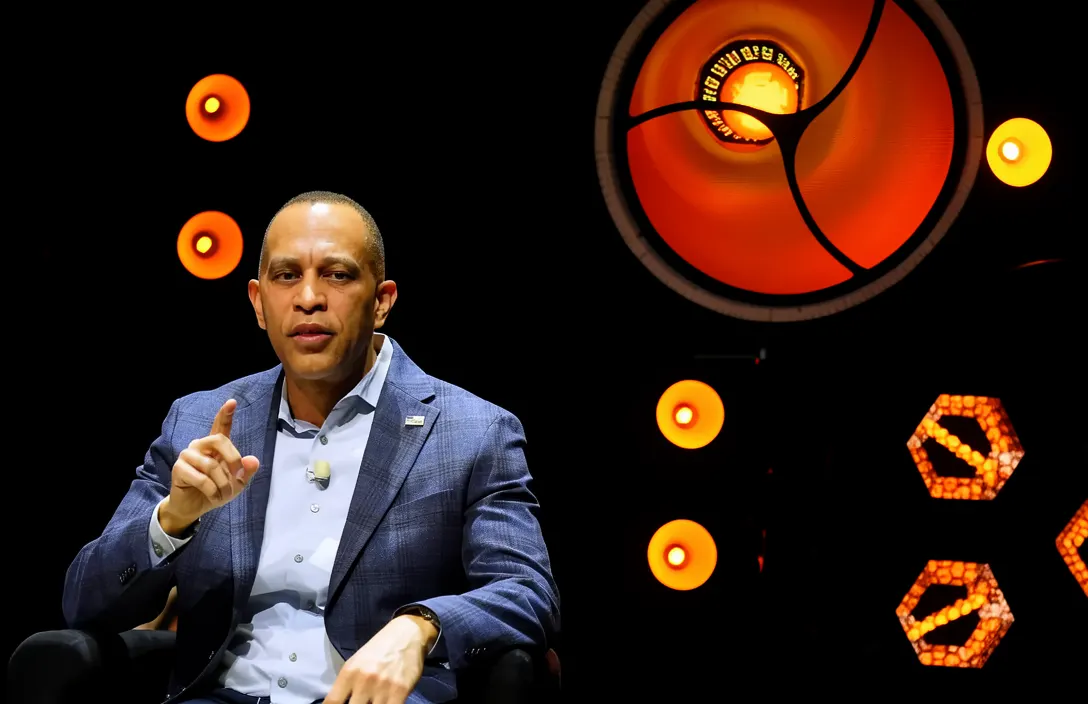

US Rep. Hakeem Jeffries' leadership style has been described as 'stoic' and 'easily misunderstood' by ex-Rep. Steve Israel at USA Today. Despite some progressive criticisms that Jeffries is 'too cerebral, even risk-averse,' Israel argues that Jeffries' approach has been instrumental in steering Democrats to an 'epic victory.' His leadership is characterized by a balance of ambition and inclusivity, essential for managing a 'broad, diverse, unwieldy majority.' Jeffries' focus on 'delivering for the American people' and 'keeping the majority' has been pivotal in his political success, according to the analysis. [1]
Sen. Ruben Gallego, in an article at The Wall Street Journal, highlights the importance of 'big-ass-truck populism' in the midterms, which saw a new generation of outsider Democrats win more races than in any election since Watergate. Gallego emphasizes that this 'populism' requires Democrats to fight for the people's interests rather than acting as 'hall monitors.' He argues that it is 'pride and love of country' that motivates efforts to 'make America better,' and that Democrats must 'redefine American populism' by focusing on the 'cost of living' and being 'champions for where Americans want their lives to go.' [1]
Maria Cardona at RealClear Politics warns that taking Hispanic voters for granted is a 'perilous stance' for any political party. After Democrats 'fell fast asleep at the switch,' Latinos shifted their support to Republicans, who promised policies to 'lower the price of gasoline, groceries, and rent; curb inflation; and make their communities safer.' This shift led to a 'sweeping, historic swing back to the Democratic coalition,' who 'recruited top-tier Latino candidates' and 'hired Latino operatives who knew their neighborhoods.' Cardona notes that the GOP's 'doubling down on hardline tactics' through appointments like Stephen Miller may not resonate with Latinos, who have 'declared in one united voice: '¡NO MÁS!'' [1]
US Rep. Hakeem Jeffries delivered remarks during a Democratic conference held in Denver on Nov. 13, 2026, as captured by AP Photo/David Zalubowski. This event took place in the context of a broader political landscape where Jeffries has been in Congress for 14 years, contributing to significant Democratic victories. His leadership style, described as stoic, has drawn both praise and criticism, with some arguing it may be too cerebral or risk-averse for high-stakes political battles. However, his strategic focus on delivering for the American people and maintaining party unity has been cited as key to Democratic successes. [1]
Advertisement
Sen. Ruben Gallego’s commentary in The Wall Street Journal highlights the rise of a new generation of outsider Democrats in the midterms, echoing a trend that saw more Democratic candidates win races than in any election since the Watergate era. This surge, termed ‘big-ass-truck populism,’ emphasizes a focus on the cost of living and aligning with American traditions rather than acting as critics of the system. Gallego stresses the importance of pride and love of country in motivating efforts to improve America, which he views as essential to redefining American populism and rebuilding Democratic majorities. [1]
The investigation into the Jason Arday affair at Cambridge, as discussed by City Journal’s Theodore Dalrymple, has been criticized for its narrow focus. Rather than examining allegations of plagiarism or the academic value of Arday’s work, the inquiry centers on institutional arrangements for addressing race equality. Dalrymple dismisses this as an ‘elaborate and expensive charade,’ suggesting it avoids the core question of whether Arday should have been appointed in the first place. He compares the investigation to a ‘blindfolded monkey who sees no evil,’ highlighting its perceived lack of substance and effectiveness. [1]
Maria Cardona’s analysis in RealClear Politics warns that both major parties risk losing Latino voters if they fail to address their concerns effectively. After Democrats neglected their promises, Latino voters shifted their support to Republicans, who had initially offered policies on lowering the cost of living and improving community safety. However, this trust was later betrayed, leading to a significant swing back toward the Democratic coalition. Cardona notes that the Democratic Party has since made efforts to recruit Latino candidates and engage the community, while the appointment of Stephen Miller as White House chief of staff may further alienate this group. [1]
E.J. McMahon’s commentary in Substack discusses New York’s record-breaking mid-year budget surplus, which reached at least $8 billion in 2026, driven largely by investment gains among high-income earners. Despite this windfall, progressive voices are pushing for Governor Kathy Hochul to implement further measures to ‘tax the rich.’ However, McMahon points out that high-income New Yorkers already face the state’s highest marginal tax rates in over 40 years, and the revenue from this group is more volatile than ever. This has led to a growing erosion of the wealthiest segment of the state’s tax base, even as state spending has increased by 42%. [1]
Advertisement
Maria Cardona at RealClear Politics warns that taking Hispanic voters for granted is a 'perilous stance' for any political party. This caution comes in the wake of a significant political realignment among Hispanic voters, who previously leaned towards the Republican Party due to perceived policies that addressed their economic concerns. The shift in allegiance is attributed to a sense of betrayal following the implementation of certain policies that did not meet the expectations of the Hispanic community. [1]
According to Cardona, the Democratic Party's strategic efforts have led to a 'sweeping, historic swing back to the Democratic coalition.' This strategic movement involved recruiting top-tier Latino candidates and employing Latino operatives who are well-versed in their communities. These efforts have been instrumental in reconnecting with the Hispanic electorate, who have shown a preference for policies that align with their interests and values. [1]
The political landscape has been further complicated by the appointment of Stephen Miller as White House chief of staff, which Cardona suggests may be perceived as a 'doubling down on hardline tactics.' This move has been met with resistance from the Latino community, who have collectively expressed their discontent with such approaches, emphasizing a unified stance against policies they believe do not serve their best interests. [1]
Sources
Prepared with AI assistance from the cited sources.
The Cali Reporter newsletter
The stories worth your time.
California, the country, and what comes next. Join our free newsletter for reporting that keeps you informed.
More in U.S. News
- Nvidia CEO Returns to Denny's After Plaque Removal
Nvidia's CEO, Jensen Huang, has returned to the Denny's in San Jose, California, where the company was founded, following the temporary removal of a commemorative plaque.
- Taylor Frankie Paul Hints at Applying for Sam Hartman's 'Bachelor' Season
Taylor Frankie Paul, whose 'Bachelorette' season was canceled, is jokingly suggesting she may apply for Sam Hartman's upcoming 'Bachelor' season.
- Kentucky Couple's Dream Home Turns Into Snake-Infested Nightmare
A Kentucky couple's new home has become a snake-infested nightmare, with evidence suggesting the infestation may have been present for decades.