

Global AI Chip Market to Soar to $670.2 Billion by 2036 Amid Generative AI Boom
The AI chip market is exploding from $87.6 billion today to $670.2 billion by 2036, yet the real winners won't be the versatile GPUs dominating now but the specialized ASICs and TPUs racing ahead on efficiency.
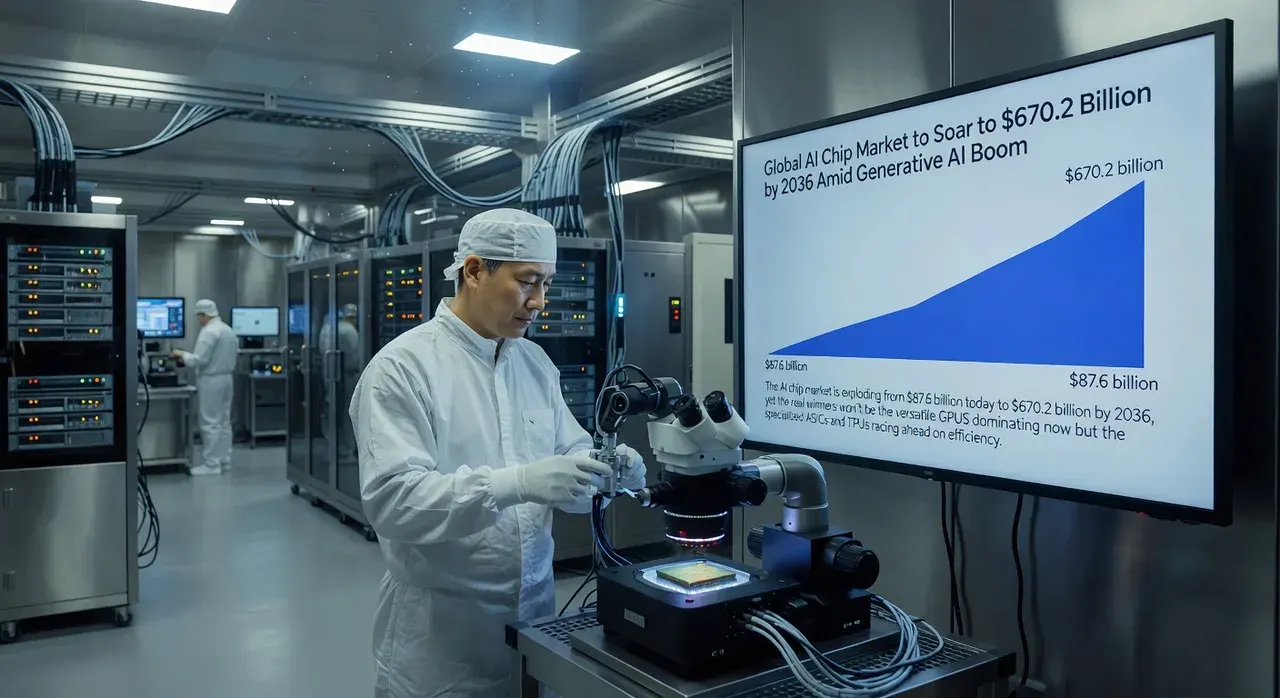
The global AI chip market is set to multiply nearly eightfold over the next decade, climbing from $87.6 billion in 2026 to $670.2 billion by 2036 at a compound annual growth rate of 22.6%. That headline number from ResearchAndMarkets.com sounds like another breathless tech forecast, but the deeper numbers reveal a shift already underway: inference chips now command the largest share because real-world deployment of pre-trained models demands low-latency, real-time decisions far more than the headline-grabbing training runs.
GPU makers like NVIDIA, AMD, and Intel still own the 2026 landscape thanks to their ability to handle large-scale training, inference, and deep learning inside modern data centers. Yet the report flags ASIC and TPU segments as the ones poised for the fastest CAGR, propelled by the need for application-specific acceleration, lower power draw, and performance efficiency that general-purpose silicon increasingly struggles to deliver.
Edge processing, once an afterthought, is gaining traction as organizations push AI closer to where decisions happen in autonomous vehicles, industrial IoT, and consumer electronics. The cloud and data-center segment still dwarfs everything because centralized infrastructure is where the biggest models get built, but the report makes clear that distributed, low-latency architectures are no longer optional.

Geographically, North America leads on sheer investment and the presence of NVIDIA, Google, Amazon, Apple, and Meta. Asia-Pacific, however, is forecast to grow fastest, riding semiconductor manufacturing muscle in Taiwan, South Korea, and China plus aggressive national AI adoption plans. Europe and the rest of the world remain bit players for now.
The explosive expansion of generative AI applications, the rush toward autonomous vehicles, and the ballooning of data-center infrastructure are listed as the main growth engines. What the report does not dwell on is whether this hardware arms race can continue without massive energy and capital constraints that specialized chips are supposed to solve but have yet to fully prove at planet scale.
The question the $670 billion forecast quietly raises is whether today's GPU incumbents will gracefully cede ground to the custom silicon specialists, or whether the entire boom depends on a handful of U.S. and Asian giants that already control the supply chain.
Original reporting: GlobeNewswire.
More in Business
- IMF Chief Warns of Economic Divergence and Debt Risks Amid Artificial Intelligence Boom
Kristalina Georgieva suggests that while AI could significantly boost global growth, it simultaneously threatens to widen inequality and exacerbate inflationary pressures and public debt burdens.
- California Limits Utility Profits and Expands Home Energy Role
Gov. Gavin Newsom signed laws capping utility returns on lower-risk projects and accelerating virtual power plant development.
- Lyft to Pay $272.5 Million in Record California Wage-Theft Settlement
Largest such settlement in state history resolves claims that Lyft misclassified drivers as independent contractors from 2016 to 2020, denying them core wage protections.