George Sosnak's Baseball Art: A Unique Blend of Sports and History
George Sosnak, a self-taught artist and former umpire, transformed baseballs into intricate works of art, capturing the essence of the sport and its history.

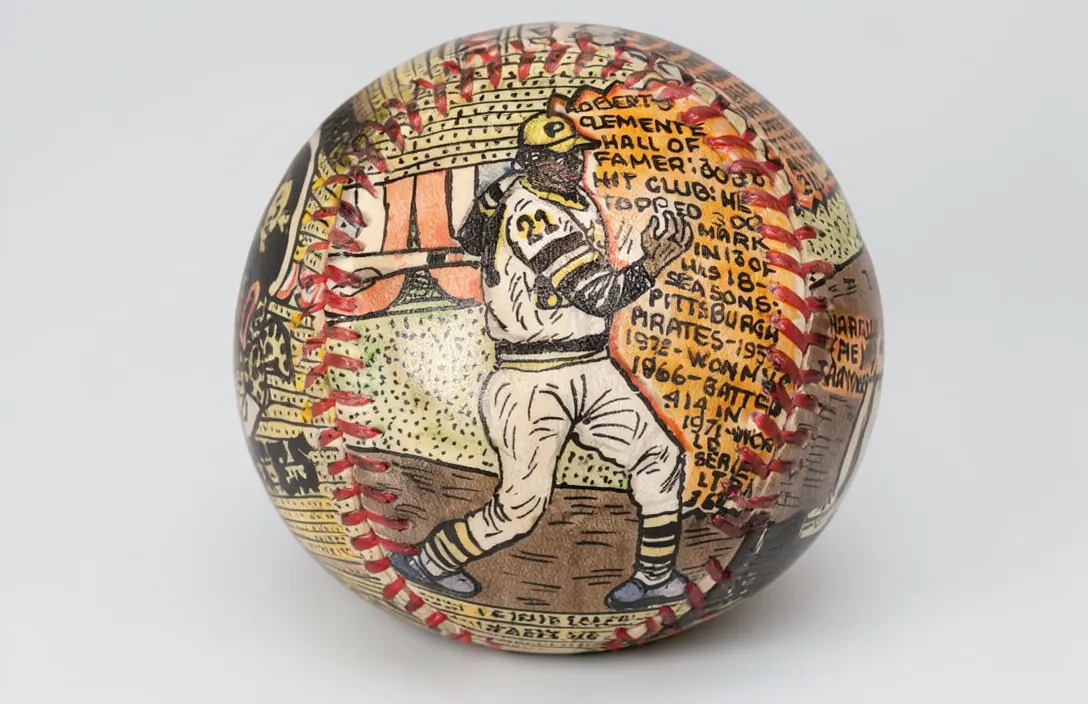

George Sosnak, born in Pittsburgh in 1924, was a self-taught artist who used baseballs as a canvas to depict moments and people significant to him and fellow fans. He painted over 800 baseballs in his lifetime, with an estimated 3,000 painted balls in total (source ID 1). Each baseball offered Sosnak at least four spaces to fill with images of players, team insignia, or text recounting playing statistics or triumphs, all meticulously rendered in India ink. His work often involved intricate details, such as spectators in Forbes Field represented by tiny ink dashes, requiring magnifying glasses to fully appreciate the nuances (source ID 1). [1]
Sosnak's creations are often colorful, depicting players in action, with facts about them or their games written alongside. Many of the baseballs function as miniature stories, a spherical, secular altarpiece that tells the story of a key game or season (source ID 1). His 1978 tribute to the Pittsburgh Pirates puts Pie Traynor, Bill Mazeroski, and Roberto Clemente together on one ball, despite the fact that they never played on a single team together. This depiction created a kind of pantheon, with the timeless image of Clemente finishing his swing juxtaposed with the specific moment Mazeroski raised his hat while circling the bases after hitting the home run that won the 1960 World Series (source ID 1). [1]
Sosnak’s scenes often involve these juxtapositions, using the raised seams and the uneven leather strips to both separate and connect moments for artistic effect. He even depicted something other than baseball itself on the balls, including other sports. But his main focus was on using the spherical leather canvas to memorialize the moments and people that mattered to Sosnak – and to fellow fans who commissioned the balls (source ID 1). His work linked the American folk art tradition with the talismanic nature of an actual baseball, creating a unique blend of sports and history (source ID 1). [1]
George Sosnak, born in Pittsburgh in 1924, was a self-taught artist who used baseballs as a canvas to depict moments and people significant to him and fellow fans. Sosnak worked as a minor league umpire starting in his 30s, but he became better known as an artist over the subsequent four decades (1). Each baseball offered Sosnak at least four spaces to fill with images of players, team insignia, or text recounting playing statistics or triumphs, all meticulously rendered in India ink (1). [1]
Advertisement
An ongoing exhibit at the Westmoreland Museum of American Art features over 60 of the approximately 800 balls he finished painting in his lifetime—he began painting nearly 3,000 balls (1). Sosnak’s creations are often colorful, depicting players in action, with facts about them or their games written alongside. Many of the baseballs function as miniature stories, a spherical, secular altarpiece that tells the story of a key game or season (1). [1]
Sosnak’s scenes often involve these juxtapositions, using the raised seams and the uneven leather strips to both separate and connect moments for artistic effect. He even depicted something other than baseball itself on the balls, including other sports. But his main focus was on using the spherical leather canvas to memorialize the moments and people that mattered to Sosnak—and to fellow fans who commissioned the balls (1). [1]
George Sosnak, born in Pittsburgh in 1924, was a self-taught artist who used baseballs as a canvas to depict moments and people significant to him and fellow fans. Sosnak worked as a minor league umpire starting in his 30s, but he became better known as an artist over the subsequent four decades. Each baseball offered Sosnak at least four spaces to fill with images of players, team insignia or text recounting playing statistics or triumphs, all meticulously rendered in India ink (1). [1]
An ongoing exhibit at the Westmoreland Museum of American Art features over 60 of the approximately 800 balls he finished painting in his lifetime—he began painting nearly 3,000 balls (1). Sosnak’s creations are often colorful, depicting players in action, with facts about them or their games written alongside. Many of the baseballs function as miniature stories, a spherical, secular altarpiece that tells the story of a key game or season (1). [1]
Advertisement
Sosnak’s scenes often involve these juxtapositions, using the raised seams and the uneven leather strips to both separate and connect moments for artistic effect. He even depicted something other than baseball itself on the balls, including other sports. But his main focus was on using the spherical leather canvas to memorialize the moments and people that mattered to Sosnak – and to fellow fans who commissioned the balls (1). [1]
George Sosnak, born in Pittsburgh in 1924, was a self-taught artist who used baseballs as a canvas to depict moments and people significant to him and fellow fans. Sosnak worked as a minor league umpire starting in his 30s, but he became better known as an artist over the subsequent four decades (1). Each baseball offered Sosnak at least four spaces to fill with images of players, team insignia, or text recounting playing statistics or triumphs, all meticulously rendered in India ink. [1]
An ongoing exhibit at the Westmoreland Museum of American Art features over 60 of the approximately 800 balls he finished painting in his lifetime—he began painting nearly 3,000 balls (1). Sosnak’s creations are often colorful, depicting players in action, with facts about them or their games written alongside. Many of the baseballs function as miniature stories, a spherical, secular altarpiece that tells the story of a key game or season. [1]
Sosnak’s scenes often involve these juxtapositions, using the raised seams and the uneven leather strips to both separate and connect moments for artistic effect. He even depicted something other than baseball itself on the balls, including other sports. But his main focus was on using the spherical leather canvas to memorialize the moments and people that mattered to Sosnak—and to fellow fans who commissioned the balls. [1]
Advertisement
The Cali Reporter newsletter
The stories worth your time.
California, the country, and what comes next. Join our free newsletter for reporting that keeps you informed.
More in Explainers
- NATO Confronts Escalating Russian Airspace Violations
NATO has faced a sharp increase in Russian airspace violations, with incidents rising sharply in 2025 and continuing into 2026, according to a systematic review of data and events.
- Target-Date Funds and Market Volatility in Retirement Savings
Market fluctuations, particularly in tech stocks like Nvidia, are prompting concerns about the impact on retirement savings held in target-date funds. These funds automatically adjust their asset allocation as…
- Understanding Polyglotism: What It Really Means to Speak Multiple Languages
The term 'polyglot' is often used to describe individuals who speak multiple languages, but determining the exact criteria for such a label remains a complex and debated topic. This section explores historical and…