

Diablo Canyon Fire Threat, $500M State Investment and the $1.5 Billion Federal Fight: California Steps In
How the state is covering federal gaps as wildfire season brings new dangers

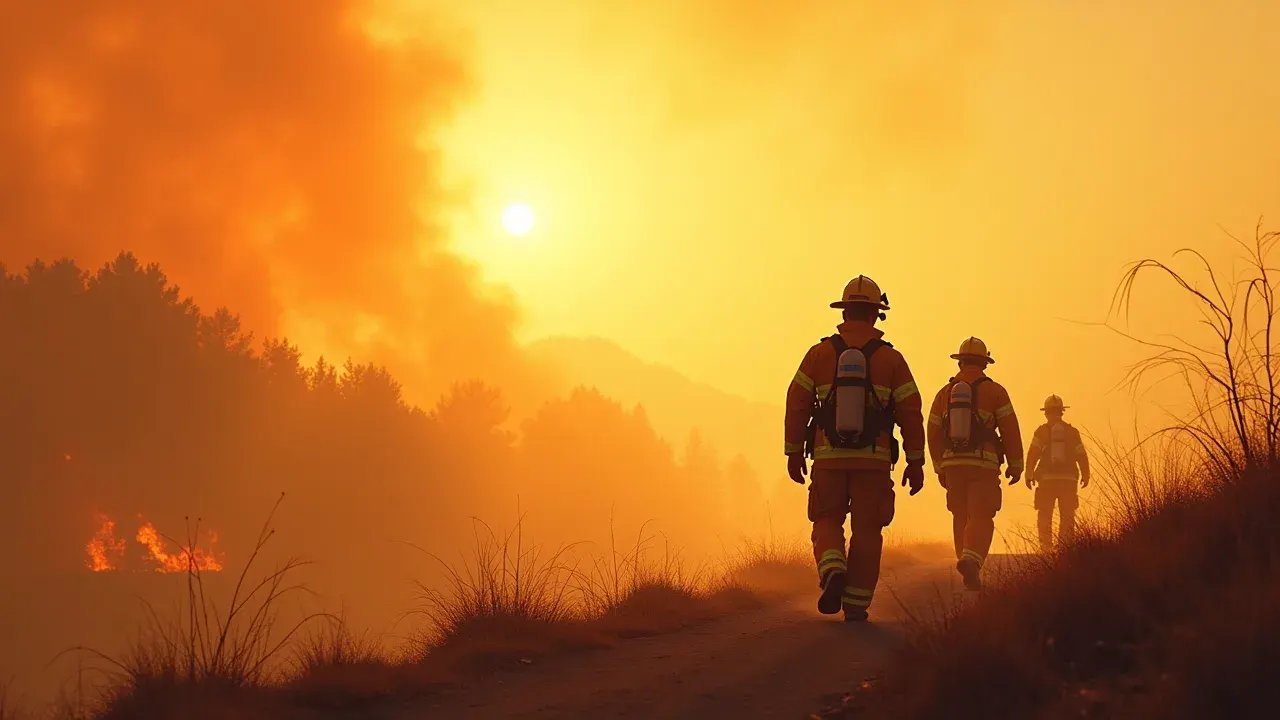
California’s last working nuclear power plant sits cradled in a landscape that would worry any firefighter when the wind picks up. The Pacific Ocean and its perpetual fog lick the western edge of the coastal bluffs holding the Diablo Canyon Power Plant. But the Irish Hills rise steeply to its east. Their slopes are rugged and dark with scrub and oak. Difficult to access. Full of fuel. This terrain presents a stark reality for those tasked with keeping the state safe.
“Any fire within the Diablo power plant area could be catastrophic,” said Dave Erickson, a division chief and forester with the Cal Fire San Luis Obispo unit. The property, he said, is in a very high fire severity zone. “So we just take precautions.” It is one of the many places where California is now stepping into federal gaps created by Congress’ long-term underinvestment in fuels management on federal lands, the Trump administration’s cuts, and firefighters stretched thin by blazes raging across the West. The situation requires a response that blends local urgency with state resources.
A local organization with state funding, the San Luis Obispo County Community Fire Safe Council, started carving a fuel break into the surrounding ridgelines. And Erickson put his crews to work closing the gaps. He aimed to create a critical toehold for firefighters to get ahead of flames. In the past, the patchwork of landowners around the power plant, which includes the U.S. Bureau of Land Management, could have derailed Erickson’s plans. But a 2023 agreement Cal Fire signed with the bureau enabled Erickson to use state resources on federal land to complete the fuel break earlier this year. The bureau managed key environmental surveys, planning, and approvals. “The project was designed from the beginning as an interagency effort,” said Philip Oviatt, a spokesperson for the Bureau of Land Management California in an email to CalMatters. “No single agency could have achieved this outcome independently.” This collaboration is a model for the state and federal partnership.

The stakes are high for California, where wildfires have burned through millions of acres in the last decade. These fires have killed more than 220 people. They have hastened the deaths of tens of thousands more. They have racked up tens to hundreds of billions of dollars in damage. The costs are high, too. California has spent nearly half a billion dollars in grants for wildfire resilience and forest health projects on federal lands since Gov. Gavin Newsom took office, according to the California Natural Resources Agency. Jonathan Fitch, manager of Cal Fire’s vegetation management program, spearheaded three new agreements Cal Fire reached last year with the U.S. Forest Service. The deals allow California to clear fuels, collect cones for seed banks, replant burned lands, and manage timber on California’s national forests, according to Fitch. The Forest Service kicked in $4 million for the agreements across the state. Some of this money will go toward fuels-reduction projects, Fitch said. But the overall need far exceeds the federal funds. “The true value is unlocking the state’s potential and resources on the federal landscape,” Fitch said.
From left, Dave Erickson, Cal Fire forester and division chief, talks with Jeff Benyo, fire captain at Diablo Fire, and Jonathan Fitch, program manager of vegetation management, as they walk through a fuel break carved into a ridgeline near Diablo Canyon Power Plant in San Luis Obispo County on July 22, 2026. The image captures the physical toll and the strategic importance of these breaks. It is a question Fitch says he hears often: why should California put its money, people, and equipment to work on federally-managed lands? “My response is, well, wildfires don’t stop at boundaries,” Fitch said. “We cannot disregard what happens in the federal space, because we’re one state. We’re one landscape.” This philosophy drives the state’s aggressive posture in wildfire management.
‘A finite number of firefighters’ Ever since President Donald Trump accused California of failing to adequately rake its forests, more than half of which the federal government manages, Sacramento and Washington have been feuding over fuels management and federal funds. Gov. Gavin Newsom taunted Trump with a “Make America Rake Again” model executive order last year. He also blasted him for withholding roughly $1.5 billion in federal aid following the catastrophic Los Angeles wildfires in January 2025. But for all the fighting, California frequently crosses federal borders to manage land and fire. As the Timber Fire kicked off in Los Padres National Forest near Big Sur, burning nearly 6,000 acres of rugged terrain and forcing the closure of Highway 1, federal incident management teams were busy. Some were on other fires in Hoopa and the Pacific Northwest. Others were taking mandatory rest, according to U.S. Forest Service spokesperson Adrienne Freeman. “So we were going to be looking at ordering a team from across the country, and even those are few and far between,” Freeman said. Instead, the federal agency called in a Cal Fire Incident Management Team to orchestrate the fire response and manage logistics, food, planning, finances, repairs, showers, and medical care. Freeman, Cal Fire, and others say the federal drawdown of incident management teams reflects surging wildfire activity across the West.
But Bobbie Scopa, retired firefighter and vice president of the organization Grassroots Wildland Firefighters, said that the Trump administration’s cuts to the Forest Service have exacerbated long-term staffing problems. “When we DOGED everybody, we lost people from the teams,” Scopa said, referring to Elon Musk’s ill-fated government efficiency program. “We’ve been having a hard time staffing the teams for the last 10 years.” Freeman said the decision to have Cal Fire coordinate the Timber Fire helped keep federal resources free to deploy to other places they were needed. “This is not the first time we’ve done this, but it’s something fairly unique to California,” Freeman said. “There are a finite number of firefighters, but California is in a better position than some states, than most states, because of this relationship.” The reliance on these partnerships is a survival strategy.
Federal blind spot In other areas, it is harder for California to fill federal gaps. As the Trump administration’s Department of Government Efficiency slashed federal agencies, the Forest Service lost at least 20% of its staff last year, according to the U.S. Government Accountability Office. The administration’s reorganization and proposed closures to research facilities have destabilized the agency and gutted morale. Key California scientists left after Trump took office, two former U.S. Forest Service employees told CalMatters. Alan Talhelm, assistant deputy director for climate and energy at Cal Fire, said federal staff losses and job changes have gutted the personnel and expertise that he and his colleagues need to incorporate federal data into the Governor’s Wildfire and Forest Resilience Task Force’s fuels treatment dashboard. “Those data still exist, but we have nobody to help us interpret those data,” Talhelm said. “If we see something that looks unusual, it’s harder for us to verify that it is what it should be and that it’s accurate information.” A spokesperson for the U.S. Forest Service said that because the agency tracks fuels treatment differently, it is “challenging to consolidate our data with our state and local agencies.” The data, which lag by a couple of years, are important for tracking California’s progress toward state and federal fuel management targets. The dashboard provides a bird’s-eye view of who is thinning or burning fuels, and where. It is critical information for state agencies targeting grant dollars and staff towards reducing fire risk, and can help plan where to send firefighters to take a stand against a blaze, Talhelm said. “They can look at this database and say, ‘Oh, there was a prescribed burn here. Oh, there was a fuel break here,’” he said. “That’s a consequence right there. If we don’t have the correct information, it makes the data less useful.”
First reported by almanacnews.com.
More in California
- UC Berkeley Lab Proposes New Civic Framework for California’s Next Governor
A research-driven agenda calls for institutionalizing 'co-governance' to address low public trust and lack of resident influence in state decision-making.
- Five Tax Measures on California’s Ballot Aim to Reshape State Finances
Propositions 3, 40–43 would alter income, wealth and local taxation rules—marking the highest number of tax measures on a general election ballot since 1994.
- Catalina Helicopter Crash Highlights Risks of Island Medevac Flights
A medical evacuation chopper carrying Catalina Romero, pilot, and nurse Jessica Devries crashed into the ocean shortly after takeoff, killing all three; federal investigators are assessing causes including night flying, spatial disorientation, and the island’s challenging Pebbly Beach heliport.