DeepMind's AI Proves Security Properties in Signal's Code
Google DeepMind's AI agents generated 6.5 million lines of machine-checked proofs verifying security properties in Signal's code, according to a report by CryptoSlate.


Google DeepMind's AI agents generated 6.5 million lines of machine-checked proofs verifying security properties in Signal's code, according to a report by CryptoSlate. The results cover specified messaging operations under explicit assumptions, with humans selecting the specifications (source ID 1). The proofs link specific security guarantees to a compiled build of Signal’s encryption library, and the resulting evidence has been made available online for others to check (source ID 1). [1]
The Nov. 10 AlphaProof Code report describes about 6.5 million lines of machine-checked Lean proof code. The result concerns a particular build of libsignal, the Signal protocol’s implementation, under explicit assumptions about cryptography and the environment in which the code runs (source ID 1). The authors state that five people worked on the proofs over four weeks, with humans directing the work, selecting reference models, and reviewing the specifications that defined what the agents had to prove (source ID 1). [1]
The target of the proofs was an AArch64 Linux executable using libsignal-protocol v0.105.4 and SPQR v1.6.0 inside a small command-line harness. The theorems cover session initialization, sending a message, and receiving one, but key generation falls outside the verified scope (source ID 1). The Google report connects the compiled executable to specified properties of PQXDH and Triple Ratchet one-to-one messaging, including forward secrecy, authentication, and post-compromise security (source ID 1). [1]
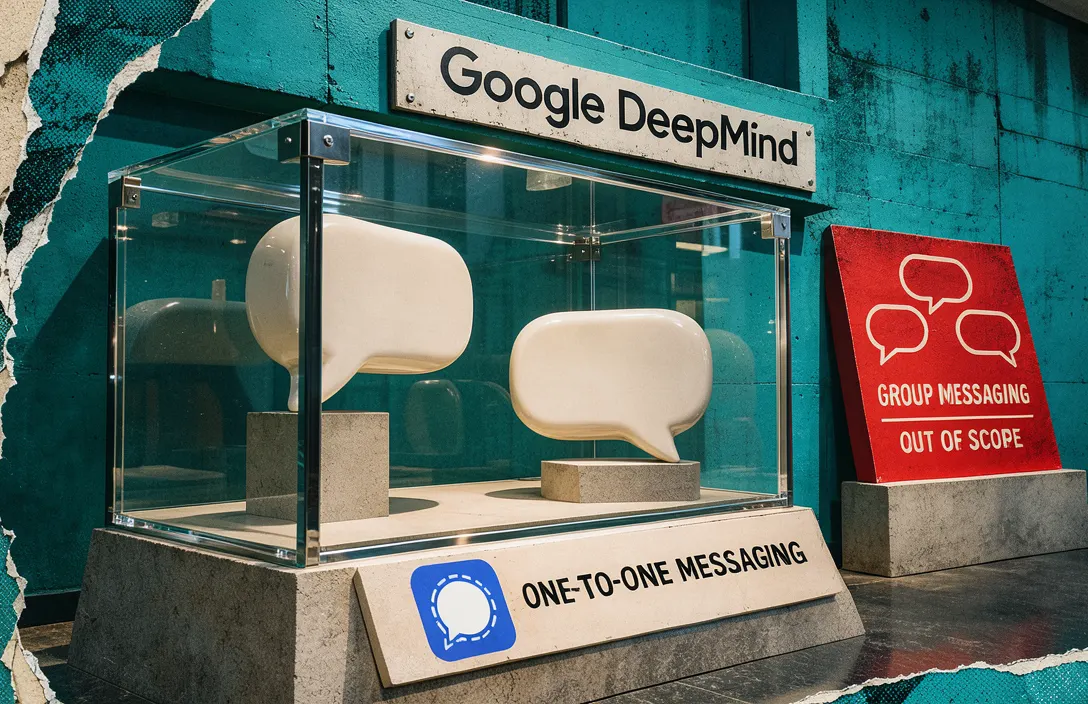
The project focused on a specific AArch64 Linux executable that utilizes libsignal-protocol v0.105.4 and SPQR v1.6.0 within a small command-line harness. The verification scope included session initialization, message sending, and message receiving, but excluded key generation and group messaging. This executable was chosen as the target for the AI-generated proofs, which aimed to verify security properties under explicit assumptions about cryptographic operations and execution environments. The work was conducted over four weeks by five individuals who directed the AI agents, selected reference models, and reviewed the specifications that the agents had to prove. The compiled build under scrutiny was distinct from Signal’s mobile applications and did not include multi-device state or quantum attacker models. [1]
Advertisement
The project's Nov. 11 update on GitHub introduced the verification of ten additional library routines, reducing the number of trusted routine hooks from 37 to 27. These hooks replace the execution of selected routines with assumed descriptions of their behavior. The update retained libsignal v0.105.4 but updated the pinned executable to a newer build that verifies the machine code for those ten routines instead of relying on modeled contracts. The project repository provides public instructions for rebuilding the pinned binary and checking its proofs. A Linux-only comparator is used to ensure that the theorems and dependent definitions match trusted statements before replaying the proofs in a fresh Lean kernel. [1]
The AI-generated proofs cover specific security properties such as forward secrecy, authentication, and post-compromise security for PQXDH and Triple Ratchet one-to-one messaging. These properties address whether earlier messages remain confidential after key theft, whether senders are authenticated, and whether a session can regain secrecy after a compromise. The symbolic analysis relies on idealized cryptographic operations and collision-free executions, while the computational analysis bounds the success of classical attackers under stated cryptographic assumptions. However, the computational proof does not cover quantum attackers, and group messaging is explicitly outside the report’s scope. The results depend on trust in Lean’s checking kernel, the specifications reviewed by the researchers, the AArch64 Linux model, and the contracts describing selected routines. [1]
The AI-generated proofs for Signal's code focus on specific aspects of its encryption library, including session initialization, sending, and receiving messages. According to the Nov. 10 AlphaProof Code report, these proofs apply to an AArch64 Linux executable using libsignal-protocol v0.105.4 and SPQR v1.6.0 within a small command-line harness. The theorems cover security properties such as forward secrecy, authentication, and post-compromise security for PQXDH and Triple Ratchet one-to-one messaging (Source ID: 1). [1]
However, the scope of the verified security properties is limited. Key generation, group messaging, and multi-device states are not included in the current verification. The symbolic proof model assumes idealized cryptographic operations and collision-free executions, while the computational model bounds classical attackers but does not address quantum threats (Source ID: 1). [1]
Advertisement
The verification process relies on trusted components such as the specifications reviewed by researchers, the AArch64 Linux model, and contracts describing selected routines. The project’s Nov. 11 update on GitHub includes additional verified library routines, reducing the number of trusted routine hooks from 37 to 27 (Source ID: 1). [1]
Public instructions are provided to rebuild the pinned binary and check its proofs using a Linux-only comparator. This allows other researchers to verify the connection between the security requirements and the executable code. However, no independent rebuild or verification of the full proof package has been performed by CryptoSlate (Source ID: 1). [1]
Sources
Prepared with AI assistance from the cited sources.
The Cali Reporter newsletter
The stories worth your time.
California, the country, and what comes next. Join our free newsletter for reporting that keeps you informed.
More in Business
- Kirkland Signature Meals: A Family's Take on Taste and Value
A family's review of Kirkland Signature meals highlights a mix of flavors, textures, and value at Costco, with some dishes standing out while others fall short of expectations.
- Ex-OpenAI Engineer Donates Equity to AI Safety
Jacob Coxon, a former engineer at OpenAI and Anthropic, has pledged to donate his equity in OpenAI to AI safety research, citing concerns over the risks of uncontrolled AI development.
- Scottish Hacker Sentenced for Crypto Theft Scheme
A Scottish hacker has been sentenced to six years in U.S. federal prison for orchestrating a large-scale cryptocurrency theft operation, according to a report from the U.S. Attorney’s Office for the Central District of…