

Gov's Secret Fire Bailout Plan Exposed as 'Emperor Has No Clothes' by Altadena Survivors Demanding Accountability
Survivors at Capitol say the governor's last-minute utility deal favors shareholders over victims and cuts critical fire aid
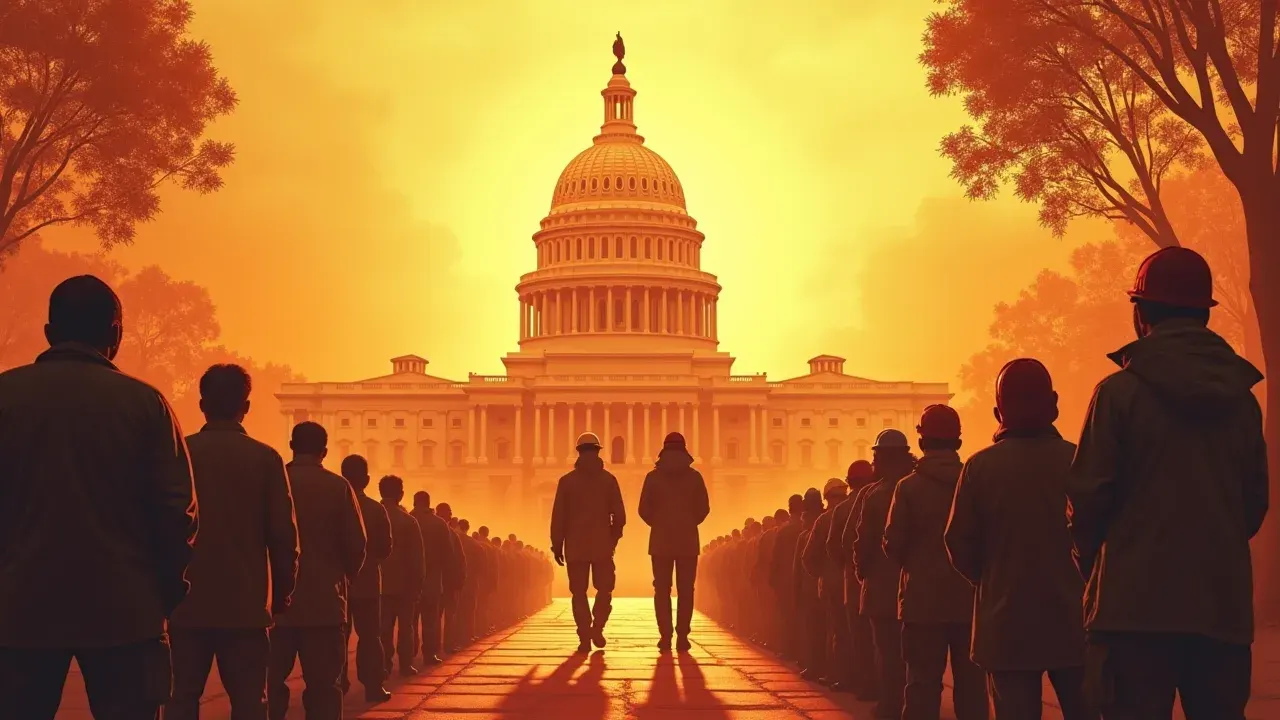
Over fifty wildfire survivors from across California gathered outside the Capitol building today to deliver a clear message to Sacramento. They called on lawmakers to stand with fire victims and reject a plan by the governor in the final days of the legislative session to bail out utilities for fires they cause. The protesters last night met lawmakers entering an end of session party at the Governor's Mansion with chants of who should pay for the devastation. The response was clear. Shareholders should pay. The governor's proposal would reduce compensation for victims of utility-caused fires local governments and insurance companies to give that money to utility shareholders. The survivors and supporters argued lawmakers should refuse to vote on legislation that is still not in print and bring the issue back in January. First reported by prnewswire.com.
“The emperor has no clothes here,” said Joy Chen executive director of Every Fire Survivor's Network. “There is no financial emergency. They refuse to show any numbers any backup any financial analysis proving the emergency they cite. This is a subversion of democracy.” Chen pointed to modeling that shows the Wildfire Fund has $38 billion in payment capacity and estimated claims of $10 billion to $15 billion. The Newsom Administration has not produced any modeling or information to refute the modeling cited by EFSN. The event highlighted a tense standoff between the state's executive branch and the communities most affected by the state's wildfire crisis. It also exposed a procedural quirk in how California passes laws. When the governor in the final days of an eight month legislative session demands that legislators approve a deal that he refuses to share the text of a deal that the modeling shows is unwarranted the process breaks down. He refuses to show his math. He refuses to show his assumptions. Yet he demands that legislators approve this in secret. This is not how a healthy democracy should function.
“Altadena is showing up in Sacramento to refocus the conversation on fire survivors,” said Senator Sasha Renee Perez. “It has been so frustrating and disappointing for the community that has been fighting for its needs fighting for its rights to watch the conversation in Sacramento be shifted to focusing instead on the fire liability for Wall Street corporations.” Perez noted that the focus on corporate liability often overshadows the immediate needs of the people losing their homes. The senator emphasized the importance of recentering the conversation on what fire survivors actually need and what they have been demanding for years. “We have heard clearly that they want to see these utilities companies held accountable for the damage they have caused the community,” Perez added. “So when I hear conversations about bailouts for utility companies that have destroyed entire communities when I hear that it is an emergency that we need to provide assistance to investor owned utilities I question what the real emergency is.” The wildfire survivors' groups said that while plans from the Assembly push back on the governor they retain a provision that would devastate survivors. This provision draws bright lines around a fire zone beyond which survivors would not be eligible for compensation for their suffering. The line could preclude people with smoke damage in their homes from receiving adequate compensation.

“There is no rational basis for using a government-drawn fire perimeter to decide which survivors can seek compensation,” said Chen. “A fire perimeter maps a fire. It does not measure actual harm.” Chen offered a personal example to illustrate this point. “My own property shows how arbitrary this is.” Chen described a property where the house sits on the south side of the property and the chicken coop sits at the north end. “That night the winds blew from north to south.” The fire burned through the backyards of the row of homes immediately north of the chicken coop. “The CAL FIRE 'fire perimeter line' cuts directly through our property: our chicken coop is inside the line while our house is outside it.” This geographical distinction creates a bizarre outcome. “Yet our harm was very real.” The insurance company paid more than $200,000 for remediation and housing while the home was unsafe and they were displaced. “Just 400 feet north of my house someone died from the fire that night. The fire was moving at roughly 200 feet per minute. We were incredibly lucky we did not get injured or killed and our house did not burn. However as we evacuated we had no idea whether we would have a home to return to. My children and I experienced the same terrifying evacuation as families inside the perimeter and we will carry that trauma for the rest of our lives.” The survivor argued that a physical line on a map cannot determine the depth of psychological and financial trauma.
“We lived in Altadena for more than 30 years. Everything we owned was gone,” said Gayle Nicholls-Ali who said her greater concern was for her son. “His home was the only one that survived. But the nightmare he is going through to get back home is horrific.” Nicholls-Ali noted that legislators often forget the reality of the situation. “And anyone with a standing home knows this. Legislators do the right thing. Think about where you would be if your home burned down.” The survivor highlighted a specific demographic concern. “There are survivors who didn't lose their home and are sometimes in a worse position returning to their homes than those who lost their homes entirely.” This subtle distinction is often lost in political debates about total loss versus partial loss. “Some of their pain and suffering and emotional devastation will be compensated and some won't.” The compensation is not proportional to the injury but rather to the location relative to a fire line. “Not because their pain was any less but because they fall on one side of a bright line.” The governor's plan is to say some fire survivors are compensated and some aren't. Setting a bright line between survivors who can be compensated and those who can't is still in all their plans. That is why some of the survivors here today have signs saying no lines separate fire survivors.
“I am outraged,” said Consumer Watchdog board member and survivor Ellen Snortland. “My husband and I are total loss survivors of the Los Angeles fire. It's daunting to start our lives over at this stage of our lives.” Snortland's perspective brings a different kind of urgency to the conversation. The focus is not just on property damage but on the complete dismantling of a family's life. The difficulty of starting over in retirement years is a factor often ignored in policy discussions. “We cannot forget about Altadena,” said Assemblymember Isaac Bryan. “We cannot forget about the people who lost their lives. We cannot forget about the black homeownership that was lost and must be regained.” Bryan connected the wildfire crisis to broader issues of racial equity and economic displacement in Southern California. “And we have to remember who caused that fire. It was arson but a different type of arson. Utility arson. So Cal Edison had been found liable for it.” Bryan's reference to utility arson provides a legal and moral framework for holding the corporations accountable. “Any conversation about wildfire liability should center on accountability for those who have found liable.” The survivors pointed to the profitability of the three for-profit utilities as further reason to delay action this year. After the Eaton fire Edison profits tripled. This data point is crucial for the argument against a bailout. If the companies are printing money why should taxpayers or ratepayers bail them out.
“In 2025 alone PG&E Edison and Sempra paid their CEOs nearly $60 million issued more than $3 billion in shareholder dividends and took in more than $10 billion in profits,” the survivors noted. These numbers paint a picture of a corporate sector that is incredibly resilient. “California's electric monopolies caused 3 of the 5 costliest wildfires ever recorded worldwide.” The groups argued that if a utility causes a fire it should stop dividends stock buybacks executive bonuses and reduce its profits until survivors and affected communities are fully compensated. The demand is simple. The profits must first serve the victims. The standoff at the Capitol represents a clash between established political power and the raw power of a community demanding justice. The governor's attempt to force a vote on a complex financial package at the end of a session is a classic move to limit debate. The survivors are proving that debate is necessary. They are proving that the Wildfire Fund has ample resources. They are proving that the financial models presented by the administration are lacking. The message is clear. Sacramento must prioritize the people over the profit margins of the utility giants. The 11th-hour maneuvering by the governor is not the end of the story but the beginning of a new fight for fire survivor rights.
First reported by prnewswire.com.
More in California
- UC Berkeley Lab Proposes New Civic Framework for California’s Next Governor
A research-driven agenda calls for institutionalizing 'co-governance' to address low public trust and lack of resident influence in state decision-making.
- Five Tax Measures on California’s Ballot Aim to Reshape State Finances
Propositions 3, 40–43 would alter income, wealth and local taxation rules—marking the highest number of tax measures on a general election ballot since 1994.
- Catalina Helicopter Crash Highlights Risks of Island Medevac Flights
A medical evacuation chopper carrying Catalina Romero, pilot, and nurse Jessica Devries crashed into the ocean shortly after takeoff, killing all three; federal investigators are assessing causes including night flying, spatial disorientation, and the island’s challenging Pebbly Beach heliport.