China's Nuclear Buildup and U.S. Policy Responses
China is significantly increasing its nuclear capabilities, raising concerns about a potential arms race with the United States. This development has prompted a reevaluation of U.S. strategy, including efforts to…

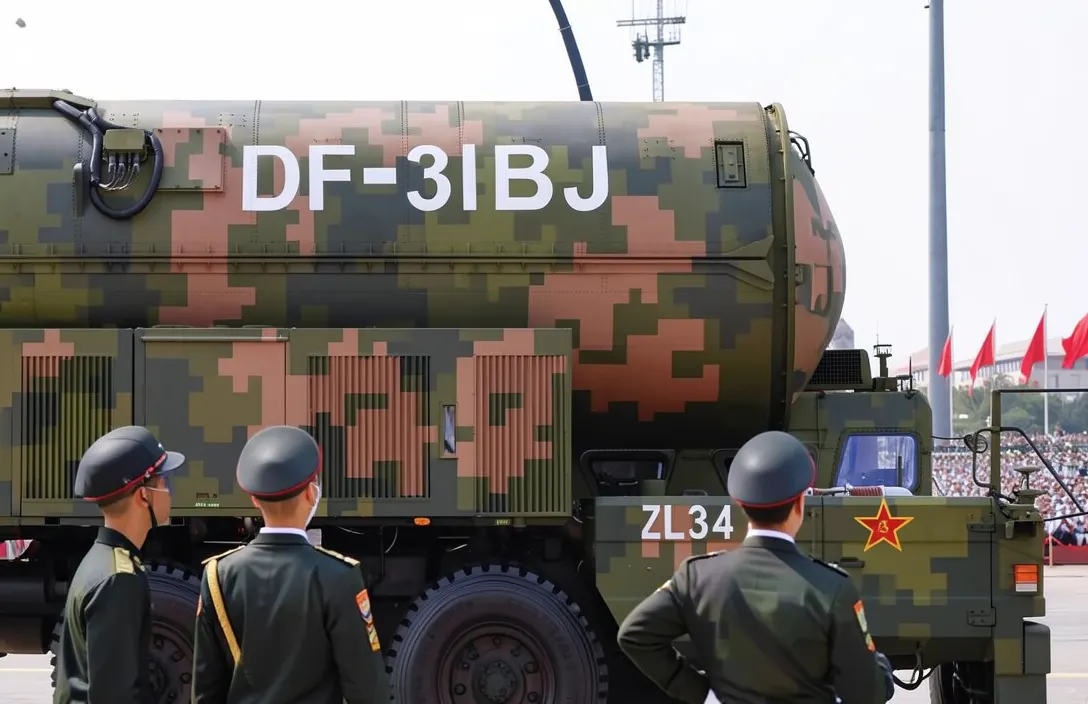

China is significantly expanding its nuclear arsenal, with evidence showing that the number of nuclear warheads has doubled between 2020 and 2025, from 300 to 600. This growth is accompanied by the construction of 350 new nuclear missile silos in Xinjiang and Gansu provinces, as well as the development of advanced nuclear weapons, including new intercontinental ballistic missiles and hypersonic cruise missiles (Foreign Affairs, 2025). Additionally, the Chinese navy tested a submarine-launched long-range ballistic missile capable of carrying nuclear weapons, enhancing China's ability to project power from protected waters near its coastline (Foreign Affairs, 2025). These developments underscore China's growing nuclear capabilities and its strategic focus on enhancing its military posture. [1]
The Chinese government has explicitly linked its nuclear buildup to its desire to exert sovereignty over Taiwan, as highlighted in a recent editorial in a leading Chinese foreign affairs newspaper. The editorial emphasized that national reunification must rest on a solid foundation of hard power, suggesting a direct connection between China's nuclear capabilities and its strategic goals in the Taiwan Strait (Foreign Affairs, 2025). This linkage has raised concerns in Washington, where policymakers increasingly view China's military modernization as a potential catalyst for conflict, particularly over the issue of Taiwan (Foreign Affairs, 2025). The perception of a growing security dilemma between the U.S. and China is further reinforced by the aggressive posture of Chinese military exercises near Taiwan, which are often perceived as provocative by U.S. officials. [1]
Despite China's growing nuclear capabilities, its long-standing tradition of nuclear restraint and its no-first-use policy continue to provide opportunities for strategic engagement. Chinese diplomats have historically supported arms control initiatives, including the 2015 Iran nuclear deal, and have played a constructive role in international efforts to manage nuclear risks (Foreign Affairs, 2025). Recent diplomatic efforts, such as the 2023 agreement between U.S. President Joe Biden and Chinese President Xi Jinping to renew military communication channels, indicate a willingness on China's part to engage in dialogue on strategic stability (Foreign Affairs, 2025). These developments suggest that, despite the current escalation in military capabilities, China remains open to de-escalation and compromise, particularly if the U.S. demonstrates a consistent commitment to arms control and strategic restraint. [1]
China has significantly expanded its nuclear arsenal, with evidence showing that the number of nuclear warheads has doubled between 2020 and 2025, from 300 to 600 (1). This increase is part of a broader military buildup that includes qualitative upgrades to its nuclear weapons and the construction of new missile silos in Xinjiang and Gansu provinces (1). In 2025, a military parade showcased new nuclear-capable weapons, including a submarine-launched long-range ballistic missile that could reach the United States from protected coastal waters (1). These developments reflect China’s growing emphasis on hard power as a means to achieve its strategic objectives, particularly in relation to Taiwan (1). [1]
Advertisement
A recent editorial in a leading Chinese foreign affairs newspaper explicitly linked China’s rapid nuclear buildup to its desire to exert sovereignty over Taiwan (1). The editorial emphasized that the foundation for national reunification must rest on a solid, realistic foundation, which it described as hard power (1). This connection between China’s nuclear capabilities and the Taiwan issue is not new, as it has been supported by scholars such as Tong Zhao, who has analyzed China’s nuclear buildup in Foreign Affairs (1). Despite this nuclear expansion, China has maintained a tradition of nuclear restraint and a no-first-use policy, which have provided opportunities for strategic engagement with other nuclear powers (1). [1]
The United States has expressed concerns about China’s nuclear buildup and its implications for regional stability, particularly in the context of the Taiwan Strait (1). U.S. military officials have warned that China may attempt to invade Taiwan as early as 2027, prompting increased defense preparations by the U.S. Pacific Command (1). While the U.S. has made some attempts to engage China on arms control and nuclear risk reduction, these efforts have been met with resistance from Beijing, which has consistently rejected sustained talks on nuclear matters (1). However, there are indications that China is open to reciprocal de-escalation and compromise, particularly if the U.S. demonstrates a willingness to modify its support for Taiwan and incorporate China into global arms control leadership (1). [1]
China has significantly expanded its nuclear arsenal, with evidence showing that the number of nuclear warheads has doubled between 2020 and 2025, from 300 to 600 (1). This rapid buildup is part of a broader military expansion that includes investments in new nuclear missile silos, advanced missile systems, and submarine-launched ballistic missiles capable of reaching the United States (1). The Chinese government has explicitly linked its nuclear buildup to its desire to exert sovereignty over Taiwan, as highlighted in a recent editorial in a leading Chinese foreign affairs newspaper (1). Despite these developments, China's long-standing tradition of nuclear restraint and its no-first-use policy continue to provide opportunities for strategic engagement (1). [1]
The United States has expressed concerns about China's nuclear buildup and its implications for regional stability, particularly in the context of the Taiwan Strait (1). U.S. officials and analysts have warned that an unrestrained arms race increases the likelihood of war over Taiwan or even of a catastrophic nuclear exchange (1). The U.S. Pacific Command has affirmed that its forces are actively preparing for a potential Chinese invasion of Taiwan, which could occur as early as 2027 (1). These developments have intensified the strategic competition between the two nations, with both sides investing heavily in military modernization (1). [1]
Advertisement
China's nuclear expansion has been accompanied by a series of military exercises and demonstrations of force near Taiwan, which have been consistent with its stated goal of peaceful unification (1). However, the growing nuclear capabilities of China have raised concerns in Washington about the potential for miscalculation or escalation (1). The Biden administration and previous U.S. administrations have attempted to engage China on nuclear risk reduction and strategic stability, but these efforts have largely been unsuccessful due to Beijing's resistance to sustained arms control talks (1). The U.S. has spent over $3.4 trillion on its militarized rivalry with China over the last decade, highlighting the financial and strategic stakes involved (1). [1]
China has significantly expanded its nuclear arsenal, with evidence showing that the number of nuclear warheads has doubled between 2020 and 2025, from 300 to 600 (1). This expansion includes both quantitative and qualitative upgrades, such as the construction of 350 new nuclear missile silos in Xinjiang and Gansu provinces, and the development of new long-range hypersonic missiles. These advancements are part of a broader military buildup that reflects China's strategic ambitions and its desire to assert influence in the region (1). [1]
The United States has expressed concerns about China's nuclear buildup and its implications for regional stability, particularly in the context of the Taiwan Strait (1). China's military exercises and demonstrations of force near Taiwan are consistent with its stated goal of peaceful unification, although these actions have raised alarms in Washington about the potential for conflict (1). The U.S. has also noted that China's nuclear expansion is accompanied by a series of military exercises that demonstrate its growing capabilities (1). [1]
A recent editorial in a leading Chinese foreign affairs newspaper explicitly linked China’s rapid nuclear buildup to its desire to exert sovereignty over Taiwan (1). This editorial highlights the connection between China's nuclear expansion and its strategic goals, emphasizing the importance of hard power in achieving national reunification (1). Despite these concerns, China has maintained a long-standing tradition of nuclear restraint and a no-first-use policy, which continues to provide opportunities for strategic engagement (1). [1]
Advertisement
The Cali Reporter newsletter
The stories worth your time.
California, the country, and what comes next. Join our free newsletter for reporting that keeps you informed.
More in World
- Irish Man Charged with Destroying U.S. Military Aircraft at Shannon Airport
A man from Ireland has been indicted for allegedly destroying a U.S. military aircraft at Shannon Airport, according to prosecutors in New York.
- Trump's APEC Summit and Strategic Meetings
President Donald Trump is set to attend the APEC summit in Shenzhen, China, where he is expected to meet with Chinese President Xi Jinping and participate in a trilateral meeting with Russian President Vladimir Putin,…
- Early Snowfall in Northern England and Scotland
Snowfall occurred in parts of Northern England and southern Scotland, with subsequent melting due to milder temperatures, according to the BBC.