Brokerage Support Systems and Agent Retention
The approach a brokerage takes in supporting its agents can significantly impact retention and long-term success, according to a recent article from HousingWire.

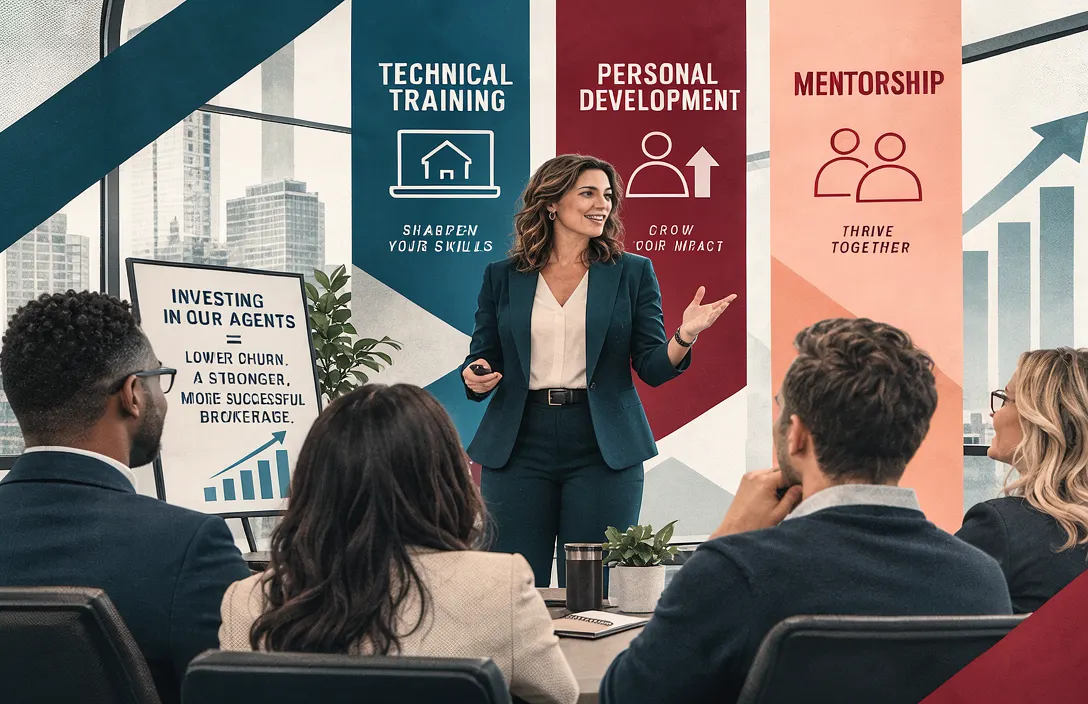

A recent article from HousingWire highlights the challenges brokers face in supporting their agents effectively without overspending. The article notes that many brokers treat education and mentorship as costs rather than investments, leading to high agent churn and low repeat business. This approach can be detrimental for both brokers and agents, as it often results in agents leaving and not becoming top producers. The article emphasizes that brokers who adopt a mentorship approach tend to have agents who thrive and stay with the brokerage longer, leading to lower HR costs and more repeat business. This is in contrast to brokers who take a 'sink or swim' approach, which leads to higher agent turnover and less stability for the brokerage. [1]
According to the article, building a support system requires a structured approach that includes technical training, personal development, and mentorship. Technical training can be developed through a well-rounded library of real estate books and weekly classes taught by experienced agents. Over time, this can be refined into a library of training videos that are tailored to the brokerage's needs and market. The article suggests that personal development should be based on trusted books from authoritative experts, such as Tony Robbins and Jocko Willink, and that interactive programs can also be used to enhance agent growth. [1]
Mentorship is highlighted as a critical component of the support system, though it requires a significant investment of time and energy. The article suggests that brokers can start by being the primary mentor and gradually involve other top producers by offering incentives and framing mentorship as a way to enhance their own skills. This approach can lead to more successful agents and greater opportunities for collaboration within the brokerage. The article concludes that creating an environment that enables agents to become more successful quickly is essential for brokers who want to thrive in the real estate market. [1]
Derek Carlson is the president and managing broker of Realty ONE Group MVP, a Florida-based real estate brokerage firm with over 1,100 Realtors. The firm operates primarily in Florida, though its influence and practices may extend to other regions depending on its market expansion strategies. The brokerage has a documented history of rapid growth, having expanded from its founding to over 1,100 agents in just nine months under Carlson's leadership as CEO and qualifying broker. This expansion was notable for its speed and scale, positioning the firm as a significant player in the Florida real estate market. The firm’s approach to agent support and training has been highlighted as a key factor in its success, particularly in its focus on mentorship and structured development programs. However, the firm’s documented limits include the challenges of managing such a large and rapidly growing workforce, which may impose constraints on the consistency of training and the personal attention each agent can receive. [1]
Advertisement
The support system developed by Realty ONE Group MVP is structured around three core elements: technical training, personal development, and mentorship. Technical training is built incrementally, starting with a library of real estate books and progressing to in-house training materials tailored to the firm’s specific business and market. The firm emphasizes the importance of keeping these materials updated as laws, regulations, and internal processes evolve. Personal development is supported through external resources, including books by well-known authors such as Tony Robbins, Jocko Willink, and Robert Greene, as well as interactive programs that agents can attend in person or virtually. The firm’s approach to mentorship is unique, with Carlson himself serving as the primary mentor initially, and then leveraging the firm’s top producers to take on mentoring roles through incentives and opportunities for collaboration. [1]
The firm’s documented limits include the financial and time investment required to implement and maintain its comprehensive support system. While the approach is designed to be cost-effective in the long term, the initial setup and ongoing maintenance of training materials, mentorship programs, and personal development resources require significant planning and resources. Additionally, the firm’s rapid growth may pose challenges in ensuring that the same level of support and training is consistently delivered to all agents, particularly as the number of agents increases. The firm also faces the challenge of maintaining a culture of mentorship and continuous learning as it scales, which can be difficult to sustain without a structured and well-resourced system in place. [1]
Sources
Prepared with AI assistance from the cited sources.
The Cali Reporter newsletter
The stories worth your time.
California, the country, and what comes next. Join our free newsletter for reporting that keeps you informed.
More in Housing
- FHA's HECM Portfolio Faces Capital Ratio Challenges
The Federal Housing Administration's 2026 report highlights a significant decline in the capital ratio for its HECM reverse mortgage program, raising concerns about its financial stability and future policy implications.
- Mortgage Rate Projections and Real Estate Industry Concerns
Industry experts are analyzing the potential for mortgage rates to rise to 9% by 2027, though such a scenario is considered unlikely by many. The real estate sector is preparing for a range of challenges, including…
- Non-QM Lending Growth Driven by Changing Buyer Behavior
New research highlights a shift in homebuyer financing strategies, contributing to the expansion of nonqualified mortgage lending.