Blood Test for Tubal Abnormalities Shows Promise in Stored Samples, but Screening Benefit Is Unproven
A Nov. 13, 2026 Medical Xpress report, republished from The Conversation, describes a Nature Medicine study of Tu-stroma. It reports encouraging detection of Stic in stored blood but no evidence that screening saves lives or that the marker is ready for clinical use.

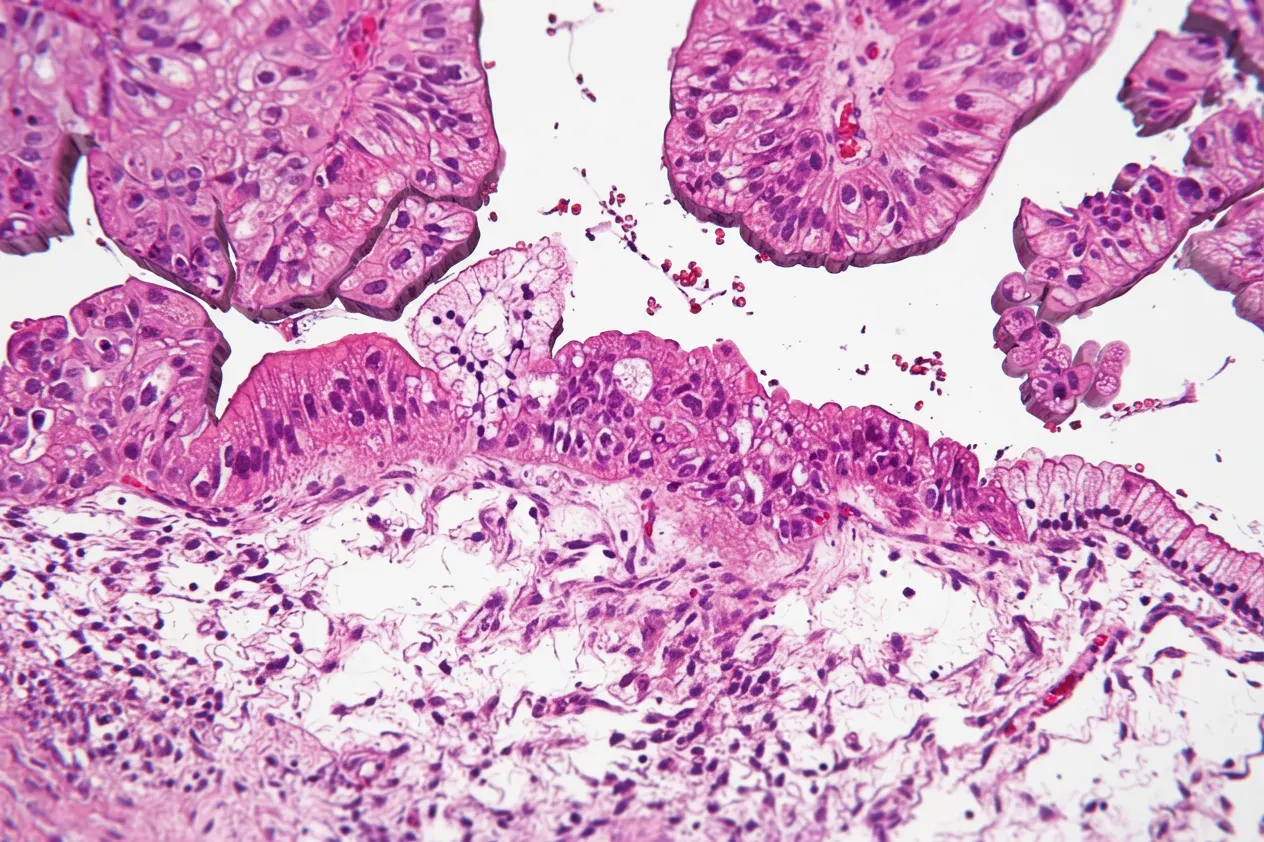

A Medical Xpress article dated Nov. 13, 2026, republished from The Conversation, describes a Nature Medicine study of a blood-borne RNA signal called Tu-stroma. The report says researchers measured the marker in stored blood samples from 506 people, including 43 with serous tubal intraepithelial carcinoma—Stic—alone. Concentrations were higher in patients with early cancer that had begun invading nearby tissue and in those with Stic alone, according to the article. The report says longitudinal tracking is needed to establish when the signal first becomes measurable. [1]
The cancer at issue is high-grade serous ovarian cancer, described as the most common ovarian cancer and one that tends to grow rapidly. The article says it often originates in a fallopian tube—one of the paired structures that carry eggs toward the uterus—and that its initial cellular alterations are generally too subtle to identify without microscopic review of surgical specimens. Stic may represent an early stage in the development of this cancer, according to the report. That background explains why a blood signal tied to tubal changes would attract research interest. [1]
The finding is notable because it concerns changes associated with a fast-growing cancer and because existing blood testing is imperfect. The article notes that ovarian cancer may cause ongoing bloating, abdominal or pelvic pain, early fullness, and more frequent urination, but that these symptoms overlap with many other conditions. Britain does not operate a population-wide screening service for asymptomatic ovarian cancer, according to the report. The article does not claim that a Tu-stroma test is clinically available or that it improves outcomes; it frames the marker as a lead requiring further study. [1]
Tu-stroma belongs to the RNA family, molecules that help regulate cellular activity. Prior work cited in the report found that ovarian cancer cells can export Tu-stroma within extracellular vesicles—small packages that carry molecular messages between cells. The new work measured the amount of Tu-stroma carried by those packages in blood. The team examined 506 stored specimens, 43 of which came from people with Stic alone, and used a separate group to evaluate assay performance. [1]
Advertisement
In that evaluation set, the report says the test detected Stic in about 92% of people who had it. In the healthy comparator group, roughly 98% had no Stic signal. The marker outperformed CA125 in distinguishing Stic cases from healthy controls and from people with benign growths near the ovaries or fallopian tubes, according to the article. These figures apply to Stic detection in stored samples; the item does not provide a single sensitivity estimate for all early invasive cancers or a measure of how many positive results would be true in an unselected population. [1]
The sample design is a central limitation. The specimens came from patients whose diagnoses were already established, and because Stic cases were few—43 in the full set—the report says the results remain uncertain. In an unselected asymptomatic population, such lesions would be uncommon, so even modest false-positive rates could generate many additional tests and possibly surgeries, according to the article. The report does not supply a prevalence figure for Stic in asymptomatic people or a false-positive rate for an unselected population. [1]
The report does not describe a completed prospective screening study; it analyzed stored specimens from people with known diagnoses. That distinction matters because archived samples cannot establish whether a positive result would appear before clinical diagnosis, or how often a signal would prompt a confirmed case. The article's call for longitudinal follow-up reflects that gap. [1]
The report does not give a false-positive rate for the assay in an unselected population, nor does it say how many people would need follow-up for each true Stic case detected. Those omissions mean the stored-sample results alone cannot establish the practical burden of a future screening program. [1]
Advertisement
The article also does not describe how a positive Tu-stroma result would be confirmed, how it would be combined with imaging or CA125, or which patients would be prioritized for follow-up. Those are implementation questions rather than settled features of the stored-sample study. Without them, the reported accuracy cannot be translated into how many people would be sent for further care after a positive result. Nor does the report specify the interval between blood draw and diagnosis in the archived samples, a detail that would affect interpretation of timing. [1]
Progression from Stic is unresolved. The report says investigators still need to determine how often abnormal cells in the tubal lining begin invading surrounding tissue. It gives no estimate of what share of Stic lesions advance, or over what period. Whether a positive signal is an early warning or a later echo of existing disease is not settled in the supplied account. The report also does not give a follow-up interval or a measure of how often a positive signal would lead to a confirmed diagnosis. [1]
CA125 is a blood protein that may increase when ovarian cancer is present. The report notes that benign conditions such as endometriosis—where uterine-lining-like tissue grows outside the uterus—can also elevate CA125, and that CA125 can remain low in some patients with early-stage disease. The article presents CA125 as something doctors may use while investigating symptoms, not as a stand-alone answer. [1]
Symptoms listed in the report include ongoing bloating, abdominal or pelvic pain, early fullness after small meals, and more frequent urination. The article notes that these symptoms are common in other conditions. If they persist or recur, it recommends evaluation by a general practitioner. No national routine screening program exists for asymptomatic people in the U.K., according to the report. [1]
Advertisement
The article cites a large U.K. trial of CA125-based screening. That trial detected more ovarian and fallopian tube cancers at an earlier stage, but extended follow-up produced no clear evidence of fewer deaths from those cancers. That history is the backdrop for any Tu-stroma screening proposal. The report says a future screening trial would ultimately have to answer whether acting on a Tu-stroma result saves lives; no such trial is reported in the item. [1]
Inherited risk is a separate setting. BRCA1 and BRCA2 are genes involved in DNA repair. The report says inherited harmful variants in either gene raise ovarian cancer risk. Affected individuals may be counseled to consider surgery to remove their ovaries and fallopian tubes after completing childbearing or if they do not intend to have children. The procedure reduces risk but eliminates unassisted fertility; in premenopausal patients, it also causes immediate menopause, according to the article. [1]
The National Institute for Health and Care Excellence says specialist teams may consider periodic CA125 testing for certain inherited-risk carriers who defer or refuse surgery, according to the report. Tu-stroma could eventually complement such monitoring, the article suggests. At present, a negative result on the experimental assay would not justify delaying recommended risk-reducing surgery, the report states. The marker is not described as ready to guide decisions about when to operate or whether to intensify surveillance. [1]
The next evidence would need to be longitudinal. The report calls for following people over time to determine when the signal first becomes detectable. It does not give a follow-up duration or endpoints. Nor does it say whether such work would show the marker rising before, or only alongside, the initial cellular alterations. Those details would help distinguish an early warning from a later signal. [1]
Advertisement
Several questions remain. How often do Stic lesions progress, and over what period? What should be done if a blood test flags a problem but imaging shows nothing? The article says researchers need to work out that scenario. It describes no pathway involving repeat testing, extra imaging, or surgery for that situation. It also does not specify the interval between blood draw and diagnosis in the stored samples, a detail that would affect interpretation of timing. [1]
A future screening trial would need to answer whether acting on a Tu-stroma result saves lives, the report says. It does not say what such a trial would look like, how large it would be, or when results might appear. What to watch includes longitudinal results, performance in unselected populations, estimates of progression from Stic, protocols for scan-negative blood flags, and evidence on mortality. The report distinguishes detection from benefit and warns that false alarms could lead to unnecessary tests or surgery. It reports no survival outcomes for Tu-stroma. [1]
The bottom line is a biologically plausible lead. High-grade serous ovarian cancer often begins in a fallopian tube, and its initial changes are usually visible only on microscopic examination after surgery. A blood test reflecting those changes could, in principle, aid monitoring or early detection. But the current evidence comes from stored samples with known diagnoses and a small Stic group. The article does not claim that Tu-stroma screening reduces deaths or is ready for widespread use. [1]
For people at higher inherited risk, the report's practical message is conservative: a negative experimental Tu-stroma result gives no basis to postpone recommended risk-reducing surgery. For people with persistent symptoms, it advises assessment by a general practitioner. For researchers, the next steps are longitudinal follow-up and work on progression and management pathways. The report presents Tu-stroma as something that might one day improve monitoring for certain inherited-risk carriers who defer or refuse surgery, not as a proven screening tool. [1]
Sources
Prepared with AI assistance from the cited sources.
The Cali Reporter newsletter
The stories worth your time.
California, the country, and what comes next. Join our free newsletter for reporting that keeps you informed.
More in Health & Medicine
- Brain Energy Mismatches in Schizophrenia
A new study explores the potential role of energy bottlenecks in brain cells in explaining fragmented experiences of time, space, and self in schizophrenia.
- Brazil Reports First Mpox Death in 2026
Brazil has recorded its first mpox-related death in 2026, but public health officials are not classifying the current surge in cases as an outbreak, according to the Fiocruz Institute.
- Personalized Therapies for IBD May Target Specific Harmful Gut Bacteria
A study led by Dr. Lukas Mager and Prof. Kathy McCoy has identified two gut bacteria that promote inflammation in inflammatory bowel disease, opening the door for personalized treatments.