Ancient Library in Rome Reopens After Centuries of Neglect
A long-buried library in Rome has been restored and is now open to the public, offering a glimpse into the intellectual life of ancient Rome.

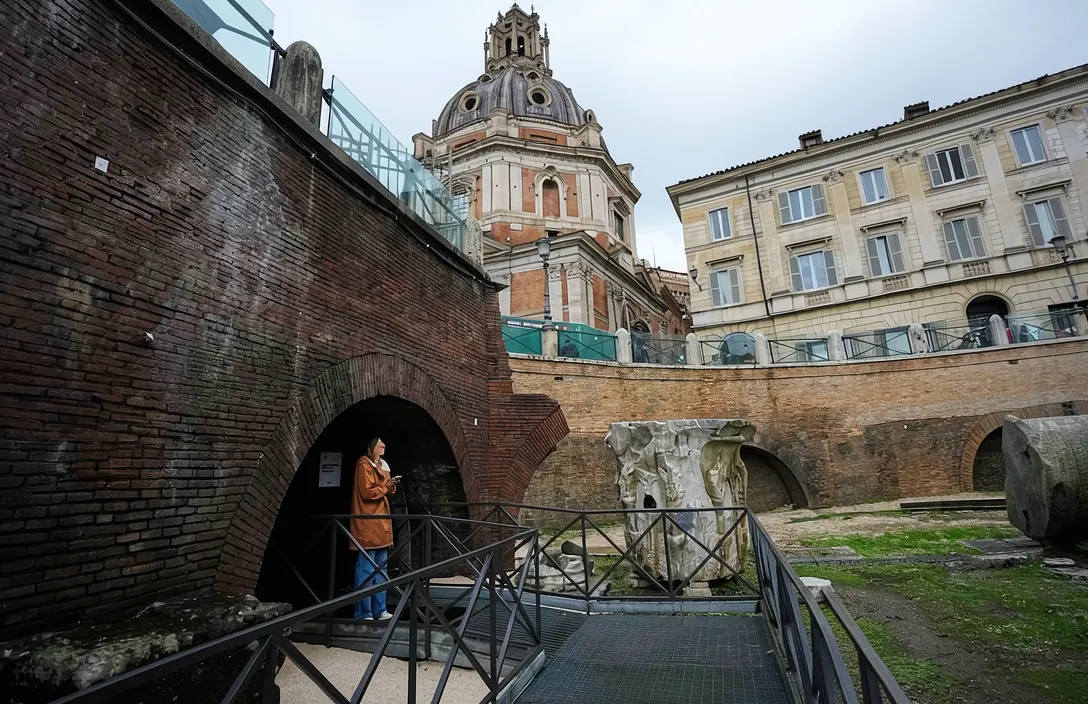

The western building of the Bibliotheca Ulpia, located in Emperor Trajan’s Forum, has been restored and is now open to the public. The library, which was discovered in 1932 during clearing works by Benito Mussolini’s government, had remained inaccessible for nearly a century. It was later covered in concrete and used as a storage room for pieces from Trajan’s Forum, which was built in 112 AD. The niches in its walls indicate that it was part of the two-story buildings that housed the Ulpia library, as referenced in ancient texts, according to Claudio Parisi Presicce, an archaeologist and Rome’s superintendent for cultural heritage (source ID: 1). [1]
The restoration of the library, which began in 2025 and lasted about a year, was funded by the European Union’s pandemic recovery funds. The 1.75-million-euro project aimed to preserve and showcase the remains of the library, including its rich marble decorations and the immersive videomapping projected on its walls. The new permanent exhibition offers visitors an idea of the space as it used to be, featuring the remains of some of the library’s rich marble decorations — white for the walls, and different colors for its floor and columns (source ID: 1). [1]
The library was a central part of Trajan’s Forum and was used by both common citizens and magistrates who needed access to older documents. It initially stored Greek-language scrolls, while the eastern building, which remains buried beneath an 18th-century church, is believed to have housed Latin-language scrolls. There are no current plans for the excavation of the eastern building. The western library will be open to visitors on Fridays, Saturdays, and Sundays, with visits scheduled every 40 minutes, accommodating 20 people at a time (source ID: 1). [1]
The Bibliotheca Ulpia, located in Emperor Trajan’s Forum in Rome, was discovered in 1932 during clearing works for the Via dei Fori Imperiali, a road constructed under Benito Mussolini’s government. The site was initially covered in concrete and used as a storage room for artifacts from Trajan’s Forum, which was completed in 112 AD. The western building of the library, which housed Greek-language scrolls, was restored after nearly a century of inaccessibility, with the restoration beginning in 2025 and concluding in 2026. The project cost 1.75 million euros, funded by the European Union’s pandemic recovery funds. The library is now open to the public on Fridays, Saturdays, and Sundays, with visits scheduled every 40 minutes, accommodating 20 people at a time. The eastern building of the library remains buried beneath an 18th-century church, housing Latin-language scrolls, and no plans for its excavation have been announced. [1]
Advertisement
The Ulpia library was one of the two, two-story buildings referenced in ancient texts, with its western section identified as the location of Greek-language scrolls. Archaeologists, including Claudio Parisi Presicce, have noted that the library was a vital part of Trajan’s Forum, attracting citizens from across Rome due to its vast collection of edicts and documents. The ruins of the library are located near the iconic Trajan’s Column, which commemorates his military campaigns against the Dacians and the Roman conquest of modern-day Romania. The restoration efforts have revealed remains of the library’s rich marble decorations, including white walls and colored floors and columns. Immersive videomapping has been added to the site to illustrate the library’s history and its discovery. [1]
The library was in a state of ruin when it was first discovered in 1932, and for decades it was left largely untouched. It was not until recent years that restoration efforts began, aiming to preserve and showcase the site’s historical significance. The western building, now open to the public, includes remnants of broken Corinthian columns and pieces of sculptures, which have been left in place to reflect the site’s archaeological context. The library was a key institution in ancient Rome, serving both common citizens with access to education and magistrates who required historical documents for legal and administrative purposes. The project highlights the importance of the Bibliotheca Ulpia as a cultural and intellectual hub in the Roman Empire, comparable in significance to the lost Alexandria Library and the Library of Pergamon. [1]
The Ulpia library was part of Trajan’s Forum, the last and greatest of the imperial fora, and was built during the reign of Emperor Trajan in the early 2nd century AD. The site was inaccessible for almost a century after its discovery, as it was covered in concrete and used as a storage area for artifacts from the forum. The restoration project has included the preservation of the library’s original marble decorations, which were a significant feature of the ancient structure. The library’s western section, now open to the public, has been transformed into an exhibition space that includes immersive videomapping to depict its historical context. The eastern building, still buried, is believed to have housed Latin-language scrolls and remains unexcavated due to its location beneath an 18th-century church. [1]
The western building of the Bibliotheca Ulpia, located in Emperor Trajan’s Forum, has been restored and is now open to the public. The restoration of the library, which began in 2025 and lasted about a year, was funded by the European Union’s pandemic recovery funds. The library was a central part of Trajan’s Forum and was used by both common citizens and magistrates who needed access to older documents (1). [1]
Advertisement
The ruins of the Ulpia library are located in Emperor Trajan’s Forum, just next to the iconic column that celebrates his victorious campaigns against the Dacians and the Roman conquest of what is modern-day Romania. It remained inaccessible for almost a century. The place was in a state of ruin when discovered in 1932 during clearing works by Benito Mussolini’s government for the road that became the famous Via dei Fori Imperiali (1). [1]
Archaeologists from Rome’s superintendency for cultural heritage identify it as the Ulpia library’s western building, which ancient texts indicate stored Greek-language scrolls. The new permanent exhibition offers visitors an idea of the space as it used to be, featuring the remains of some of the library’s rich marble decorations — white for the walls, and different colors for its floor and columns (1). [1]
Restoration started in 2025, and lasted about a year. The 1.75-million-euro cost ($1.92 million) came from the European Union’s pandemic recovery funds — just one of many restoration projects Rome is carrying out across the city with EU money. It will initially be opened to visitors only on Fridays, Saturdays and Sundays (1). [1]
Sources
Prepared with AI assistance from the cited sources.
The Cali Reporter newsletter
The stories worth your time.
California, the country, and what comes next. Join our free newsletter for reporting that keeps you informed.
More in West Coast
- COP31 Collapse Highlights Climate Negotiation Challenges
The collapse of COP31, the U.N. climate talks in Turkey, has underscored the difficulties in achieving global consensus on climate action, with experts emphasizing the need for reform and individual efforts moving…
- ScienceWorks Museum to Transition to Community Science Center
ScienceWorks Hands-On Museum in Ashland, Oregon, is pausing most activities and transitioning to a community science center with new resources for all ages, according to a report by Jefferson Public Radio.
- Seniors Embrace Tesla's Automated Driving Despite Safety Concerns
A growing number of older drivers are using Tesla's Full-Self Driving (Supervised) technology to maintain their independence, despite warnings from safety experts about potential risks.