

AI Data Center Market to Hit USD 2.02 Trillion by 2032, Rising from USD 471.6 Billion in 2026 | Analysis of Market Dynamics, Opportunities, and Key Players
The AI data center market is forecast to explode from $471.6 billion in 2026 to $2.02 trillion by 2032, but the real winners are already clear: hyperscalers and a handful of hardware giants.
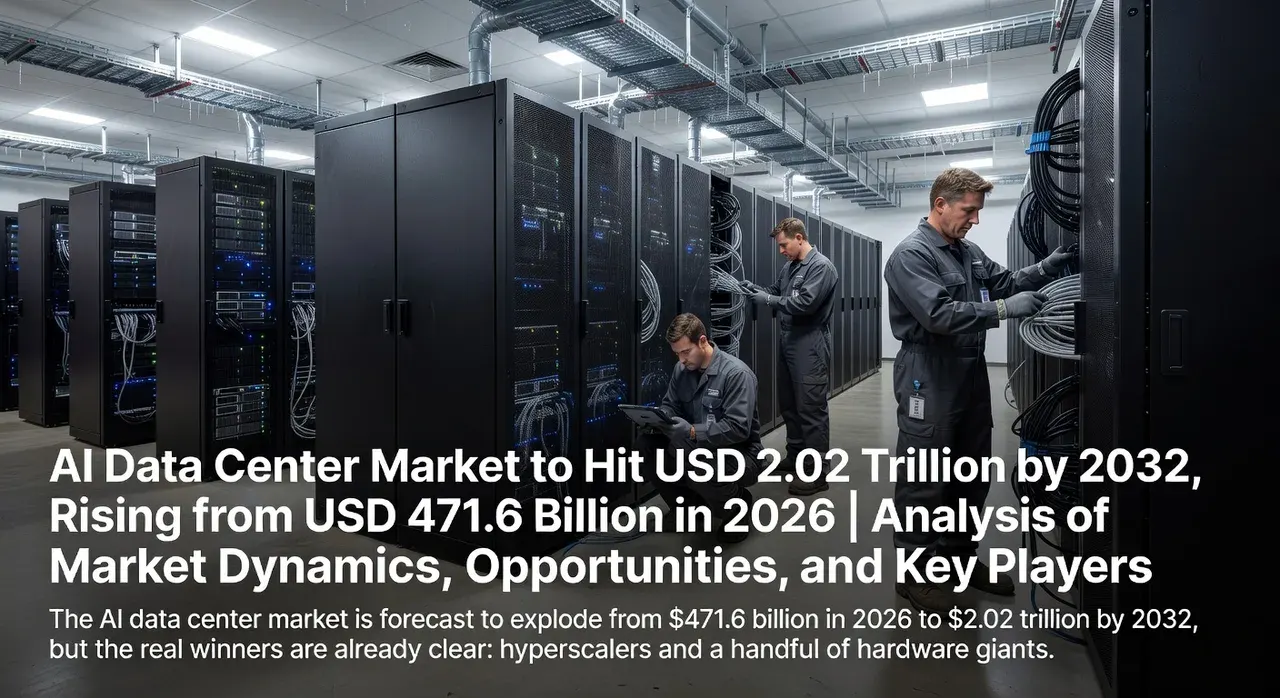
The AI data center market is set to more than quadruple in six years, climbing from $471.59 billion in 2026 to $2.02 trillion by 2032 at a blistering 27.5% compound annual growth rate. That projection, laid out in a new ResearchAndMarkets report, rests on one assumption: the world will keep demanding ever-larger clusters of specialized chips to train and run generative AI models.
Yet the report makes plain where the money will concentrate. Hyperscale data centers are expected to claim the largest share by 2032, thanks to "enormous infrastructure investments from global cloud providers" and their ability to spread massive GPU deployments, high-bandwidth storage, and advanced networking across economies of scale that smaller operators cannot match. The same facilities also deliver multi-tenant cloud services, letting enterprises and developers tap AI compute without building anything themselves.
On the customer side, enterprises are projected to post the highest CAGR among end users. Healthcare, financial services, manufacturing, retail, and telecom operators are pouring money into predictive analytics, fraud detection, process automation, and generative AI workflows. The report notes that the "substantial structured and unstructured data" these industries generate from IoT, digital platforms, and operations is forcing them to seek dedicated high-performance infrastructure or hybrid setups.

Geographically, Asia Pacific is slated for the fastest growth, driven by national AI strategies in China, Japan, South Korea, India, and Singapore. Government funding, semiconductor manufacturing clusters, and surging cloud data volumes give the region structural advantages that North America and Europe will struggle to replicate at the same pace.
The hardware beneficiaries read like a familiar roster: Dell, Hewlett Packard Enterprise, Lenovo, Huawei, IBM, Super Micro Computer, Cisco, and Fujitsu, along with a lengthening list of specialists in liquid cooling and immersion systems such as LiquidStack, Iceotope, and JetCool. Advances in GPUs, ASICs, high-bandwidth memory, and high-speed interconnects are the explicit technical foundation for the entire forecast.
The numbers are eye-watering, but they also expose a narrowing funnel. A few hyperscalers and a concentrated set of suppliers are positioned to capture the bulk of a multi-trillion-dollar buildout while everyone else scrambles for access. The question the report implicitly raises is whether this concentrated power will accelerate genuine innovation or simply entrench a new class of AI gatekeepers.
Original reporting: GlobeNewswire.
More in Business
- IMF Chief Warns of Economic Divergence and Debt Risks Amid Artificial Intelligence Boom
Kristalina Georgieva suggests that while AI could significantly boost global growth, it simultaneously threatens to widen inequality and exacerbate inflationary pressures and public debt burdens.
- California Limits Utility Profits and Expands Home Energy Role
Gov. Gavin Newsom signed laws capping utility returns on lower-risk projects and accelerating virtual power plant development.
- Lyft to Pay $272.5 Million in Record California Wage-Theft Settlement
Largest such settlement in state history resolves claims that Lyft misclassified drivers as independent contractors from 2016 to 2020, denying them core wage protections.