

A solution to our data center woes? Covering California’s canals with solar panels could generate a staggering 13GW of clean energy and save enough water for two million people, so why the opposition?
California could generate 13GW of clean power and save 63 billion gallons of water by shading its canals with solar panels, yet critics fixate on cost while data centers guzzle resources and the state loses 40% of its Colorado River share.
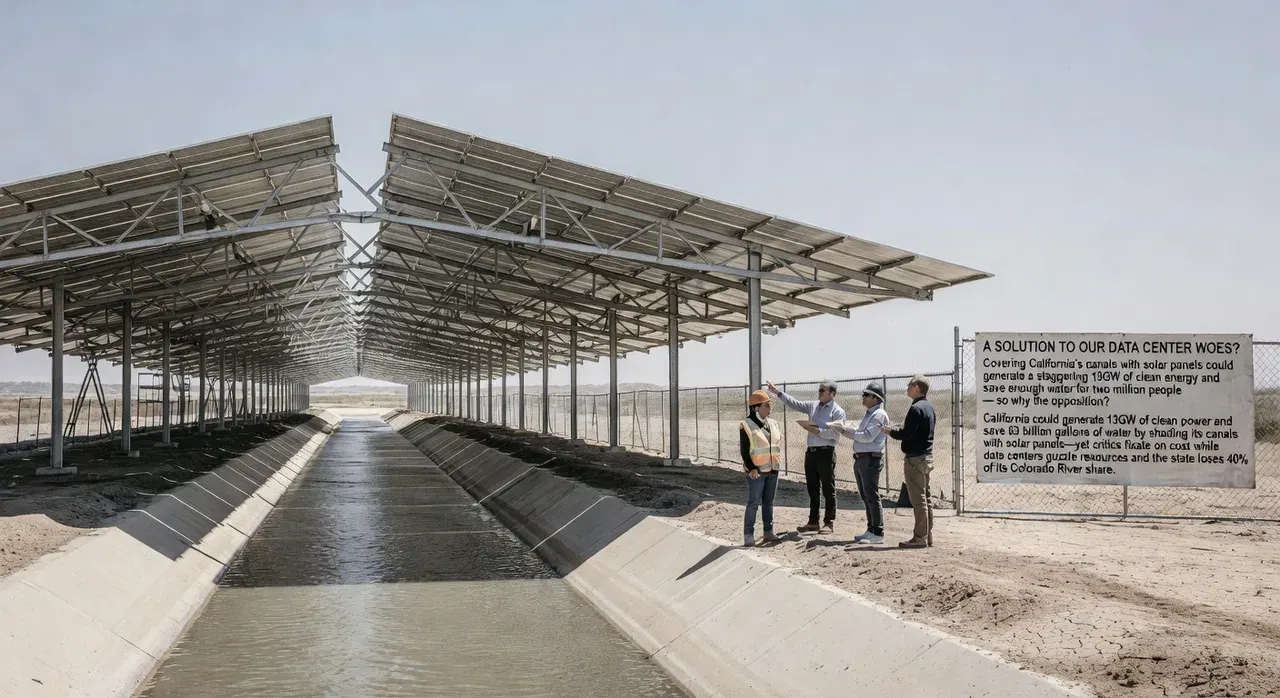
California’s 4,000 kilometers of canals could be turned into a dual-purpose power and water infrastructure, producing 13 gigawatts of solar electricity each year while conserving 63 billion gallons of water, enough to supply two million households. A University of California study laid out the numbers. The Nexus pilot project on Turlock Irrigation District canals already delivered: 50 to 70 percent less evaporation, 85 percent less algae, and solar panels that ran 2.5 to 5 percent more efficiently because the water kept them cool.
Yet the idea is meeting organized resistance. The heavy steel structures needed to span the canals can eat up 40 percent of project costs, far more than ground-mounted solar on desert land. Critics insist canals exist for water delivery, not industrial platforms, and that maintenance crews will struggle to desilt or repair channels beneath overhead panels. They point to abundant cheap desert acreage where conventional farms can be built without engineering headaches.
That logic ignores the trade-offs staring the state in the face. California has already lost 40 percent of its Colorado River allocation this year. Every drop lost to evaporation is a drop that cannot cool data centers or sustain farms. Desert solar produces power, but it does nothing to preserve water where agricultural and urban demand actually exists. Canal-top arrays generate electricity closer to load, cutting transmission losses that distant desert projects simply shift onto the grid.

The water-conservation angle matters even more as data centers proliferate. A single facility can consume millions of gallons annually. Shading canals could redirect saved water to keep servers from overheating instead of letting it vanish into dry air. The 13GW potential could power hundreds of such centers without gobbling extra land or further straining an overtaxed electrical system.
Opponents are right that blocking evaporation is not an unqualified environmental win. Reduced dissolved oxygen could harm aquatic ecosystems, and the effect on local humidity appears minimal. Those risks deserve measurement. But dismissing the entire concept because steel is expensive or maintenance is inconvenient treats water scarcity as an afterthought rather than the crisis it has become in a drought-prone state.
The Nexus project will keep gathering data. The real question is whether California will assign a realistic price to conserved water and transmission savings, or keep defaulting to the cheapest visible option even when it solves only half the problem.
Original reporting: TechRadar.
More in Business
- IMF Chief Warns of Economic Divergence and Debt Risks Amid Artificial Intelligence Boom
Kristalina Georgieva suggests that while AI could significantly boost global growth, it simultaneously threatens to widen inequality and exacerbate inflationary pressures and public debt burdens.
- California Limits Utility Profits and Expands Home Energy Role
Gov. Gavin Newsom signed laws capping utility returns on lower-risk projects and accelerating virtual power plant development.
- Lyft to Pay $272.5 Million in Record California Wage-Theft Settlement
Largest such settlement in state history resolves claims that Lyft misclassified drivers as independent contractors from 2016 to 2020, denying them core wage protections.