A Small World, a Long Record: What Artificial Learners Learned From Eight Childhoods
Princeton's 1,000 Days Project gave models the everyday speech of eight children. A nightly replay step helped them find sounds and words, while the gaps between model and child expose what is still unexplained.

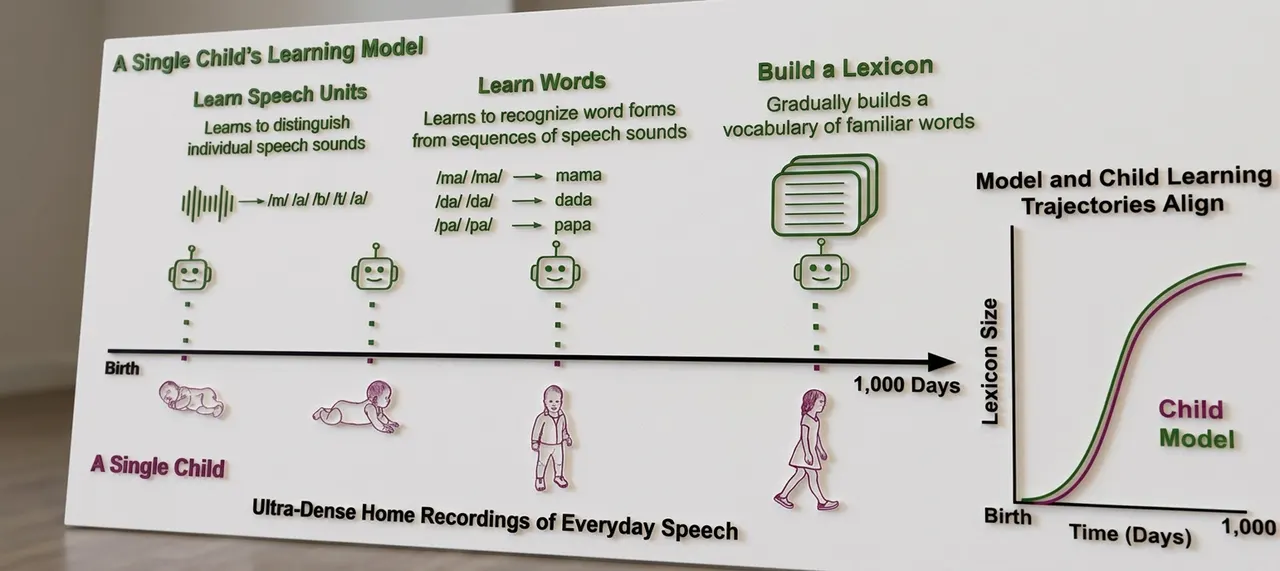

A Princeton-led project spent three years recording daily life in 15 households, using cameras and microphones to capture most of each child's waking hours from infancy to about age three. That archive, the 1,000 Days Project, was built for developmental research. In a 2026 Science paper, the team repurposed it to ask a narrower question: could a machine learner given one child's speech, in the order the child heard it, discover language from sound alone? The paper is titled 'The first 1000 days: Modeling language learning from individual children's everyday speech.' [1]
Uri Hasson, a Princeton psychology and neuroscience professor, was the project's principal investigator and led the work. Hadas Raviv, a computational cognitive scientist, led development of the analysis infrastructure and the computational modeling. Liat Hasenfratz led research operations, helped build the behavioral assessment battery with Casey Lew-Williams, and designed the ethical and governance framework. Lew-Williams, a psychology professor and director of the Princeton Baby Lab, was co-principal investigator and guided the behavioral assessment strategy. [1]
The source stresses that this was not a single-lab effort. Engineers built recording systems for homes; staff visited families; annotators converted audio into usable data; machine-learning researchers built models. Hasson credited people from many professions who worked on the project over the years, and said the families made it possible by opening their homes for three years. Lew-Williams said the project's challenges were immense and that it took years to rethink ethical considerations, data collection, data storage and analysis techniques; he said the data set would help rethink children's development and learning. The modeling sample was smaller than the full project: eight children, identified by pseudonyms. [1]
For each of the eight children, researchers built a separate learner and fed it speech taken from hundreds of recorded days. The learner began with no inventory of speech sounds, no lexicon, and no clue where one word stopped and the next began. It never saw text. Its only route to language was the acoustic stream. The model also received that stream in sequence—day one, then day two—rather than as a shuffled pile of three years. As a child's waking hours expanded, so did the daily input. [1]
Advertisement
The first test, with a child called Coral, did not work. The model kept little from one day to the next. By the point corresponding to Coral's second birthday, it had no words. The source describes the result as discouraging and says the team concluded that rich daily speech, by itself, was not enough. This is important for how the study should be read: the initial failure came before the added mechanism, not after a model was already tuned to succeed. [1]
That failure set up the paper's central intervention. The researchers did not add a dictionary, grammar rules or labeled text. They looked instead to a process associated with sleep. The source says a body of evidence suggests that during sleep the brain revisits recent experience, reactivating patterns from the day in ways thought to help memories stabilize. Sleep occupies a large share of infancy and has been linked to word learning. The model borrowed one simplified feature from that literature, not the full architecture of sleep. [1]
After each simulated day, the model went back over a subset of what it had already heard, drawn mostly from the recent past. This differs from standard machine-learning practice, which can cycle through training data repeatedly but often shuffles years of experience together. Here the look-back was deliberately constrained: a small nightly dose of recent sound. The researchers did not try to reproduce sleep stages or cycles. They asked whether one borrowed feature—revisiting the day—would help the learner consolidate what it encountered. [1]
With replay, the trajectory changed. Coral's model first segmented speech into units that matched nearly all English phonemes, then began identifying recurring words. By the equivalent of Coral's second birthday, it had acquired thousands of words from ordinary speech. The source calls the shift dramatic. Raviv said exposure to the day's speech by itself was not enough and that allowing limited replay of recent experience helped the model retain what it learned while continuing to learn from new days. [1]
Advertisement
The team then used the same settings for the seven other homes. The households were not uniform: children heard different amounts of speech, families talked about different things, and conversational partners and patterns varied. The learner still succeeded in each home, discovering English sounds and building a vocabulary of thousands of words. Hasson said a child born into any of these homes would still be expected to learn language, and that a plausible mechanism should be robust to such differences. That is a claim about robustness in this sample, not a universal guarantee. [1]
A second puzzle appeared when the researchers compared the children's reported development. Some parents reported a large vocabulary well before the first birthday; others reported the same milestone nearly a year later. Such variation is described as a normal part of development. But when the identical learner was run against each household, it moved at similar speed every time. The model captured the shared mechanism but not the individual timing. [1]
To address that, the team altered the learner, not the recorded home. Three settings changed from one child's model to the next: the amount of nightly replay, the rate of learning from input, and the point at which word learning began. With those adjustments, each model could reproduce the timing of the child it represented. The source presents this as reproducing timing, not as a causal account of why the children differed. [1]
This part of the study is a fit, not a causal explanation. The three parameters were allowed to vary across models, and they succeeded in reproducing timing within the modeled set. The source does not show that replay amount, learning rate or onset are the actual causes of variation among children. Raviv described the challenge as capturing both a distinctive linguistic environment and an individual developmental trajectory at once. Lew-Williams said the recordings make visible everyday complexity across language, vision, social interaction and screen time. [1]
Advertisement
The study engages a long-running argument in developmental science. One family of theories stresses knowledge humans bring into the world; another stresses the developing brain's capacity to extract structure from experience. Testing those views has been limited by a basic data problem: no one had captured almost everything a child hears during language acquisition. The 1,000 Days archive was built to close that gap, and the modeling turns the record into a test bed for candidate mechanisms. [1]
The paper borrows a line associated with Richard Feynman about creation and understanding. A theory can be tested by building a learner, exposing it to a real child's experience and comparing its development with the child's. Where the model falls short, the shortfall points to missing ingredients. Hasson said psychology has largely studied development from the outside; the new approach lets researchers build a system, give it a child's actual experience and ask whether it develops the same way. That is complementary to observing children, not a replacement for it. [1]
The contrast with mainstream AI is deliberate. Large language models normally get one training run, then are fixed for release, and they consume vastly more written material than a child. Children learn from a local, social, embodied world that is often noisy and chaotic, and they keep learning. Raviv said the aim is not superhuman performance but understanding human learning and how it gives rise to intelligence. The researchers do not present the model as a child. It lacks a body and cannot crawl, point or watch a caregiver's face; it has none of the social motivations or biological machinery of a developing brain, and it does not yet know what words mean. [1]
Several questions remain open. Does artificial replay correspond to biological replay, and if so, which parts? The team borrowed one idea from sleep and tested whether it helped consolidation; the source does not describe direct measurements of sleep or brain activity. How much of individual variation can three parameters explain? The model needed tuning to match each child's timeline. Would social interaction, visual experience, attention or word meaning improve the match? Hasson said the goal is to give the models more capacities over time and see what emerges. [1]
Advertisement
Boundaries matter. The modeling sample covered eight children from a 15-home project, and the children were learning English. The timing comparison used parent-reported vocabulary milestones. Replay was a simplification, not a reproduction of sleep cycles and stages. The source does not describe an independent replication. Questions for future work include whether the approach scales to other languages, other family structures and children with different developmental paths. [1]
What to watch next is not a product or a parenting rule. Watch for replication, for broader samples, and for tests that add the missing ingredients one at a time. Watch for clearer evidence on whether replay-like consolidation is a general learning mechanism or a useful engineering trick. The study's contribution is a method: put a learner inside a child's ordinary input, then compare the learner's path with the child's. The value lies in what that comparison reveals, including where the model still fails. That is a slow research program, not an overnight answer. [1]
Sources
Prepared with AI assistance from the cited sources.
The Cali Reporter newsletter
The stories worth your time.
California, the country, and what comes next. Join our free newsletter for reporting that keeps you informed.
More in Health & Medicine
- Brain Energy Mismatches in Schizophrenia
A new study explores the potential role of energy bottlenecks in brain cells in explaining fragmented experiences of time, space, and self in schizophrenia.
- Brazil Reports First Mpox Death in 2026
Brazil has recorded its first mpox-related death in 2026, but public health officials are not classifying the current surge in cases as an outbreak, according to the Fiocruz Institute.
- Personalized Therapies for IBD May Target Specific Harmful Gut Bacteria
A study led by Dr. Lukas Mager and Prof. Kathy McCoy has identified two gut bacteria that promote inflammation in inflammatory bowel disease, opening the door for personalized treatments.