

650,000 Ballots Seized: California Supreme Court Unanimously Orders Sheriff Bianco to Halt Voter Fraud Probe
The high court rules the ballot seizure unlawful and demands the investigation stop before November

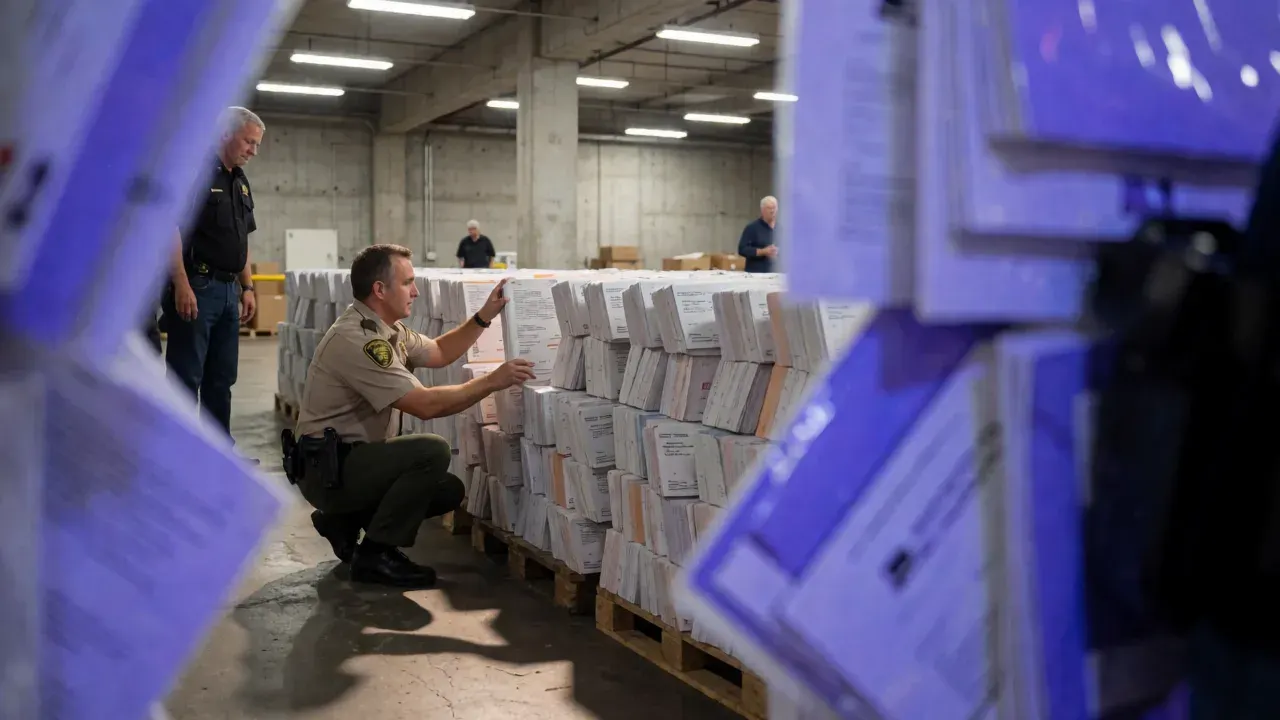
The silence in the ballot box is louder than the shouts of those demanding answers. When the physical doors of the Riverside County registrar’s office swung open last year, the scene was set for a battle over the integrity of the democratic process. Sheriff Chad Bianco did not just look at a file. He seized more than 650,000 ballots to probe alleged voter fraud. This was not a casual glance through a window. It was a physical takeover of the county’s election infrastructure. The air in the room was thick with the scent of paper and tension as the counting machines hummed in the background, unaware that their data was about to be wrested from the custody of those sworn to protect it.
The tension finally broke in a ruling delivered on a Thursday. The California Supreme Court reached a decision that resonated through the hallowed halls of the state judiciary. The court unanimously found that Sheriff Bianco’s actions were flatly unlawful. Chief Justice Patricia Guerrero wrote the opinion with a clarity that left little room for debate. The high court held that the state election code explicitly says parties cannot remove ballots from the custody of election officials. This was a decisive moment in a season defined by the high stakes of the November midterms. The message sent by the justices was unmistakable. It was a strong rebuke against election interference from within the very agencies tasked with maintaining order.
The legal battle did not end with the opinion. The court held separately in another opinion that Bianco must comply with the directives of Attorney General Rob Bonta. Bonta sued the sheriff after Bianco repeatedly declined to pause the investigation. The Attorney General argued that the sheriff’s notion that Bonta’s authority applies only when a law enforcement official fails to act was legally flawed. Guerrero explained that a rule denying the Attorney General the ability to issue binding instructions regarding an investigation would be unworkable in practice. It would frustrate the AG's constitutional powers. This legal maneuvering highlighted the friction between local law enforcement and state oversight. The ruling underscored the importance of the court affirming Bonta's authority to supervise sheriffs since it is an "important constitutional safety valve." Bonta took to a press conference to celebrate the victory. He emphasized that the sheriff’s actions created a "constitutional crisis" and described the behavior as "deceitful" and "duplicitous." He stood firmly on the side of the rule of law.

To understand the stakes of this conflict, one must look at the specific grievances that sparked the sheriff's crusade. The investigation was launched after the Riverside Election Integrity Team flagged the November 2025 election results. The group was looking at Proposition 50, which would re-draw the state’s congressional districts to favor Democratic Party candidates. They hoped to offset Republican gains from a 2025 Texas re-districting measure. Their focus was sharp. They claimed a nearly 50,000 vote discrepancy by the Riverside County Registrar of Voters concerning the number of votes it certified versus what it calculated as being the ballots cast. This number is massive. It is the difference between winning and losing in a close race. Bianco, a Republican who failed to secure a nomination for this year's gubernatorial election, saw probable cause where others might have seen error. He asserted that the probe is a lawful criminal investigation supported by judicially authorized warrants. The scene in the registrar's office was one of armed officers moving through rows of ballot boxes like thieves in the night, processing warrants that appeared facially valid but operated outside the spirit of the election code.
The high court moved with a speed that shocked the legal community. The ruling was delivered much faster than the 90-day window the state Supreme Court typically has to issue opinions following oral arguments. During arguments in a rare August special session, the justices expressed skepticism. One justice called Bianco's theory bizarre. The justice questioned how one could seize ballots and claim they did not break the law. The debate was visceral and real. Justices Carol A. Corrigan, Goodwin H. Liu, Leondra R. Kruger, Joshua P. Groban, and Kelli M. Evans joined the opinion. Goodwin Liu wrote a concurring opinion that added nuance to the discussion. Liu noted that Riverside County Registrar of Voters Art Tinoco, who was also sued by local voters, could not reasonably be faulted for complying with warrants presented by armed officers. This distinction highlighted the complexity of the situation. It was not just about the sheriff. It was about the registrar caught in the crossfire. Bradley W. Hertz of Los Angeles represented Bianco, fighting a rear-guard action against the state machine.
The perspective of the voters who sued provides the emotional counterweight to the legal maneuvering. The UCLA Voting Rights Project represents these plaintiffs. They argued before the high court in August. Their stance was simple yet profound. "These are the voters’ ballots," said attorney Chad Dunn. He argued that the ballots must be protected through the processes the Legislature has established. The court partially denied the suing voters’ request for further legal relief in a future proceeding, finding they failed to meet their burden to show further relief is warranted. However the core victory remained. The ruling reaffirmed that the state election code applies to everyone including law enforcement. It was a check on the unchecked power of a sheriff acting as a partisan enforcer. The physical ballots are back in the system. The probe is shut down. The question of fraud remains open, but the method of investigation has been deemed illegal by the highest court in the state.
Gov. Gavin Newsom weighed in on the outcome with a press release. He said the ruling shows California "will defend democracy." "People deserve to know their ballot is counted and secure, and in California we will do everything we can to protect that constitutional right, this year, and beyond," Newsom said. The ruling comes at a time of national tension regarding election skepticism. Legal experts have called this a broader trend. The cases are Cervantes v. Bianco and Attorney General for the State of Cal. v. Bianco. The final decision on the ballots has been made. The sheriff must comply. The investigation must end. As the dust settles on the ballot boxes, the sound of silence is the loudest thing left in the room. "Sanity, common sense, and importantly the rule of law, have prevailed," Bonta declared. The system held fast in Riverside County.
First reported by r/California.
More in California
- UC Berkeley Lab Proposes New Civic Framework for California’s Next Governor
A research-driven agenda calls for institutionalizing 'co-governance' to address low public trust and lack of resident influence in state decision-making.
- Five Tax Measures on California’s Ballot Aim to Reshape State Finances
Propositions 3, 40–43 would alter income, wealth and local taxation rules—marking the highest number of tax measures on a general election ballot since 1994.
- Catalina Helicopter Crash Highlights Risks of Island Medevac Flights
A medical evacuation chopper carrying Catalina Romero, pilot, and nurse Jessica Devries crashed into the ocean shortly after takeoff, killing all three; federal investigators are assessing causes including night flying, spatial disorientation, and the island’s challenging Pebbly Beach heliport.