

631 Points Lost: The Fed's 130-Word Warning to Wall Street and the President
Warsh hikes rates, stocks crash, and explains why central bank independence is a non-negotiable asset

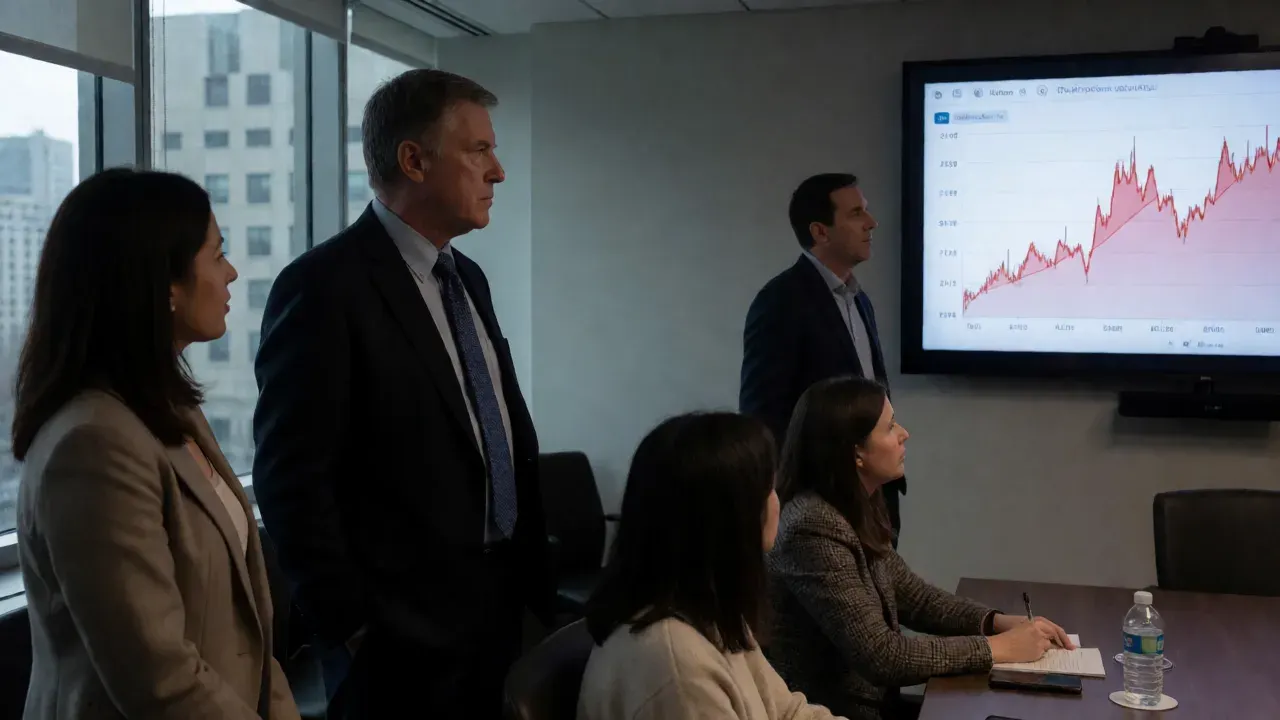
The Federal Reserve executed a 0.25 percentage point interest rate increase during a meeting in Washington on Wednesday, a move greeted with a mix of relief and renewed volatility by market participants. Chairman Kevin Warsh followed the announcement with a press conference that was notably brief, emphasizing the committee's collective focus on inflation control rather than political pressure. The action marks another step in the central bank's attempt to normalize monetary policy in a still-unstable economic environment.
Surprisingly, the Federal Open Market Committee voted unanimously on the hike. For weeks, market observers speculated that Governor Christopher Waller might dissent, given the growing range of viewpoints among policymakers. However, all 12 voters agreed, removing one variable from the equation. The market did not respond with the anticipated relief. In fact, the reaction was sharp. The Dow Jones Industrial Average tumbled 631 points immediately following the announcement. This drop was accompanied by a 7 basis point increase in the 2-year Treasury yield, a security that is typically the most sensitive to short-term interest rate expectations.
The financial market's response suggests that investors are pricing in more aggressive monetary tightening than they initially hoped for. The sell-off mirrors the reaction seen during the July meeting, indicating a pattern of skepticism toward the Fed's ability to guide the economy without triggering a broader downturn. Investors are currently grappling with the reality that the central bank is willing to let asset prices fall to combat inflationary pressures.

The substance of the meeting was as constrained as the market reaction was volatile. The Fed's post-meeting statement clocked in at a mere 130 words, the shortest version since the current leadership took the helm. Warsh followed this skeletal document with a press conference that lasted barely half an hour, with about 22 minutes dedicated to answering reporters' questions. This economy of words communicates a clear message to the market: the Fed is in a hurry to finish its current cycle of adjustments.
This austerity in communication extends to the political sphere as well. President Donald Trump has recently threatened to cut off trade with certain countries unless the Federal Reserve lowers interest rates. During the press conference, Warsh deflected these inquiries. He stated that he has nothing to discuss regarding the President's demands, reinforcing the concept of central bank independence. 'Part of the independence of the Federal Reserve is we stay in our lane,' Warsh explained. He framed independence not as a privilege but as a functional necessity for a stable economy.
The Federal Reserve's 'dot plot' reveals a divided but generally hawkish outlook for the future. Sixteen of the 18 participants in the meeting expect at least one additional rate hike before the year ends. The divergence becomes apparent in the longer-term projections, with significant disagreement regarding rates in 2027, 2028, and 2029. This chart of individual expectations illustrates the difficulty of forecasting economic conditions five years out, a challenge that creates uncertainty for long-term borrowers and investors.
Financial analysts offered varied perspectives on the implications of this hike. Mike Madowitz, a principal economist at the Roosevelt Institute, highlighted the economic cost of the policy. He noted that with unemployment around 4 percent and core PCE inflation expected at 3.5 percent, the Fed has a valid case to remain focused on inflation. However, Madowitz argued that using interest rates to solve the problem is currently 'a really costly way' to do so.
Andrzej Skiba, who leads the BlueBay U.S. Fixed Income team at RBC Global Asset Management, offered a more optimistic view on the stability of risk assets. He suggested that the 'reset' in market expectations following the Fed's resolve could actually help support Treasury prices further down the curve. Skiba believes that despite the initial volatility, Warsh's clear messaging will provide a floor for long-term bond prices.
Finally, Krishna Guha, head of economics and central bank strategy at Evercore ISI, characterized the chair's performance as coherent and disciplined. Guha described Warsh's approach as balancing a 'stern but disciplined message on inflation' with an 'upbeat take on growth.' This combination of tough talk on inflation and optimism about economic expansion suggests the Fed is attempting to manage expectations without derailing the expansion, a delicate balance that defines the current financial landscape.
First reported by CNBC: Finance.
More in Business
- IMF Chief Warns of Economic Divergence and Debt Risks Amid Artificial Intelligence Boom
Kristalina Georgieva suggests that while AI could significantly boost global growth, it simultaneously threatens to widen inequality and exacerbate inflationary pressures and public debt burdens.
- California Limits Utility Profits and Expands Home Energy Role
Gov. Gavin Newsom signed laws capping utility returns on lower-risk projects and accelerating virtual power plant development.
- Lyft to Pay $272.5 Million in Record California Wage-Theft Settlement
Largest such settlement in state history resolves claims that Lyft misclassified drivers as independent contractors from 2016 to 2020, denying them core wage protections.