

16,000 Acres of Solar vs. Housing: The Santa Barbara Credibility Gap Explained
Supervisors prioritize renewable energy projects over affordable living in a county desperate for homes

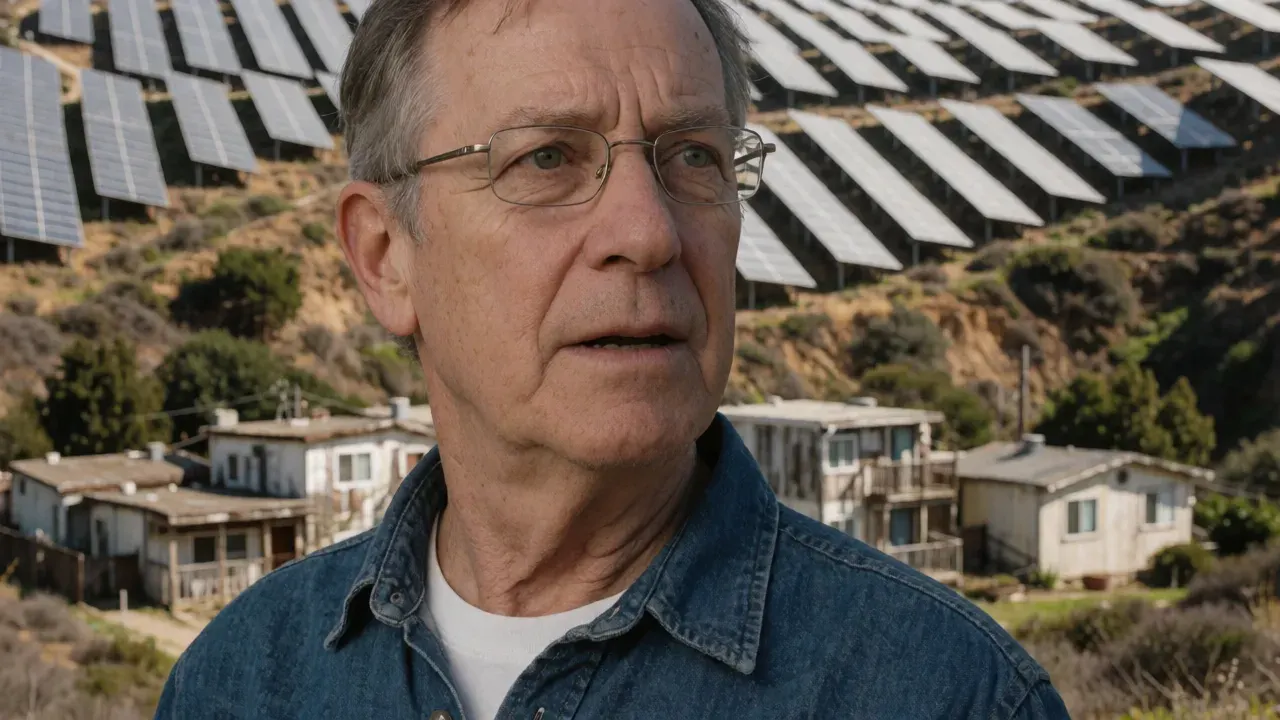
The sun beats down on the Central Coast with a relentless intensity. It shapes the landscape of Santa Barbara County, turning the golden wheat fields into shimmering grids and creating a heat that radiates off the asphalt. This is the same sun that powers the global transition to green energy, a transition that the county leadership seems eager to accelerate. Yet, as the mercury climbs, a different kind of heat is building at the local level. This heat stems from a disconnect between the county's rapid embrace of one type of development and its stubborn refusal to embrace another. We are talking about the housing crisis and how it is being managed, or perhaps more accurately, how it is being ignored in favor of other priorities.
Andy Caldwell, the executive director of COLAB and host of a local radio show, recently put a mirror to this reality. He asked the Santa Barbara County Board of Supervisors a question that cuts through the noise of local politics. He inquired why the county would rezone a massive 16,000 acres of agricultural land for the installation of solar panels. He noted that California already has an excess of solar capacity. The logical pivot in his question was even sharper. He asked why the same effort was not being applied to rezone that same amount of land for housing, considering the severe shortage of available homes in the region.
The response was telling. The only answer provided was a grimace from Supervisor Laura Capps. It was a non-answer that spoke volumes. It highlighted a troubling trend in the region where the pursuit of a specific environmental aesthetic or energy goal seems to trump the basic human need for shelter.

Those who argue that the high cost of living in California is purely a function of capitalism often miss the nuance of local governance. In Santa Barbara County, the situation is not just about market forces. It is about deliberate choices made by those in power. The law of supply and demand is a brutal teacher. When housing supply is restricted while other forms of development are encouraged, prices rise. The county leadership seems to understand this concept when it comes to solar panels, but it struggles to apply it when it comes to building the bedrooms for the workers who keep the county running.
Looking back thirty-five years, the roots of this issue go deep. A former county planning and development director left behind a quote that remains chillingly relevant today. He stated that the cost of preserving the high quality of life in Santa Barbara County includes limiting opportunities for others. He added that this limitation includes limiting economic mobility, but he framed it as a legitimate political choice. This is not a capitalistic argument. It is an entirely elitist one. It suggests that paradise is a finite resource that must be hoarded by a select few.
This philosophy is evident in the resistance to affordable housing projects, particularly in scenic areas like the Santa Ynez Valley. When planners attempted to zone the valley for its fair share of affordable housing, they ran into a buzz saw of local sentiment. A valley resident famously told officials that the Santa Ynez Valley is for those who can afford it and they want to keep it that way. This sentiment is not unique to the Santa Ynez Valley. It is a prevailing attitude on the South Coast and throughout the county.
People who live in these areas believe they inhabit a paradise. They are willing to pay a premium to stay there. Their fear is that an influx of affordable housing will alter the character of the place they love. However, Laura Capps has proposed a phony solution to the housing crisis. To prove she has bleeding-heart bona fides, she suggests building housing on county land for government workers. She calls this the "county family." The implication is that the county staff deserves housing, but the broader community does not.
This approach ignores the reality of the serf-like existence faced by the average resident. They watch as the county prioritizes the needs of its own employees over the needs of the people who pay the taxes that fund the government. It is a disconnect that breeds frustration.
The sabotage of the housing crisis goes beyond simple refusal. It is active and calculated. The county is working to undermine the efforts of several cities to expand their boundaries. This is essential because state housing mandates require cities to accommodate a certain number of new homes. By blocking these expansions, the county tries to offload the responsibility and the cost.
The mechanisms for this sabotage are two-fold. First, the county assists in blocking approval of city limit expansions via the Local Agency Formation Commission, or LAFCO. LAFCO is the governmental body that oversees the changing shape of local government boundaries. Second, the county removes the financial wherewithal for cities to annex land through a concept known as revenue neutrality.
Revenue neutrality is a somewhat optional condition the county can impose on cities during negotiations. It is supposed to make the county whole for lost property tax, sales tax, and bed tax revenues because of a jurisdictional boundary adjustment. The theory is that if a city takes land out of the county jurisdiction, the county loses a source of income.
This concept is entirely bogus when a city is annexing undeveloped land. The county is not going to lose much of anything by the process because the land is vacant. Nevertheless, even if the land in question is undeveloped, the county insists on gaining future "lost" revenues. This greedy approach to negotiations is happening right now as it affects the Richard’s Ranch development in the Santa Maria Valley.
The historical example of Goleta serves as a cautionary tale. The community got assaulted by the county when they went through the process of becoming a city. The county used every tool in the book to slow the process down and extract financial concessions.
None of this negates the fact that what the region actually needs is more land dedicated to housing. Without this, the fear is that everyone will end up living in an urban jungle by the sea. The quality of life will erode until it resembles the crowded streets of a major metropolis.
Based on a lived experience of living on the Central Coast for 58 years, a solution exists. It is a solution that works in San Luis Obispo. Nobody can claim that SLO resembles the San Fernando Valley or Orange County in any way, shape, or form. SLO has managed to maintain its character while meeting housing needs.
The solution for Santa Barbara County should be to allow low density development and clustered development throughout the county and by way of city annexations on non-prime ag lands. This would allow ranchers to stay in business because low density development can easily coincide with cattle operations. The same holds for allowing things like vineyard estates or the dreaded "mc-mansions" on the Gaviota Coast. I, for one, would rather see some beautiful homes pop up here and there rather than thousands of acres of grotesque solar farms.
Finally, the county should bring back the ag cluster development ordinance. This policy was strangled in its crib by county supervisors. It would have allowed, for instance, a 3,000-acre ranch to build 30 homes (one home per 100 acres) on 2-acre plots, thereby leaving the bulk of the land in its natural state. This approach respects the agricultural heritage of the land while allowing for residential expansion.
Without a recalibration of land-use policy, the county risks deepening both its housing shortage and its credibility gap. By maintaining rigid zoning and procedural barriers, Santa Barbara County undermines the entire county’s ability to meet state housing goals. It worsens the affordability crisis and signals that renewable energy expansion is a higher priority than expanding the housing supply.
The county supervisors must act now. Here is what they should be doing. First, they must conduct a comprehensive review of agricultural land designations to identify parcels unsuitable for farming and rezone them for mixed-use or residential development. Second, they must reform the LAFCO process to allow cities to annex land more efficiently when meeting state housing mandates. They must provide clear timelines and reduced bureaucratic hurdles while making every attempt to avoid prime ag lands. Third, they must establish policies that weigh renewable energy expansion against housing needs. They must ensure that large-scale energy projects do not displace opportunities for residential growth.
Fourth, the county should offer tax breaks, density bonuses, or expedited permitting for developers who build housing on marginal agricultural land or other underused parcels. Fifth, the county must develop a countywide plan that aligns renewable energy targets with housing production requirements. This avoids zero-sum trade-offs between environmental and housing priorities. Finally, the supervisors must forego the temptation to be greedy when it comes to negotiating revenue neutrality agreements for the good of the entire county, especially vacant land.
The choice is clear. The county can continue down the path of exclusion, or it can embrace a policy that provides opportunity for all.
First reported by CalCoast News.
More in California
- UC Berkeley Lab Proposes New Civic Framework for California’s Next Governor
A research-driven agenda calls for institutionalizing 'co-governance' to address low public trust and lack of resident influence in state decision-making.
- Five Tax Measures on California’s Ballot Aim to Reshape State Finances
Propositions 3, 40–43 would alter income, wealth and local taxation rules—marking the highest number of tax measures on a general election ballot since 1994.
- Catalina Helicopter Crash Highlights Risks of Island Medevac Flights
A medical evacuation chopper carrying Catalina Romero, pilot, and nurse Jessica Devries crashed into the ocean shortly after takeoff, killing all three; federal investigators are assessing causes including night flying, spatial disorientation, and the island’s challenging Pebbly Beach heliport.